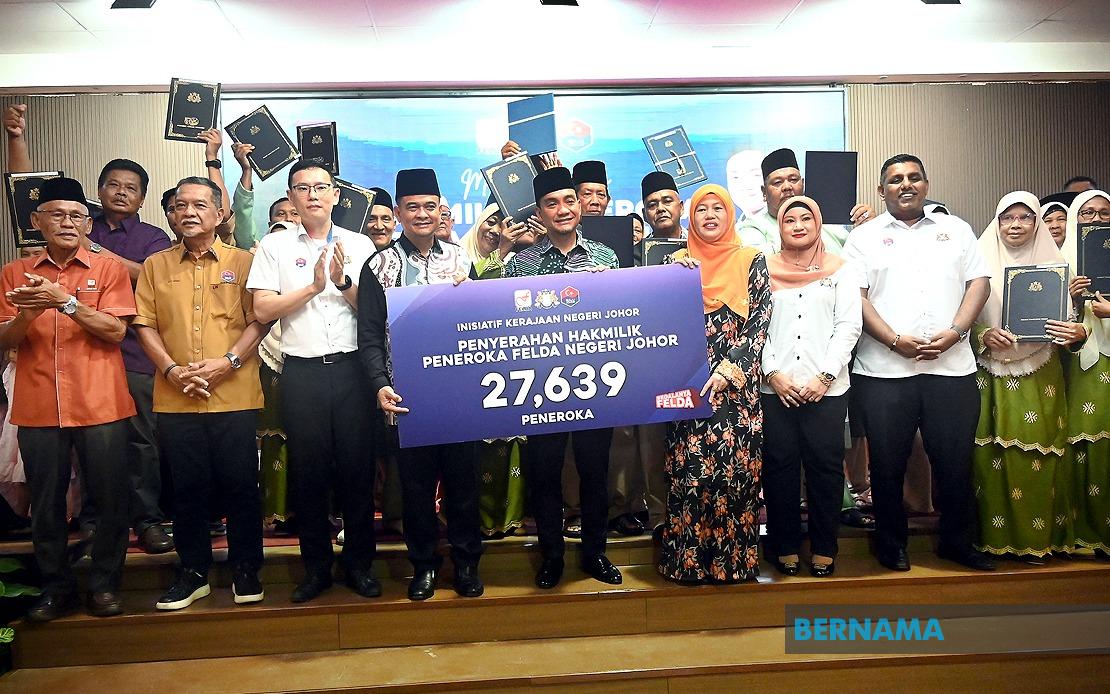
The Johor state government has virtually eliminated a longstanding administrative backlog that has plagued Federal Land Development Authority (FELDA) settlers for decades, with Menteri Besar Datuk Onn Hafiz Ghazi announcing the resolution of 27,639 land title applications out of a total 27,642 cases—a completion rate of 99.99 per cent. The announcement came during a ceremonial presentation of land titles in Kluang on June 23, where 210 settlers from Kluang, Kota Tinggi and Mersing received formal documentation for their residential and agricultural holdings.
The resolution of land title disputes represents far more than a clerical achievement for Johor's administrative machinery. For FELDA communities across the three districts, many of whom have operated farms and homes without clear ownership documentation for years, the titles provide the legal security necessary to access credit, refinance mortgages, or plan succession arrangements. The issue had festered for so long that an entire generation of settlers worked their land under uncertain legal conditions, unable to leverage their primary assets for economic advancement.
The historical context underlying this resolution reveals systemic weaknesses in how land schemes were originally administered under FELDA's mandate. The authority, established to develop and distribute agricultural land to rural communities, often fell behind in registering titles despite settlers having already paid for and occupied their plots. This gap between practical occupation and legal recognition created a shadow economy where banks were reluctant to lend, reducing settlers' capacity to invest in farm improvements or diversify their income streams. For younger settlers hoping to inherit family land, the absence of clear title documentation created uncertainty about succession rights and tax implications.
Menteri Besar Onn Hafiz framed the achievement within the broader philosophy of his administration toward rural development, emphasizing that FELDA settlements remain a government priority despite competition for resources and attention from urban constituencies. His comments suggest a deliberate policy shift to address grievances that previous state administrations may have deprioritized. The statement that "whatever issues arise there will continue to receive attention" indicates an acknowledgment that 99.99 per cent resolution, while impressive, leaves open the possibility of lingering cases requiring individual attention.
The completion of this backlog carries implications beyond individual settler welfare. Land title resolution strengthens property tax collection systems, clarifies ownership records for state planning purposes, and reduces potential legal disputes that might otherwise consume judicial resources. From a macroeconomic perspective, documented land ownership enables more efficient agricultural credit markets, which can facilitate farm modernization and productivity improvements across FELDA schemes.
Johor's approach offers a model relevant to other Malaysian states managing agricultural schemes and rural development initiatives. Sabah and Sarawak, which operate their own indigenous land frameworks and settlement schemes, face comparable challenges in ensuring that land title documentation keeps pace with actual settlement and usage. The capacity to resolve such backlogs demonstrates administrative capability that extends beyond mere land registry updates—it reflects inter-agency coordination between the state land office, FELDA, district administration, and the agriculture ministry.
The presence of Johor Agriculture, Agro-based Industry and Rural Development Committee chairman Datuk Zahari Sarip at the ceremony underscores that land title resolution connects directly to the broader agricultural development agenda. Settlers with secure title are more likely to adopt improved farming practices, maintain longer-term crop planning, and respond to state incentives for agricultural modernization. The psychological impact of formal recognition should not be underestimated—many settlers likely experienced decades of subtle stigma or bureaucratic marginalization due to their unresolved title status.
The three districts benefiting from this ceremony—Kluang, Kota Tinggi, and Mersing—cover diverse agricultural zones within Johor, from rubber and oil palm plantations to mixed smallholder farms. Each region has distinct demographic profiles and economic challenges, suggesting that the land title resolution process was not one-size-fits-all but required localized administration and potentially individual case review for the remaining 0.01 per cent of unresolved applications.
Looking forward, the maintenance of this achievement depends on institutional systems ensuring that newly granted titles remain secure and that future FELDA settlers or land scheme participants do not encounter similar documentation delays. This may require periodic audits of title registry systems, training for local administrative staff, and inter-agency protocols preventing backlogs from accumulating again. State government performance in maintaining these systems will signal whether this resolution represents permanent improvement or temporary clearing of an isolated problem.
The resolution also touches on equity considerations within FELDA communities. Settlers in Johor have now gained formal recognition and security, but similar backlogs may persist in FELDA schemes across Pahang, Perak, and other states. This potential disparity could create pressure on federal FELDA headquarters and other state governments to accelerate their own title resolution processes, or conversely, it could highlight resource constraints limiting other states' capacity to match Johor's performance. Regional competitiveness in rural governance could thereby drive improvements in land administration across Malaysia's agricultural heartland.