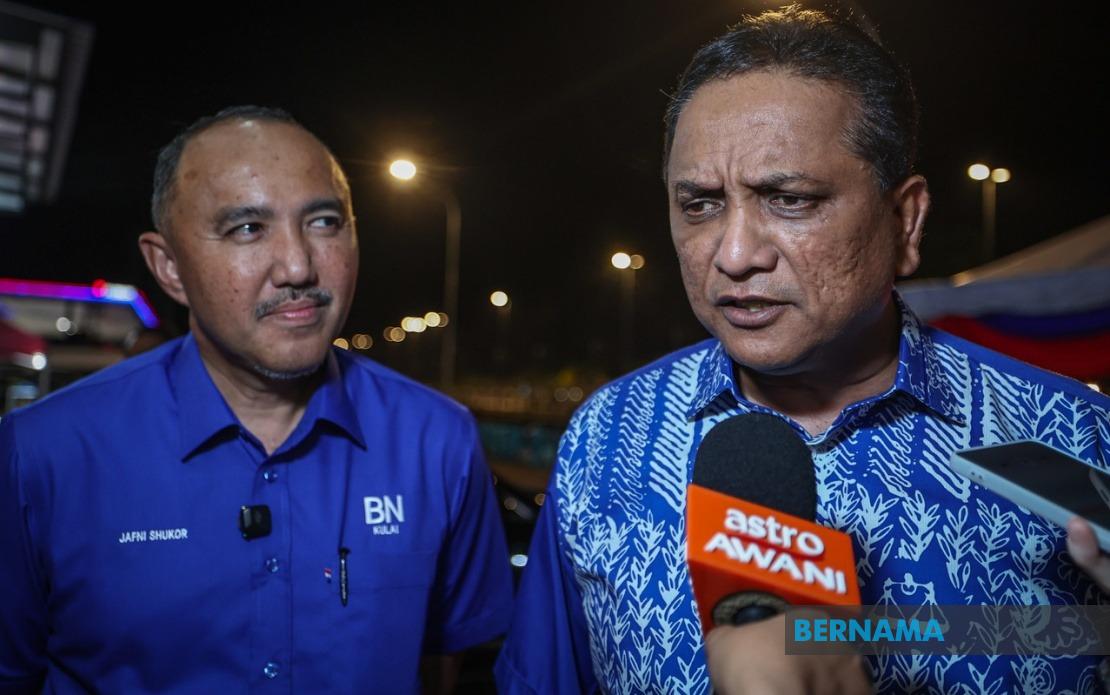
An UMNO Supreme Council member has firmly rejected accusations that Johor's Regent has transformed the state government into a compliant institution, calling such assertions baseless and unduly exaggerated at a politically sensitive time. Datuk Seri Reezal Merican Naina Merican made the statement in Johor Bahru on June 25, arguing that the Tunku Mahkota Ismail's vocal stance on state development matters should be understood as part of his constitutional role rather than undue interference in executive functions.
The timing of these remarks comes as Johor prepares for state elections, with nomination day scheduled for June 27 and polling day set for July 11. The electoral calendar has heightened political sensitivities across the state, and questions about institutional power dynamics have become a subject of public debate. Reezal Merican's intervention suggests that the allegations have gained enough traction to warrant a public rebuttal from senior party leadership, indicating the controversy has touched a nerve within the ruling coalition.
According to Reezal Merican, the Regent's directives and statements reflect his constitutional prerogatives and reflect his accountability to Johor's citizens. He characterised the Regent's role as providing institutional checks and balances against the Menteri Besar and the State Secretary, describing this as a fundamental aspect of good governance rather than authoritarian control. Such oversight mechanisms are embedded within Malaysia's constitutional framework and operate across all states where hereditary rulers hold defined executive and consultative powers.
The controversy intensified following the departure of Datuk Dr Mohd Puad Zarkashi from UMNO, who cited concerns about the Menteri Besar's decision-making autonomy. Mohd Puad, a former Speaker of the Johor State Legislative Assembly, had suggested that the chief executive had become overly deferential to palace interests. Reezal Merican questioned the motives behind introducing royal institution dynamics into pre-election political discourse, suggesting that the timing and framing reflected opportunistic positioning rather than genuine institutional concerns.
Reezal Merican's comments reveal internal tensions within Johor's ruling establishment ahead of the state election. The fact that a senior UMNO figure felt compelled to publicly defend the arrangement between the Regent and the executive suggests that doubts about institutional independence have gained currency among party members and the broader electorate. Such criticisms, if unaddressed, could undermine public confidence in the state administration's autonomy and decision-making capacity.
The relationship between Malaysia's sultans and state governments has long been constitutionally defined, with rulers serving as constitutional heads of state who retain important powers including advice, consent, and consultation on major policies. However, the actual exercise of these powers varies significantly across different states, and disputes about the appropriate extent of royal involvement in governance periodically surface. In Johor's case, the Regent's prominence in public statements about development priorities has apparently sparked debate about whether this represents active engagement within constitutional bounds or overreach beyond ceremonial functions.
Reezal Merican's assertion that UMNO leadership has never perceived Johor's party apparatus as palace-controlled carries weight given his position within the party's highest deliberative body. However, his comments also implicitly acknowledge that such perceptions exist among at least some party members and observers. The distinction he draws between constitutional oversight and political puppetry hinges on subjective judgments about where legitimate institutional checks end and undue influence begins.
The controversy reflects broader questions about governance and institutional relationships across Southeast Asia, where ceremonial and executive roles sometimes intersect in complex ways. Malaysia's constitutional monarchy system attempts to balance strong royal institutions with democratic governance, but tensions can emerge when these roles interact in ways that appear to diverge from established norms. For Malaysian readers, particularly those in Johor, the debate underscores the importance of transparent institutional boundaries that preserve both the dignity of traditional institutions and the autonomy of democratically accountable executives.
As Johor heads into its electoral campaign, the allegations about executive independence may influence voter perceptions about the Menteri Besar's ability to govern in the state's interests. Whether the public accepts Reezal Merican's characterisation as entirely persuasive remains unclear, but his intervention signals that UMNO recognises the narrative as potentially damaging to its electoral positioning. The broader challenge for Johor's leadership involves demonstrating institutional autonomy while respecting the constitutional role of the Regent, a balance that requires both substantive decision-making authority and effective communication about governance boundaries.

