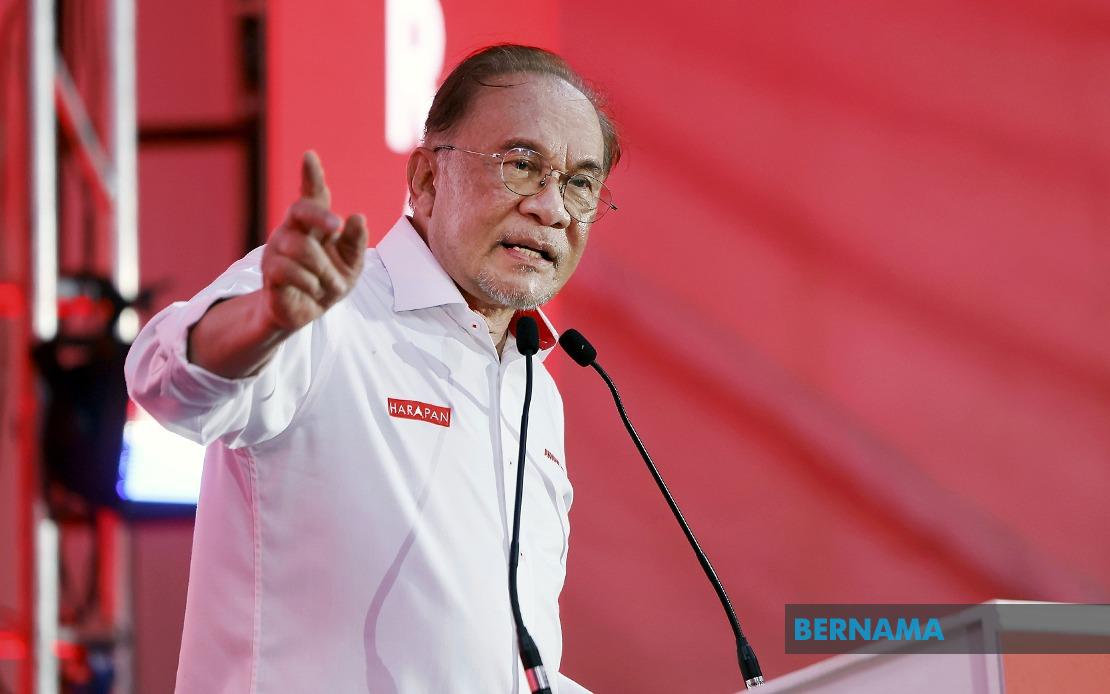
Prime Minister Datuk Seri Anwar Ibrahim has set forth a clear demand for Johor's electorate: the state requires elected representatives who combine shrewd judgment with decisive action and a genuine connection to public sentiment. Speaking as Pakatan Harapan's chairman on the opening day of campaigning for the 16th Johor state election, Anwar articulated the coalition's vision of leadership rooted in pragmatism and accountability. His remarks underscore the coalition's positioning ahead of voting day on July 11, with early voting scheduled for July 7, as multiple parties vie for control of the state assembly.
Through a video message posted on his official Facebook account, Anwar framed the upcoming election as a pivotal moment for Johor's trajectory. He emphasised that the coalition intends to amplify the voices of ordinary Johoreans, protect the state's strategic interests, and chart a development path that benefits all communities. The slogan "Johor Progresses. Vote HARAPAN" encapsulates the forward-looking message the coalition hopes will resonate with voters across the state's 56 constituencies. This framing attempts to position the election not merely as a partisan contest but as a choice between competing visions for the state's future.
Anwar's appeal to unity across Malaysia's diverse populations reflects a broader campaign strategy. By explicitly mentioning that Malays, Chinese, and Indians must work together to strengthen Johor and the nation, the Prime Minister was addressing voter concerns about communal harmony and inclusive governance. This multiethnic appeal carries particular weight in Johor, where demographic diversity has historically made coalition-building essential. The emphasis on collaboration rather than division signals that PH is seeking to capture centrist voter sentiment dissatisfied with zero-sum political messaging.
The Prime Minister's first day of campaigning proved vigorous and ground-focused. He attended seven separate events throughout various Johor localities, demonstrating hands-on engagement with voters rather than relying solely on top-down messaging. These programmes—encompassing community meetings, public talks, social gatherings, and local initiatives—were designed to build momentum for PH candidates by establishing personal connections and demonstrating leadership presence. Such grassroots activity is standard practice in Malaysian electoral campaigns, yet signals a coalition confident enough to engage voters directly rather than depending on organisational machinery alone.
Pakatan Harapan has committed substantial resources to this contest, fielding candidates across all 56 state constituencies. The coalition's internal distribution reflects its component parties' relative organisational strength: the PKR has nominated 20 candidates, Amanah 19, and DAP 17. This balanced ticket suggests efforts to maintain unity within the three-party alliance while respecting each member's territorial interests and supporter bases. The full-slate candidacy indicates that PH views Johor as winnable territory despite the state's traditional stronghold status for other political forces.
The broader electoral context reveals intensifying competition. A total of 172 candidates are contesting the 56 available seats, indicating that multiple parties and alliances are pressing claims to represent Johorean interests. This fragmentation of the candidate pool suggests that electoral outcomes will depend heavily on vote consolidation and voter mobilisation rather than being predetermined by simple demographic calculations. Anwar's appeal for disciplined party machinery to maximise support reflects awareness that victory margins could be narrow and that organisational efficiency will determine outcomes.
For Malaysian observers and regional analysts, the Johor election carries significance extending beyond state-level politics. As one of Malaysia's most populous and economically developed states, Johor's political direction influences national coalition dynamics and the broader balance of power in Parliament. A strong PH performance could reinvigorate the coalition's credibility ahead of future national contests, while disappointing results might embolden rival coalitions seeking to demonstrate waning public support for the current federal government. The electoral mathematics in Johor therefore possess ripple effects across Malaysia's political landscape.
The campaign's timing and intensity also reflect stakes perceived as genuinely consequential by competing parties. Johor's development trajectory, governance priorities, and resource allocation will shape opportunities for hundreds of thousands of residents and businesses. Questions regarding infrastructure investment, public service delivery, economic diversification, and fiscal management—themes implicit in Anwar's appeal for visionary leadership—are substantive concerns that voters have legitimate reasons to deliberate carefully. The Prime Minister's emphasis on electing representatives who understand "the pulse of the people" acknowledges that electoral legitimacy depends on genuine responsiveness to constituents' material interests and aspirations.
Anwar's exhortation to PH machinery to work with maximum dedication reflects the coalition's recognition that complacency could prove fatal in a competitive environment. Malaysian political history demonstrates that voter sentiment can shift rapidly and that assumed advantages frequently evaporate when campaigns prove listless or disconnected from public concerns. By mobilising extensively and projecting a coherent development message, PH seeks to consolidate support among core constituencies while expanding appeal among persuadable voters. Whether this strategy successfully converts campaign activity into electoral victory will become apparent once voting concludes on July 11.

