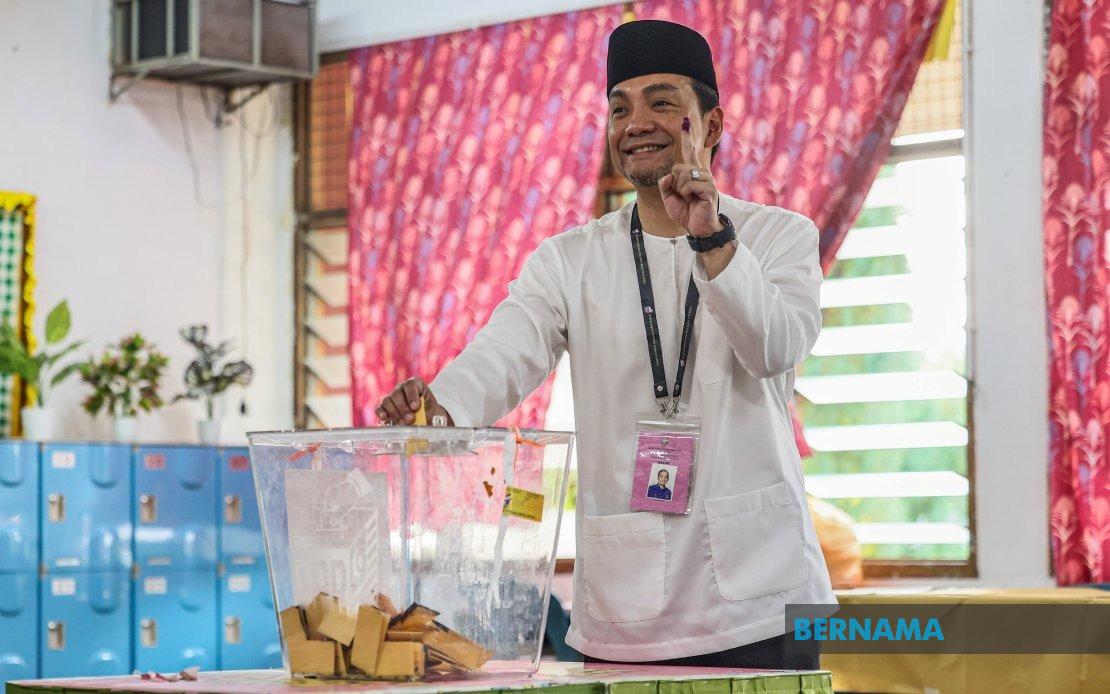
Johor's political landscape faced a critical test as voters headed to polls for the 16th state election, with Menteri Besar Datuk Onn Hafiz Ghazi casting his ballot early at Sekolah Kebangsaan Simpang Renggam on July 11. The sitting leader, who also chairs the Johor Barisan Nasional coalition, voted at 8.33 am in what represents his bid to secure another term steering the economically significant southern state. His presence at the polling station underscored the stakes involved in an election contest that will shape Johor's political direction for the coming years.
Before proceeding to cast his vote, Onn Hafiz engaged with other voters assembled at the centre, a traditional political gesture demonstrating accessibility and solidarity with the electorate. This informal interaction, though brief, carried symbolic weight in Malaysian electoral culture where such moments are often interpreted as candidates connecting directly with ordinary citizens rather than relying solely on campaign machinery. The Menteri Besar's movement through the polling station highlighted the grassroots dimension of democratic participation that extends beyond formal voting procedures.
Onn Hafiz confronts a direct contest against Nur Hafiz Roslan representing the opposition Pakatan Harapan coalition. This straight fight between two candidates captures the binary nature of electoral competition in some constituencies, where voter choice crystallises around distinct political camps. The concentration of support behind these leading contenders reflects broader consolidation in Malaysian politics, where smaller parties and independent movements struggle for traction against established coalitions. For Johor voters, the choice between the incumbent Barisan Nasional leadership and Harapan's alternative offered a fundamental referendum on state governance priorities.
After voting concluded, Onn Hafiz addressed media representatives, appealing to all eligible voters to participate promptly in the electoral process. His emphasis on early turnout reflected practical election administration concerns—smooth polling operations depend on consistent voter flows rather than last-minute rushes that overwhelm polling stations. Beyond logistics, however, his public exhortation to fulfil democratic responsibilities tapped into broader narratives about civic duty and legitimacy. A high-turnout election in Malaysia is traditionally viewed as conferring stronger mandates on winning coalitions, making turnout appeals strategically significant.
Simultaneously, competition unfolded across multiple constituencies within Johor, with the Puteri Wangsa seat attracting particularly crowded competition. Dr Maszlee Malik, fielded by Pakatan Harapan, arrived at polling station SJK (C) Tuan Poon in the same locality at 8.58 am to cast his vote. The former education minister brought national profile recognition to the contest, his previous ministerial experience under Harapan's 2018–2022 federal government lending weight to opposition aspirations in the state.
The Puteri Wangsa contest illustrated the fragmented nature of some Malaysian electoral battles, with five candidates competing for a single seat. Malik faced challenges from Rashifa Aljunied of MUDA, Teow Chia Ling representing Barisan Nasional, Nicholas Paul Vincent from Parti Bersama Malaysia, and independent Wang Wee Siong. This five-cornered configuration demonstrated how Malaysia's electoral landscape has fractured beyond traditional two-coalition competition, with micro-parties and independent candidates capturing sufficient support to mount credible challenges. For Malik, securing victory in such fragmented contests requires either commanding plurality support or tactical voting coalescing behind the opposition banner.
The presence of MUDA in Johor constituencies reflected the newer political entity's strategic push into state-level contests after earlier federal parliamentary participation. As a party positioned between established coalitions, MUDA's candidacies potentially complicated calculations for opposition-leaning voters deciding between Pakatan Harapan and alternative non-Barisan choices. Similarly, Parti Bersama Malaysia's field presence suggested ongoing efforts by smaller political movements to establish footholds in Malaysia's electoral system.
For Malaysian and regional observers, Johor elections carry weight beyond state boundaries. As Malaysia's second-most populous state and an economic powerhouse adjacent to Singapore, Johor's political trajectory influences national coalition dynamics and investor confidence in the peninsula's stability. If Barisan Nasional consolidated Johor under continuing Onn Hafiz leadership, the coalition would maintain crucial state-level strongholds despite 2022 federal government loss. Conversely, Pakatan Harapan breakthroughs in Johor would represent opposition momentum rebuilding after the 2023 federal election disappointments.
The election unfolded against backdrops of national economic challenges, with inflation and cost-of-living pressures influencing voter sentiment across Malaysia. State governments control education, local infrastructure, and social services, making them relevant to household economic wellbeing. Johor's electorate faced familiar Malaysian polling-day dynamics—questions about which coalition could better manage state resources, deliver development projects, and respond to resident grievances. The 16th state election represented voters' opportunity to hold the incumbent Onn Hafiz administration accountable or chart alternative directions through opposition victories.

