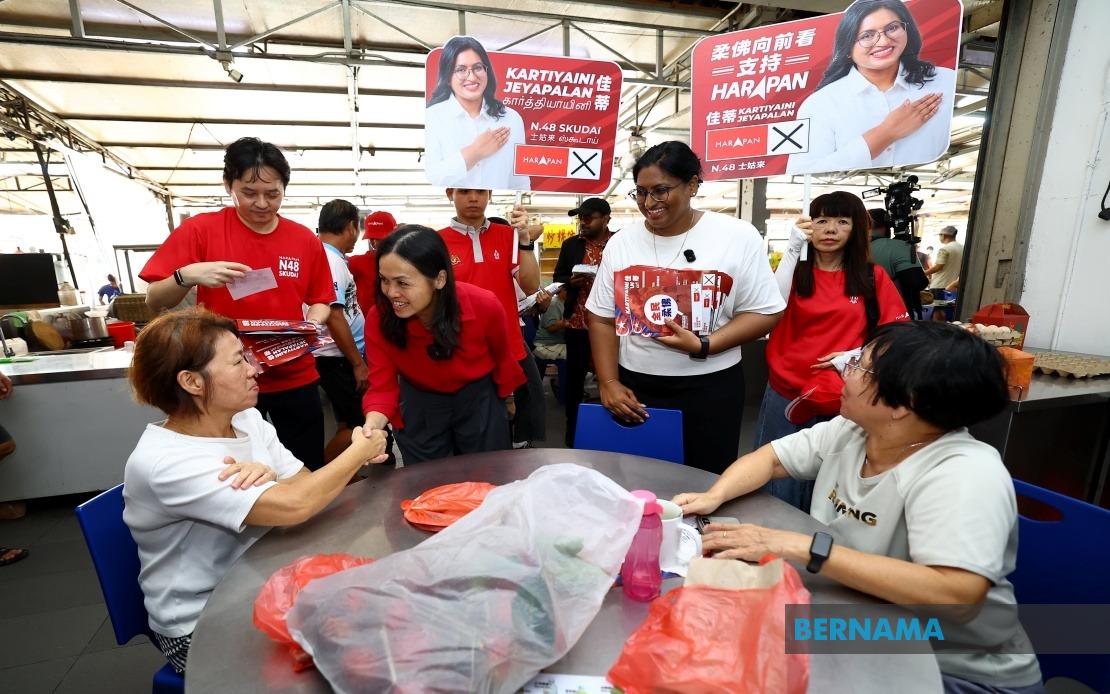
The final push toward Johor's state election on Saturday has taken on a distinctly personal tone, with senior political figures attempting to inspire voters through tales of sacrifice from those living abroad. Johor DAP chairman Teo Nie Ching, who serves as Deputy Communications Minister, has framed the electoral exercise not merely as a civic duty but as a privilege that demands both appreciation and active participation. Meeting residents in Kampung Baru Skudai alongside Pakatan Harapan candidate Kartiyaini Jeyapalan, Teo articulated a message designed to shame those with the luxury of proximity into showing the same commitment as diaspora voters who must overcome significant logistical hurdles to participate.
The narratives Teo highlighted paint an emotionally compelling picture of Malaysian determination across continents. A Queensland-based voter's desperate search at airport terminals for someone willing to hand-carry his postal ballot demonstrates the extraordinary lengths some are prepared to undertake when postal services cannot guarantee timely delivery. Similarly, a postgraduate student enrolled in a Chinese university absorbed a personal financial burden exceeding RM1,000 to reschedule her flight and return to Johor for polling day. These anecdotes, while individually remarkable, collectively underscore a broader phenomenon: Malaysians separated from home by geography have developed a fierce protective instinct regarding their voting rights, viewing each ballot not as one among millions but as a precious and irreplaceable instrument of democratic expression.
Teo's strategy reveals a calculated attempt to leverage what might be termed "democratic guilt" among domestic voters. Her implicit comparison between overseas voters willing to spend substantial sums and time against convenience-minded electors in nearby Kuala Lumpur or Singapore targets a specific demographic—cross-border workers and city-based professionals whose voting participation has historically been inconsistent. By celebrating the overseas voter's determination, she invites internal reflection among voters who lack such compelling reasons to abstain. The subtext carries weight in Malaysian political discourse, where questions of civic engagement and societal commitment intersect with contemporary patterns of mobility and economic opportunity.
The 2.7 million registered voters across Johor will determine the composition of the state assembly on Saturday, with 56 seats at stake. This scale of electoral participation warrants serious attention to voter mobilisation across all demographic segments, but particularly among those whose participation rates tend toward the lower end of the spectrum. State elections, despite their institutional importance in determining local governance, habitually attract less voter engagement than federal elections, a pattern that political parties across the spectrum have struggled to reverse consistently.
Beyond voter mobilisation, Teo's remarks addressed a parallel concern that has intensified as the campaign approached its final days: the weaponisation of social media through deliberately fabricated content and fraudulent accounts. Her emphasis on digital literacy and the adoption of a "verify before you share" culture reflects a recognition that modern elections operate simultaneously on physical and digital terrain, with the latter increasingly determining political outcomes. The velocity at which falsehoods propagate online—faster than truth, by most objective measures—has created an asymmetrical information environment that disadvantages voters seeking reliable guidance.
The challenge of misinformation takes particular resonance in the Malaysian context, where social media penetration remains exceptionally high and where past electoral cycles have demonstrated that coordinated disinformation campaigns can meaningfully alter voter behaviour. Teo's appeal to adopt greater scepticism before sharing unverified content represents an essentially defensive strategy, asking citizens to police themselves rather than proposing structural interventions into platform governance or regulatory frameworks. This individualistic approach places the burden of information verification squarely on voters themselves, a responsibility that presupposes both digital competency and sufficient time for thorough fact-checking.
Kartiyaini's parallel campaign operations reveal the granular level at which political parties are now targeting voters, particularly those whose geographic mobility creates voting access challenges. Positioning herself and other Pakatan Harapan operatives at the Sultan Iskandar Building Customs, Immigration and Quarantine Complex at 5 am demonstrates willingness to meet voters in the literal spaces they occupy during their cross-border transit. The strategic positioning on buses transporting workers to Singapore carries even greater specificity, representing an attempt to reach persuadable voters at the precise moment they are leaving Johor's jurisdiction. Such tactics suggest that parties increasingly recognise the vulnerability of cross-border workers to demobilisation—their regular departure from the state throughout the week creates genuine friction for voting participation.
Kartiyaini's framing of the state election carries significance beyond mere get-out-the-vote rhetoric. By explicitly arguing that state elections warrant equivalent importance to federal elections and that state government quality directly determines local development outcomes, she addresses a persistent challenge in Malaysian electoral politics. Voters have historically treated state elections as second-order contests, with many abstaining or voting differently at state and federal levels. The contention that a responsive, competent state government can implement policies that improve daily life for ordinary Johoreans represents an attempt to reframe the stakes and importance of Saturday's polling.
The combination of inspirational narratives about overseas voters and aggressive ground mobilisation targeting cross-border workers suggests that both major political coalitions anticipate a closely contested election where voter turnout at the margins could determine individual seat outcomes. The historical pattern of lower state-election turnout compared to general elections creates an environment where relatively modest increases in participation among typically underrepresented groups could produce measurable electoral advantages. For cross-border workers specifically, the inconvenience factor traditionally suppresses their participation rates, and any campaign that successfully overcomes this structural barrier gains meaningful advantage.
The misinformation warning arrives at a moment when digital platform dynamics and political incentives have aligned to produce extensive content creation and circulation in the final campaign period. While Teo's emphasis on individual verification reflects best-practice digital citizenship, the structural reality remains that coordinated disinformation campaigns possess organisational and financial advantages that make them difficult for decentralised fact-checking efforts to fully counteract. The appeal to voters represents an important reminder of information verification principles but cannot entirely substitute for platform governance and regulatory frameworks that address malicious content creation at source.
As the campaign enters its final hours, the competing imperatives of mobilising voters and combating information pollution reflect the contested terrain of contemporary Malaysian electoral politics. The emotional appeal of overseas voters' sacrifice, the logistical targeting of cross-border workers, and the sober warnings about digital deception all represent rational political strategies within an environment where voter participation and information reliability remain contested and imperfect. The 2.7 million Johor voters will ultimately decide whether these campaigns succeed in their objectives, but the intensity of effort suggests that organisers on both sides perceive this election as consequential and competitive.

