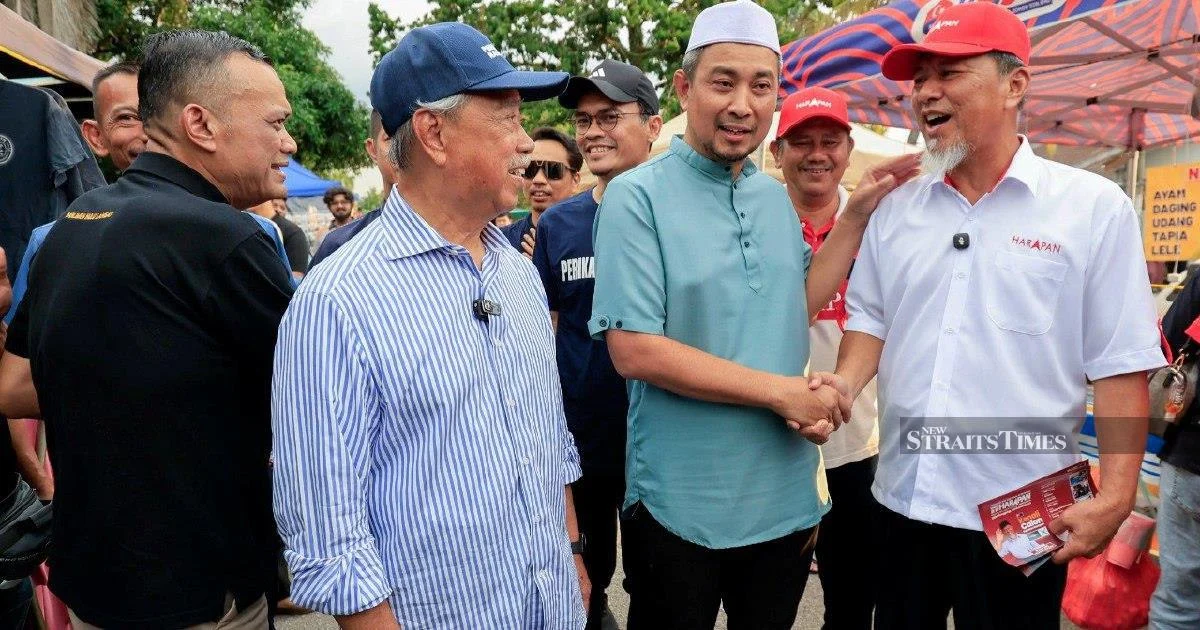
The Johor state election campaign trail took a notably theatrical turn when supporters and voters at the Taman Sri Pagoh night market witnessed an unscripted encounter between rival candidates on the campaign's third day. Both representatives, fielded by opposing political coalitions Pakatan Harapan and Perikatan Nasional, were conducting simultaneous grassroots outreach at the bustling market venue, creating a rare moment of direct proximity between opposing camps.
Night markets across Malaysia remain crucial campaigning grounds during election periods, serving as dense concentrations of voters and opinion-makers from various demographic segments. The Taman Sri Pagoh night market in the parliamentary constituency of Pagoh functions as a commercial and social hub, drawing residents across different age groups, income levels, and family structures. Campaign teams recognise these venues as authentic spaces to connect with voters in informal settings, where conversations can flow more naturally than at scheduled rallies or town halls. The presence of both candidates at the same location simultaneously underscores the intensity of competition in the Johor state election and the determination of major coalitions to leave no voter precinct untouched.
The Pagoh constituency represents a strategically significant battleground in the broader Johor electoral landscape. Historically, the area has demonstrated shifting voting patterns and competitive margins between coalitions, making it neither a guaranteed stronghold for any single political force nor an impossible target for challengers. Such constituencies attract disproportionate candidate attention and campaign resource allocation, as victories here can substantially influence overall state-level outcomes and signal shifting voter sentiment within key demographic groups.
The operational overlap between campaign teams at popular night markets reflects the intensity of contemporary Malaysian electoral competition. Both Pakatan Harapan and Perikatan Nasional have invested significantly in ground-level organisation and voter contact strategies, moving beyond traditional broadcast-style campaigning. Candidates increasingly adopt "ground game" methodologies, emphasising direct personal interaction and community presence. This shift places candidates in closer proximity to rival campaigners, creating scenarios where opposing camps inevitably intersect during their respective canvassing activities.
The third day of campaigning represents an early phase in the electoral calendar, when candidates are still establishing their messaging and building initial voter awareness. Early-stage campaign encounters tend to be more improvisational and less rehearsed than activities occurring during the campaign's final days, when campaigns typically move into consolidated, message-focused modes. The night market setting further reduced the formality and scripted nature of the interaction, as both candidates navigated crowded, bustling conditions while attempting to engage individual voters.
Night markets hold particular cultural and social significance in Malaysian communities, functioning as gathering spaces extending well beyond purely commercial transactions. They serve as informal town squares where neighbours encounter one another, community news circulates, and local issues gain visibility through word-of-mouth discussion. Campaign teams recognise these organic social networks as powerful vectors for political messaging, as voter-to-voter conversations often carry greater persuasive weight than direct candidate communication. The unplanned candidate encounter at such a location becomes part of the informal narrative voters subsequently discuss with friends, family, and neighbours.
Peeriod election campaigning in Malaysia's states typically spans several weeks, providing ample time and numerous venues for campaign activities. However, the concentration of candidates at specific popular locations during compressed timeframes creates inevitable overlaps. Campaign schedulers face persistent tensions between optimising candidate visibility at high-traffic venues and minimising risky proximity to rival candidates. The Taman Sri Pagoh night market evidently ranked sufficiently high in campaign priority rankings that both coalitions determined the voter contact opportunity justified proceeding with their respective canvassing activities simultaneously.
The Johor state election itself carries significance extending beyond the state level, as results can influence broader federal political calculations and coalition positioning. Major coalitions view state-level contests as platforms for testing campaign messages, mobilising organisational infrastructure, and capturing media attention before potentially larger federal contests. The competitive intensity visible at market-level candidate interactions reflects these higher-stakes political calculations occurring at state and national levels.
Voter reactions to direct candidate encounters vary considerably based on individual political predispositions, campaign messaging saturation, and broader electoral context. Some voters appreciate opportunities to observe multiple candidates and compare their approaches directly, viewing such encounters as organic decision-making opportunities. Others find simultaneous candidate presence distracting or view it as unnecessary campaign theatricality. Photographic and video documentation of the market encounter likely circulated through digital networks and social media channels, extending the incident's visibility well beyond the immediate night market attendees and influencing broader campaign narratives.
The incident illustrates contemporary Malaysian electoral dynamics, where campaign competition has become increasingly granular and presence-based rather than purely message-dependent. Candidates invest substantial time in person-to-person voter contact, seeking genuine community engagement rather than relying solely on formal campaign events. This approach generates unpredictable interactions and occasional dramatic moments when rival campaigns operate simultaneously in the same spaces. Such occurrences become noteworthy precisely because they represent departures from carefully controlled campaign scripts, offering voters glimpses of candidates responding to real-time situations rather than executing predetermined strategies.
As the Johor campaign progresses through its remaining days, similar market-based candidate encounters may occur with increasing frequency as campaigns intensify their grassroots activities. Both Pakatan Harapan and Perikatan Nasional will likely maintain aggressive canvassing schedules targeting high-concentration voter venues, suggesting additional instances where opposing candidates navigate shared campaign spaces. These unscripted moments, while representing campaign inefficiencies from strategic planning perspectives, generate authentic engagement opportunities and human-scale political interaction that resonates within communities.

