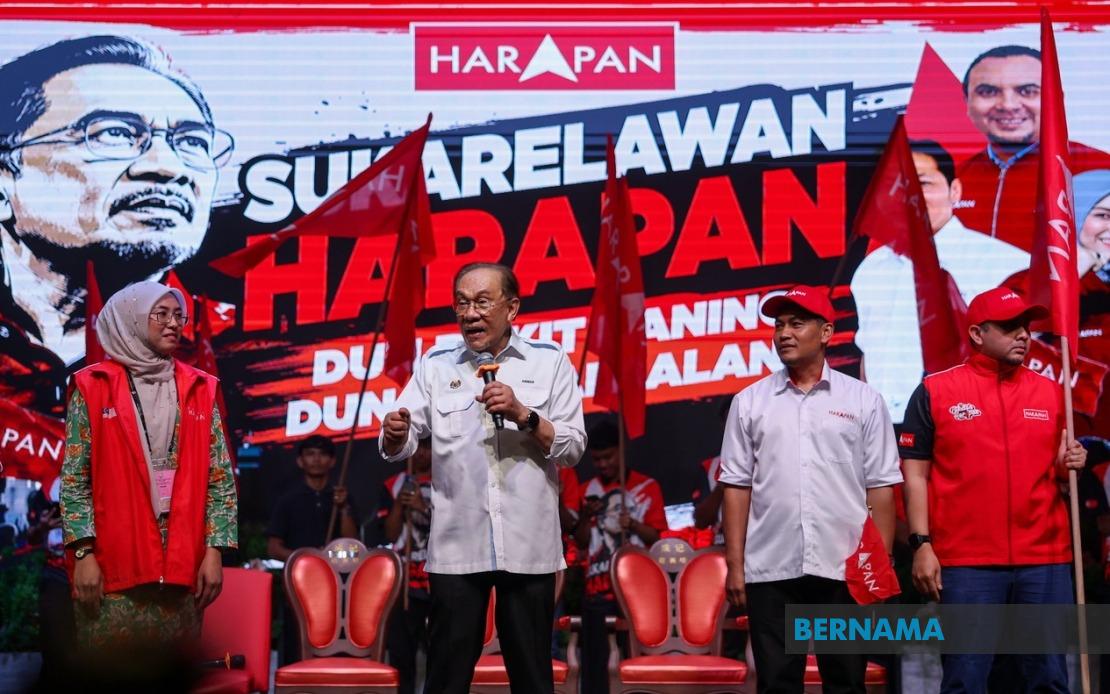
Prime Minister Datuk Seri Anwar Ibrahim has made an impassioned appeal to Johor's younger voters to move beyond the divisive rhetoric of identity politics, framing the upcoming state election as a pivotal moment for the generation to take control of its own destiny. Speaking at a campaign event in Muar, Anwar positioned the electoral contest not merely as a choice between competing political parties, but as a generational reckoning in which young Malaysians must decide whether to perpetuate old patterns of racial antagonism or chart a new course grounded in pragmatic, inclusive governance.
The Prime Minister, who also heads Pakatan Harapan, drew a sharp contrast between the substantive issues that shape young people's daily experiences and the inflammatory narratives that he argues continue to dominate portions of Malaysia's political discourse. He emphasized that voters ought to evaluate candidates and parties based on their demonstrated capacity to deliver tangible improvements in areas directly affecting quality of life—particularly access to quality education, meaningful employment prospects, and equitable economic opportunities across the state. This framing repositions electoral choice away from communal identity and toward a results-oriented calculus that transcends traditional voting blocs.
Anwar's criticism of what he termed "rotten political system" centred on what he characterised as deliberate attempts to manufacture fear and resentment among Malaysia's different communities. He specifically highlighted efforts to stoke anxieties about Chinese Malaysians, foster antagonism toward Indian Malaysians, and weaponize inter-ethnic tensions as a distraction from substantive governance failures. By articulating this critique directly to an audience of young supporters from multiple backgrounds, Anwar sought to inoculate younger voters against what he portrayed as manipulative tactics designed to benefit entrenched elites rather than ordinary citizens struggling with real economic and social challenges.
The Prime Minister's remarks carried particular resonance given the scale of youth participation witnessed at the campaign event. Anwar expressed genuine surprise and encouragement at the turnout, describing the scene as historically significant and reflecting a palpable shift in younger generations' willingness to engage actively in political change. He drew on his decade-long experience in electoral politics to emphasise that the energy and commitment demonstrated at this particular gathering represented a qualitative difference from previous campaigns, suggesting that a genuine appetite for transformation may be gaining traction among voters who came of age in an era of economic constraints and perceived institutional stagnation.
The Johor state election itself encompasses a substantial competitive field, with 172 candidates vying for 56 state assembly seats. Polling is scheduled for July 11, with early voting having been set for July 7, establishing a compressed timeline in which campaigns must mobilize support and persuade undecided voters. Pakatan Harapan has fielded candidates including Nazri Abd Rahman for the Simpang Jeram seat and Md Ysahrudin Kusni for Bukit Naning, where Anwar delivered his remarks. The electoral stakes carry implications extending beyond Johor's state politics, as this contest represents a significant test of whether the broader Malaysian electorate—particularly its younger cohorts—remains receptive to messages emphasizing unity and performance-based governance.
Anwar expanded his critique beyond the immediate context of state-level politics to articulate a broader vision of Malaysia's national identity and future trajectory. He rejected racial-divisive narratives as fundamentally incompatible with an independent nation, positioning such rhetoric as a relic of an earlier historical period that has outlived both its practical utility and moral legitimacy. By characterizing racial antagonism as a form of sabotage against the national cohesion that has historically anchored Malaysian stability, the Prime Minister framed inclusive politics not merely as a moral imperative but as a strategic necessity for collective national advancement.
Central to Anwar's address was an articulation of multiculturalism as Malaysia's enduring competitive advantage and source of strength. He stressed that Malays, Chinese, Indians, and Orang Asli communities have demonstrated a capacity for coexistence grounded in mutual respect and reciprocal care—a reality that he suggested remains underappreciated and under-defended in contemporary political discourse. This positive framing of Malaysia's diversity stood in deliberate contrast to the negative narratives he had just condemned, offering young voters an aspirational vision of what the country might become if electoral choices were guided by inclusive rather than divisive principles.
Anwar's closing message to younger voters emphasized agency and responsibility in ways that transcended the immediate electoral campaign. He cautioned against the temptation toward political passivity or disengagement, exhorting young Malaysians to recognize themselves as architects rather than mere observers of their nation's trajectory. This call for active participation carried an implicit rebuke to any segment of the electorate inclined toward apathy or cynicism, positioning electoral engagement as not merely a right but a moral obligation for those seeking meaningful change in governance quality and national direction.
The campaign event at Muar represented Pakatan Harapan's attempt to leverage youth enthusiasm and demographic shifts toward sustained electoral advantage. Whether younger voters will respond to Anwar's appeals for issue-focused, solidarity-based politics remains an open question that will be definitively answered when Johor residents cast ballots on July 11. The outcome will provide crucial indicators about whether efforts to reframe political competition around performance metrics and inclusive governance can successfully counter more traditional appeals to communal identity and ethnic solidarity—a tension that continues to shape Malaysian electoral dynamics across all states and at the national level.

