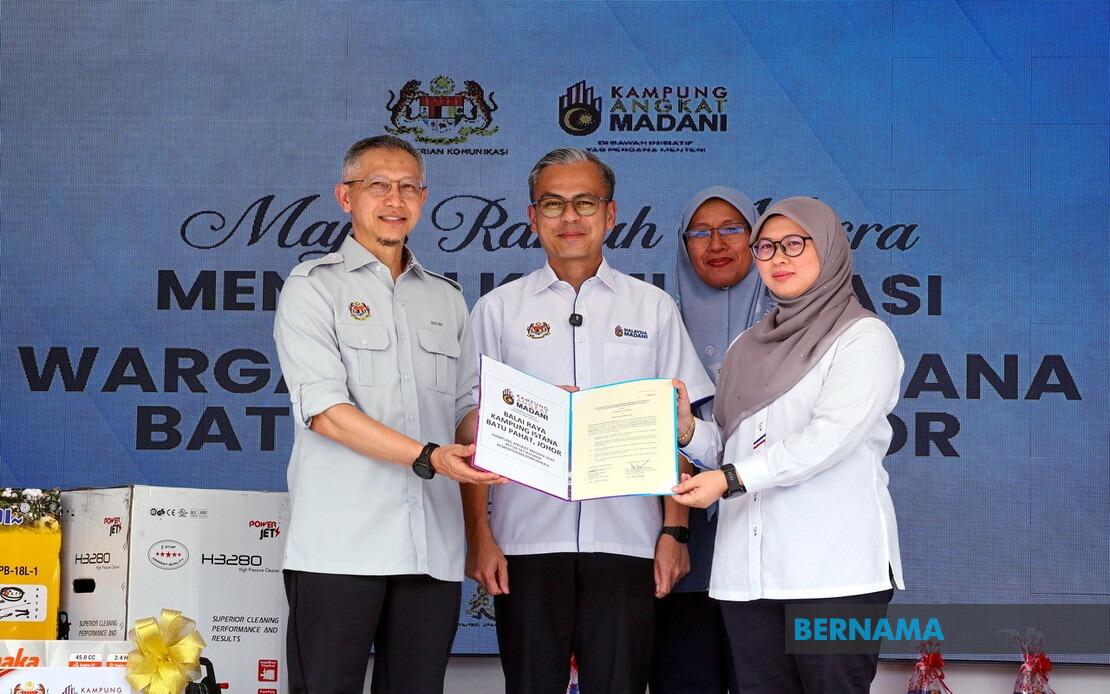
The 16th Johor State Election looms as a contest about leadership and vision for the state rather than a referendum on any single person, according to Pakatan Harapan's Communications Director Datuk Fahmi Fadzil. Speaking in Batu Pahat after engaging with residents, Fahmi pushed back against what he characterised as distracting narratives that conflate election results with support for particular figures, emphasising that voters should focus their attention on which leadership team can genuinely improve Johor's prospects. This framing reflects PH's broader election strategy: positioning the poll as a forward-looking choice about governance and economic management rather than backward-looking judgements about individuals.
Fahmi's remarks came in direct response to comments by Datuk Nazifuddin Mohd Najib, who had suggested that a Barisan Nasional victory would signal public backing for his father, former Prime Minister Datuk Seri Najib Razak, to receive a pardon. The PH official described such statements as concerning and potentially counterproductive, warning that voters should be alert when elections are framed through the lens of personal vindication. By characterising these narratives as a "wake-up call" for the electorate, Fahmi sought to redirect public conversation away from personalities and toward substantive questions about state administration, development priorities, and economic policy—terrain where PH believes it can compete effectively.
The underlying tension here reflects deeper anxieties within Malaysian politics about the instrumentalisation of electoral contests. PH's messaging strategy assumes that Johor voters, when presented with a clear choice between competing visions for their state's future, will prioritise practical governance outcomes over loyalty to particular leaders or factional interests. This assumption carries particular weight in Johor, historically considered a stronghold of UMNO and Barisan Nasional, where challenging the incumbent coalition's narrative dominance remains strategically important. By separating the election from individual personalities, PH attempts to open intellectual space for voters to reconsider traditional allegiances.
Fahmi also addressed the question of whether non-Malay support for DAP—and by extension, the broader PH coalition—remains predictable and assured. He rejected the idea that any political party deserves automatic voter backing, insisting instead that all coalitions must continuously earn and maintain public confidence through performance and responsiveness. This acknowledgement that no electoral bloc is permanently locked into supporting any particular party reflects changing realities in Malaysian politics, where younger voters, urban constituencies, and swing segments are increasingly willing to shift their votes based on perceived competence and policy direction rather than communal identification or historical voting patterns.
The Communications Minister illustrated this point by referencing former Rengit assemblyman Datuk Dr Mohd Puad Zarkashi, whose recent endorsement of PH candidates suggested that even established UMNO figures were reconsidering their political calculations. Fahmi presented this development as evidence that UMNO's traditional claim to Johor—once treated as a virtually uncontestable "fixed deposit"—no longer held absolute sway. Such defections, even if limited in scale, carry symbolic importance in signalling that the incumbent coalition faces genuine pressure and that alternatives exist for voters dissatisfied with the status quo. The fact that Fahmi highlighted cross-party support for specific PH candidates indicates PH's strategy of emphasising the breadth of its appeal beyond its traditional base.
Further examples cited included support from Bersatu members for PH's candidate in Sri Medan, Hishamuddin @ Misrin Ishak, and backing for the Rengit seat. These endorsements, while perhaps individually modest, collectively suggest that PH is successfully positioning itself as the beneficiary of broader realignments in Johor politics. Rather than framing the election as a binary contest between two evenly matched coalitions, Fahmi presented PH as a gathering point for diverse elements dissatisfied with the existing arrangement—a narrative that, if it gains traction, could shift momentum in PH's favour even if the coalition itself remains numerically behind BN in conventional polling assessments.
Fahmi connected these political developments to the broader economic and governance agenda, arguing that crossover support reflected confidence in Prime Minister Anwar Ibrahim's leadership and his administration's management of the economy. This linkage served two purposes: it grounded PH's electoral pitch in tangible policy outcomes rather than personality-driven appeals, while simultaneously reasserting Anwar's centrality to PH's political identity and appeal. By suggesting that economic improvement in Johor itself was attributable to the federal government's direction, Fahmi attempted to convert national economic performance into local electoral advantage—a classic strategy in federalist systems where state elections become referenda on federal governance.
The practical context of the election itself provides crucial ballast to these political arguments. With 172 candidates contesting 56 state seats, and voting scheduled for July 11 following early polls on July 7, the Johor election represents a significant test of both coalitions' organisational capacity and popular appeal. For PH, demonstrating that voters will choose alternatives based on governance competence rather than communal reflex or personality politics would mark a major shift in Malaysian electoral behaviour. For BN, maintaining control of the state despite internal dissension and the shift toward issue-based rather than identity-based politics would reaffirm the coalition's resilience and continued ability to command majority support in conservative states.
Fahmi's reframing of the election raises important questions about how Malaysian voters actually make political choices. His argument—that voters should assess which team can deliver better outcomes for Johor rather than deciding based on whether particular figures deserve pardons or whether their vote counts as predictable support for established parties—represents an implicit challenge to assumptions about voting behaviour that have long dominated Malaysian political analysis. Whether Johor voters respond to this appeal by prioritising governance and development over other considerations will substantially shape both the election outcome and broader patterns of political competition in Malaysia. The stakes, as Fahmi suggested, extend beyond Johor itself, potentially influencing how subsequent electoral contests are framed and what voters expect from their representatives.

