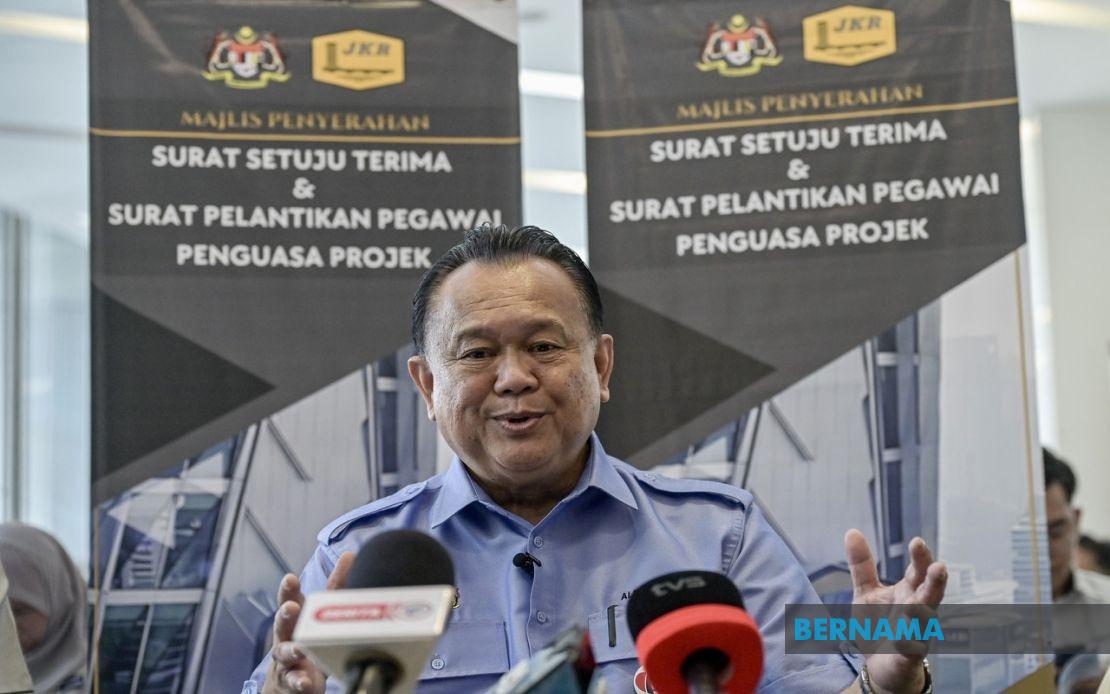
Works Minister Datuk Seri Alexander Nanta Linggi has challenged a prevailing narrative in Malaysia's construction sector, arguing that project completion cannot be judged by speed alone. Speaking in Kuala Lumpur on August 21, he underscored that true project success demands simultaneous achievement across three critical dimensions: adherence to the planned timeline, compliance with budgeted costs, and maintenance of agreed quality standards. His remarks reflect growing frustration within the Ministry of Works (KKR) over contractors who prioritise early handover at the expense of structural integrity or fiscal discipline.
The minister's intervention comes as the Public Works Department (JKR) grapples with a persistent challenge in Malaysia's infrastructure landscape: the phenomenon of "sick projects" that consume resources yet deliver substandard results. Nanta elaborated that finishing ahead of schedule means nothing if quality defects subsequently emerge or if the final bill exceeds projections. For a project to truly be classified as advanced, it must cross the finish line within the originally stipulated timeframe and cost envelope while meeting all specified quality criteria. This reframing suggests the ministry recognises that cost overruns, construction defects, and project abandonment have collectively damaged public confidence in JKR's capability.
To address systemic weaknesses, the Ministry of Works and JKR have instituted key performance indicators (KPIs) aimed explicitly at eliminating sick and abandoned projects. The department has also introduced standardised operating procedures (SOPs) and monitoring guidelines to govern implementation across all construction sites. These administrative mechanisms represent an attempt to impose discipline at the institutional level, though their effectiveness ultimately depends on contractor compliance and field-level enforcement by supervising engineers. Notably, Deputy Minister of Works Datuk Seri Dr Ahmad Maslan disclosed on the preceding day that the proportion of sick projects had declined to 4.13 per cent from a prior 5 per cent, with 36 of 871 ongoing projects currently classified as troubled. While the downward trend is encouraging, the persistence of problematic sites indicates deeper structural issues requiring continued intervention.
The minister's comments were delivered while overseeing the formal handover of acceptance letters for the Perak police contingent headquarters (IPK) and housing construction initiative, a RM366 million undertaking located in Bandar Meru, Ipoh. Serada Realty Sdn Bhd has been appointed developer for this strategic project, which will occupy a 25-hectare parcel adjacent to Bulatan Sultan Azlan Shah. The construction period has been fixed at 42 months, with completion anticipated in February 2030. As a Ministry of Home Affairs (KDN) priority, this project exemplifies the type of large-scale, multifaceted infrastructure that demands rigorous oversight to prevent the cost, schedule, and quality slippages that have plagued other major undertakings.
The existing Perak IPK complex, now 58 years old, has deteriorated to a point where comprehensive renovation would prove economically indefensible. The decision to construct a new facility rather than rehabilitate the old structure reflects practical recognition that certain ageing buildings have exhausted their useful lifecycle. The new complex is projected to substantially enhance operational efficiency for Perak PDRM, the state police contingent. Officials anticipate that the facility will contribute to reducing the crime index by approximately 5 per cent annually whilst simultaneously improving police response times from the current 15 minutes to an optimised 10 minutes. These performance targets underscore the government's expectation that infrastructure investment should translate into measurable improvements in public safety outcomes.
Nanta's address to contractors emphasised the profound responsibility accompanying the award of construction contracts. He called upon successful bidders to execute their mandate with unwavering integrity, genuine accountability, and steadfast commitment throughout the construction lifecycle. Contractors bear the obligation to deliver completed facilities that conform precisely to engineering specifications, attain the highest achievable quality standards, and respect the agreed schedule without deviation. This messaging appears designed to reinforce that cost-cutting corners, material substitution, or schedule compression cannot be tolerated as business-as-usual practices.
Equally significant is the superintending officer's role in project governance. Nanta stressed that these supervisory professionals must actively monitor construction progress on a continuous basis rather than adopting passive observation. They are tasked with identifying emerging problems at site level and implementing corrective measures promptly, thereby preventing minor issues from snowballing into major delays or quality failures. The effectiveness of this oversight depends on superintending officers possessing sufficient technical expertise, adequate site presence, and genuine authority to halt non-compliant work. In practice, power imbalances sometimes favour contractors over supervisory teams, particularly when projects face financial pressure or political deadlines.
For Malaysian readers and construction stakeholders, the minister's pronouncements carry several implications. First, they signal that KKR and JKR have acknowledged past failures and are attempting systematic reform rather than continuing with incremental adjustments. Second, the emphasis on balanced outcomes suggests that tenderers should expect contracts to be evaluated not solely on bid price but on demonstrated capability across cost control, schedule management, and quality assurance. Third, the visible commitment to eliminating sick projects may create market expectations that will ultimately benefit end-users through improved infrastructure.
From a Southeast Asian perspective, Malaysia's experience with problematic construction projects is not unique. Regional counterparts in Indonesia, Thailand, and the Philippines face analogous challenges managing large infrastructure portfolios. The shared lesson appears to be that administrative reforms, whilst necessary, require complementary improvements in contractor selection, transparent monitoring mechanisms, and realistic scheduling. Nanta's framing of project success as a three-dimensional achievement—rather than a race to completion—reflects international best practice in infrastructure management and suggests Malaysia is aligning with more sophisticated approaches to capital project governance.
The Perak IPK project will serve as a test case for whether these renewed institutional commitments can be sustained in practice. Successful delivery within the 42-month window and RM366 million budget whilst maintaining construction standards would demonstrate that systemic change is taking root. Conversely, any significant deviation from the projected completion date or projected costs would suggest that rhetoric regarding quality and fiscal discipline has not yet translated into operational reality. As Malaysia continues investing heavily in infrastructure modernisation, the outcomes of major projects like the Perak IPK facility will shape contractor behaviour and public confidence in JKR's stewardship of national resources.

