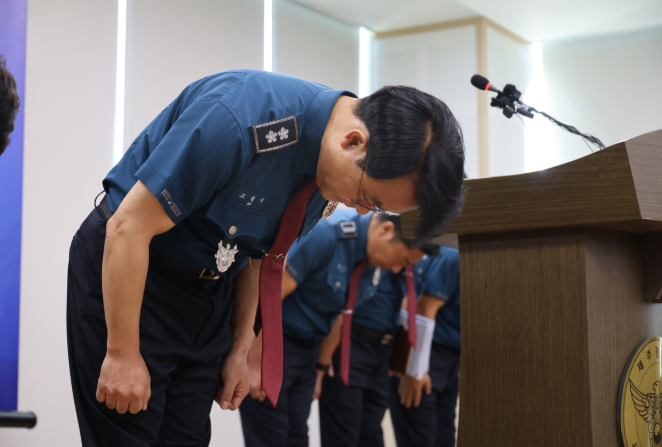
South Korea's Jeju Police Commissioner Ko Pyeong-gi issued a formal public apology on Thursday following a serious misconduct case involving the mishandling of missing person investigations. The bungled cases led to the deaths of two individuals—a woman and a man—whose disappearances had been prematurely closed by a police officer who allegedly fabricated contact with them.
The most prominent case involved Jang Mi-ran, a 37-year-old woman who vanished in May. Officer Bu, whose full name was not disclosed, claimed to have personally spoken with Jang and subsequently closed her missing person file on false pretences. Jang's body was discovered on Monday, highlighting the fatal consequences of the officer's negligence. In a separate but strikingly similar incident, the same officer employed identical tactics to close the investigation into a man in his 60s, whose remains were located on Saturday.
At a press conference held at the Jeju Provincial Police Agency, Commissioner Ko delivered a carefully worded statement acknowledging the gravity of the failures. His apology extended beyond mere formality, directly addressing the deceased individuals and their grieving families. Ko emphasised the profound trauma inflicted upon relatives who had endured uncertainty regarding their loved ones' fates, only to receive confirmation of death after police had already abandoned the search.
The incident raises troubling questions about investigative standards and accountability within South Korea's regional police forces. For Malaysian readers familiar with regional law enforcement challenges, the case underscores how institutional lapses in even developed democracies can have irreversible human costs. The closure of active missing person cases based on false documentation represents not merely an administrative error but a fundamental breach of public trust.
Ko's statement emphasised that police officers bear a sacred duty to protect citizens and preserve lives. By falsifying records and ceasing legitimate investigations, Officer Bu violated this foundational responsibility and caused lasting damage to the families involved. The commissioner acknowledged that such conduct had inflicted enduring emotional scars on the bereaved, damage that extends far beyond the immediate grief of losing a family member.
In response to the scandal, authorities have committed to conducting a comprehensive and transparent investigation into Officer Bu's conduct and the circumstances surrounding both cases. This pledge of openness is intended to restore public confidence in an institution that has demonstrably failed in its fundamental obligations. The investigation will likely examine not only Officer Bu's actions but also systemic weaknesses that permitted such misconduct to occur undetected.
Beyond the individual investigation, Jeju police have announced plans to conduct a full audit of all missing person cases handled across the island. This sweeping review reflects concern that Officer Bu's alleged malpractice may not represent an isolated incident but rather a symptom of wider procedural deficiencies. Police authorities will scrutinise case files to identify whether other investigations were similarly compromised through negligence, fraud, or deliberate misconduct.
The timing of this scandal is particularly sensitive for South Korean law enforcement, which has faced mounting public criticism regarding investigative competence and ethical standards. Cases of this nature fuel broader concerns about whether police resources are allocated effectively and whether supervision mechanisms adequately prevent individual officers from circumventing established protocols. For regional observers, the incident demonstrates that police accountability remains a challenge even in economically advanced nations with sophisticated institutional frameworks.
The implications for missing person investigations across South Korea extend beyond Jeju. If systematic weaknesses have permitted such egregious falsification of records, similar problems may exist in other jurisdictions. The national police hierarchy will likely face pressure to implement enhanced oversight procedures, particularly for cases involving vulnerable populations or those classified as potentially high-risk disappearances.
For families awaiting resolution of missing person cases, revelations of this magnitude inevitably erode confidence in police assurances regarding investigation status. The discovery that officers may be falsely documenting case progress creates a chilling scenario where relatives cannot reliably assess whether authorities are genuinely pursuing leads or simply closing files for administrative convenience.
The incident also highlights the critical importance of transparent communication between police and families during active investigations. Had Officer Bu been required to provide documented, verifiable evidence of contact with Jang before closing her case, the premature termination of the investigation might have been prevented. Enhanced evidentiary standards could serve as a preventive mechanism against similar future misconduct.
Moving forward, Commissioner Ko's pledge of thoroughness will be tested by the rigour with which authorities investigate their own institution. Public accountability requires not merely identifying Officer Bu's misconduct but establishing systemic reforms that make such deception substantially more difficult to perpetrate and conceal. For South Korea's law enforcement community and regional observers, this moment represents a critical juncture for demonstrating institutional capacity for self-correction and genuine reform.

