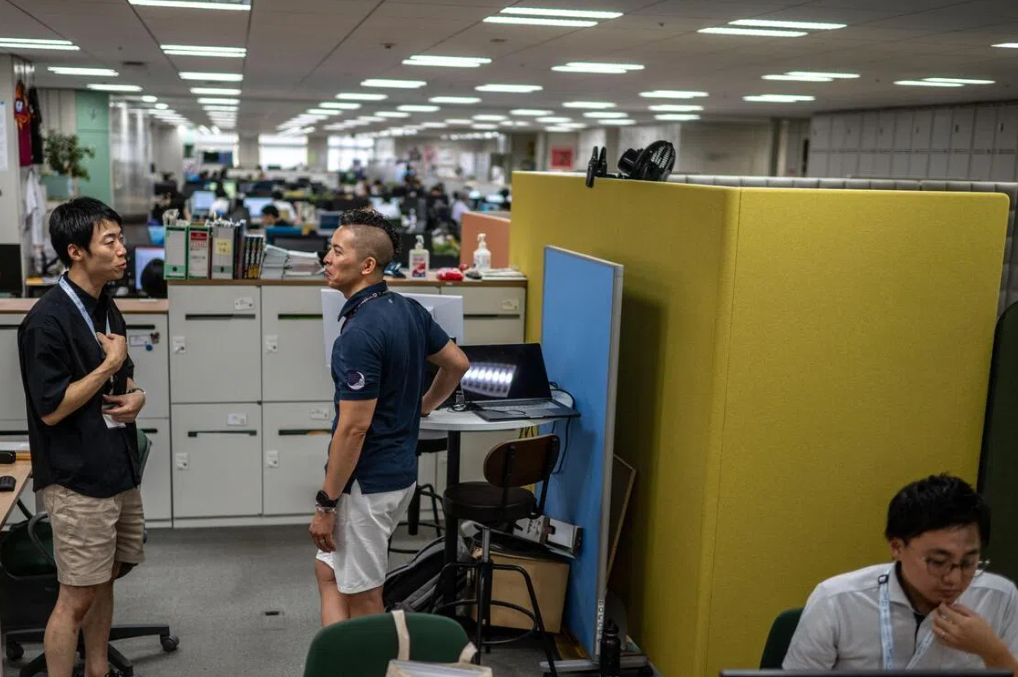
Tokyo's drive to make office workplaces more bearable during Japan's oppressive summer months has collided with an unlikely cultural flashpoint: the visibility of male colleagues' leg hair. The Tokyo metropolitan government expanded its dress-down initiative in April, formally encouraging workers to abandon traditional business suits and neckties in favour of casual alternatives including t-shirts, sneakers and shorts. This move, framed as a practical response to the extreme heat that makes conventional office attire unbearable, has inadvertently triggered widespread discussion about what constitutes appropriate workplace appearance and who determines those standards.
The tension centres on a concept Japanese commenters have termed "sunehara," loosely translatable as "leg hair harassment." The phrase reflects discomfort some female workers experience at being confronted with the sight of male colleagues' exposed shin hair in professional settings. This resistance reveals deeper complexities in Japan's workplace culture, where dress codes traditionally served not merely as functional requirements but as markers of formality, discipline and respect for colleagues. The proposal to liberalise these conventions, while intended to ease the physical burden of summer heat, has exposed fundamental disagreements about comfort, propriety and whose sensibilities deserve priority in shared office environments.
Tokyo's environmental officials frame their initiative as an expansion of worker choice rather than an imposition of looser standards. Noboru Watanabe, an environmental official with the Tokyo metropolitan government, told the BBC that authorities aim to provide flexibility rather than dictate appearance, emphasizing that casual attire should cause no offence to those sharing the workspace. This measured positioning suggests officials recognise the policy's controversial nature whilst maintaining that discomfort about body hair should not override practical considerations like heat management and energy conservation. The framing attempts to position the government as neutral arbiter rather than cultural innovator, though the debate's intensity suggests many citizens disagree with this neutrality.
Market research provides concrete evidence of public division on the matter. A June survey conducted by Gorilla Clinic, a men's cosmetic treatment specialist, revealed near-perfect polarization: 53.5 percent of respondents opposed wearing shorts to work while 46.5 percent supported the practice. The clinic's analysis identified body shape anxiety and concerns about body hair as principal reasons for opposition. Notably, women represented a significantly larger proportion of those opposing shorts, suggesting the "leg hair harassment" critique resonates more strongly among female office workers than their male counterparts. This gender dimension adds another layer to the discussion, touching upon questions about whose comfort takes precedence when office dress codes shift.
The cosmetic industry has capitalized on this cultural anxiety with striking effectiveness. Akifumi Funatsu, a director at Gorilla Clinic, reports that male clients increasingly seek laser hair removal services not primarily for aesthetic reasons but as what they frame as "social etiquette when wearing shorts." This phenomenon reveals how workplace concerns translate into consumer behaviour, with men internalizing the discomfort others reportedly express and taking personal action to conform. The business response demonstrates how cultural anxieties around dress codes can rapidly reshape consumer markets, turning what might be peripheral grooming choices into perceived workplace necessities for men concerned about colleague reactions.
Japan's journey toward casual office dress spans nearly two decades, reflecting gradual shifts in workplace culture alongside changing energy concerns. The original Cool Biz campaign launched in 2005 when Yuriko Koike, then serving as environment minister, introduced guidelines encouraging workers to abandon jackets and ties in favour of short-sleeved shirts. The campaign gained considerable traction when Prime Minister Junichiro Koizumi publicly embraced the new dress code, lending it political legitimacy. This institutional endorsement proved significant, suggesting that cultural change required visible leadership from senior figures willing to model behaviour before ordinary workers would embrace alternatives to traditional formal dress.
The 2011 earthquake and tsunami disaster fundamentally altered Japan's energy calculus, prompting introduction of "Super Cool Biz," an even more relaxed dress code framework. Power shortages following the nuclear emergency made energy conservation an urgent practical necessity rather than merely an environmental preference. This context allowed further casualization of workplace dress, particularly within innovative sectors like technology startups where casual attire had already gained acceptance. The Tokyo government's current push toward shorts represents the logical endpoint of this two-decade evolution, yet encounters resistance that earlier stages perhaps did not trigger, suggesting there exist cultural boundaries beyond which formal dress-down measures encounter genuine opposition.
Japan faces increasingly severe summer heat conditions that make conventional office clothing genuinely dangerous. Between July 6 and 12, the Fire and Disaster Management Agency recorded seven heatstroke deaths and 4,580 hospitalizations, statistics underscoring the legitimate public health dimensions of dress code relaxation. The government's advocacy for casual clothing sits within a broader heat management strategy emphasizing hydration, air-conditioning use and gradual heat acclimatisation. Beyond policy measures, consumer markets have responded with specialized cooling products including fans integrated into clothing, temperature-reducing wipes, umbrellas designed to block radiant heat and portable cooling devices. This marketplace response indicates broad recognition that rising temperatures demand innovative personal adaptation strategies.
The leg hair controversy illuminates tension between two legitimate workplace values: practical adaptation to environmental stressors and maintenance of shared comfort standards. Japan's intensifying summer temperatures genuinely threaten worker wellbeing, making heat-mitigation measures increasingly pressing as climate change progresses. Simultaneously, workplace environments require baseline comfort among colleagues, and dismissing genuine discomfort about shared spaces risks creating tension that undermines workplace cohesion. The unresolved question concerns where this balance should settle: whether practical heat management demands override aesthetic preferences, or whether social comfort should constrain even reasonable adaptations to environmental conditions.
This debate carries significance extending beyond Japan's borders into other East and Southeast Asian economies facing similar climate pressures. As temperatures rise across the region and energy conservation grows more urgent, neighbouring countries will likely contemplate comparable relaxation of formal dress codes. Malaysia, Thailand, Singapore and other tropical nations already navigate considerable summer heat, potentially making them sympathetic to Cool Biz-style initiatives. Yet the Japanese experience suggests that simply liberalizing dress codes does not automatically succeed; success requires navigating complex cultural preferences about appropriate workplace appearance and building consensus across gender lines about what constitutes acceptable casualization.
The dispute also reflects broader questions about how Asian workplaces balance traditional formality with modernization and practical necessity. Japan's decades-long struggle with dress code evolution suggests that formal business attire carries meanings beyond mere convention, embodying respect hierarchies and workplace professionalism in ways that resist rapid change. The seemingly technical question of shorts acceptability thus becomes proxy for larger cultural negotiations about how workplaces should evolve. Resolution likely requires not government mandate alone but gradual cultural acceptance, possibly enabled by visible adoption among senior figures willing to normalize casual dress through example and sustained practice.

