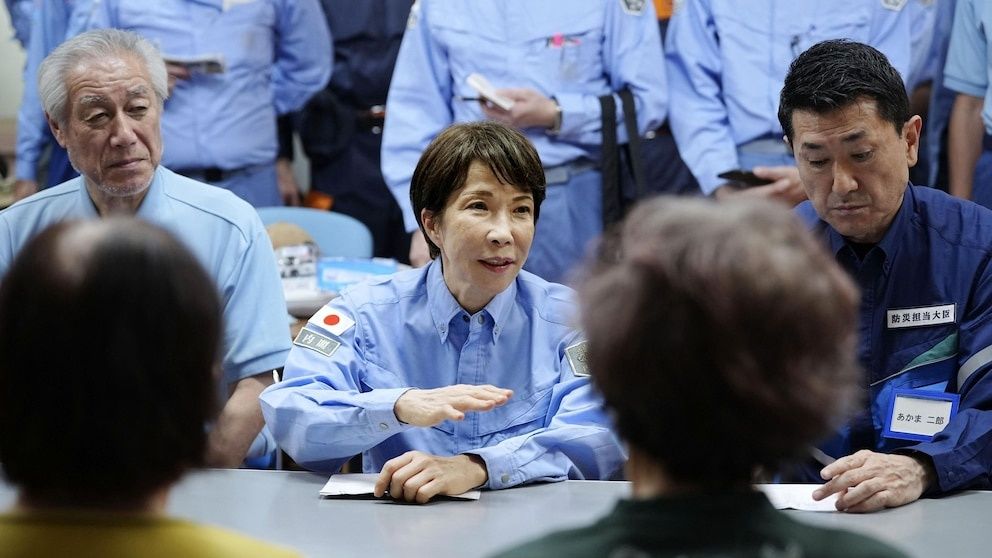
Prime Minister Sanae Takaichi visited Japan's southern Kumamoto Prefecture on Monday for the first time since a magnitude 7.1 earthquake struck the region on Tuesday, August 4, leaving 38 dead and thousands displaced. Her visit came as residents began the grueling process of clearing debris under sweltering conditions, with the catastrophe exposing how natural disasters in Japan intersect dangerously with seasonal weather patterns and infrastructure vulnerabilities that Southeast Asian nations also face.
The earthquake's toll continues to mount as recovery workers assess the full extent of damage across the affected areas of Kyushu. Beyond the confirmed deaths, authorities are still investigating other casualties, including one person who died of apparent heat stroke while sheltering in a car—a grim reminder of how secondary hazards can prove as lethal as the initial disaster. More than 114 people sustained injuries, while approximately 700 homes were completely destroyed and over 11,300 buildings sustained varying degrees of damage, stretching local resources to the breaking point.
The timing of the earthquake during Japan's summer season has created a perfect storm of humanitarian challenges. With temperatures forecast to approach 40 degrees Celsius by Monday, the Japan Meteorological Agency warned of dangerous heat conditions precisely when residents are most vulnerable. More than 46,000 households remain without access to clean water, a critical shortfall during extreme heat when dehydration poses a significant health threat. Simultaneously, fuel supplies have dwindled across the region, limiting the ability to operate generators or provide adequate cooling to emergency facilities, forcing difficult triage decisions about where scarce resources should be allocated.
Evacuation centers have become overcrowded and inadequate to meet residents' needs. More than 8,500 people remain housed in hastily converted community centers, school gymnasiums, and classrooms—many of which lack air-conditioning entirely. Others have retreated to their vehicles in parking lots or to makeshift camps outside their damaged homes, exposing them to the full force of the summer heat. This situation echoes warnings from disaster management experts across the Asia-Pacific region about how inadequate shelter provision inevitably creates unsanitary conditions, threatens privacy, and elevates risks of disease and secondary health crises in the aftermath of major earthquakes.
Governor Takashi Kimura used his meeting with the Prime Minister to highlight the exceptional pressures the "abnormal heat" is placing on residents already struggling with displacement and loss. He specifically requested enhanced government intervention to upgrade conditions at evacuation centers, emphasizing the urgent need for clean water distribution systems and medical care facilities. The governor's appeal reflects how earthquake response strategies must adapt to account for seasonal factors—a lesson increasingly relevant as climate change intensifies extreme weather patterns across the region.
Takaichi's response, while measured, committed the government to examining and implementing support measures, though critics questioned whether her visit genuinely conveyed the scale of hardship. She toured the disaster zone by army helicopter and visited one of the most comprehensively equipped shelters, complete with cardboard beds, privacy partitions, and functioning air-conditioning. Social media users quickly pointed out that this particular facility represented the exception rather than the rule, raising questions about whether high-level political visits always translate into policy responsiveness or sometimes function as public relations exercises disconnected from the ground reality facing ordinary evacuees.
In a troubling development highlighting corporate accountability issues relevant across Asia, Habita—the local general store operator that ran a shop inside the collapsed Aeon Mall in Kashima—acknowledged instructing two young employees to return to the severely damaged building to secure sales proceeds in a safe. The company's decision proved catastrophic when a gas leak triggered an explosion that killed both workers. Company executives attended the wake of one victim, 22-year-old Kurumi Otake, to apologize directly to her grieving parents. The young woman's mother expressed the raw anguish of such preventable loss: "I wish someone had stopped her. My daughter is not coming back."
The mall operator subsequently confirmed that the explosion stemmed from a gas leak occurring after approximately 3,000 shoppers had been safely evacuated to the parking lot. However, certain employees—including the two who were fatally instructed to return—remained inside the structure. Rescue teams managed to extract five survivors from the rubble but recovered the bodies of seven others, underscoring how decisions made in the chaos and confusion immediately following an earthquake can have life-or-death consequences that reverberate through families and communities for years.
This disaster carries particular relevance for Malaysia and other Southeast Asian nations that face comparable seismic risks. While the region does not experience earthquakes with Japan's frequency, countries including Indonesia, the Philippines, and Malaysia all sit within or near tectonically active zones. The Kumamoto earthquake demonstrates how critical it is to establish clear emergency protocols that prioritize human life over property or commercial interests, and how disaster preparedness must account for seasonal environmental factors that can amplify suffering. The crowded, inadequate shelter conditions visible in Kumamoto highlight why pre-disaster planning for evacuation center capacity and supply chain resilience should be treated as essential infrastructure investment rather than an afterthought.
As cleanup operations intensify and the region faces weeks of recovery, the intersection of earthquake damage with extreme heat underscores a fundamental challenge facing disaster management across Asia: natural hazards rarely strike in isolation, and effective response requires coordinated attention to multiple overlapping crises. The Kumamoto experience will likely shape discussions about disaster resilience throughout the region, particularly regarding how governments can better prepare for and respond to scenarios where primary and secondary hazards compound each other's effects on vulnerable populations forced to rebuild their lives.

