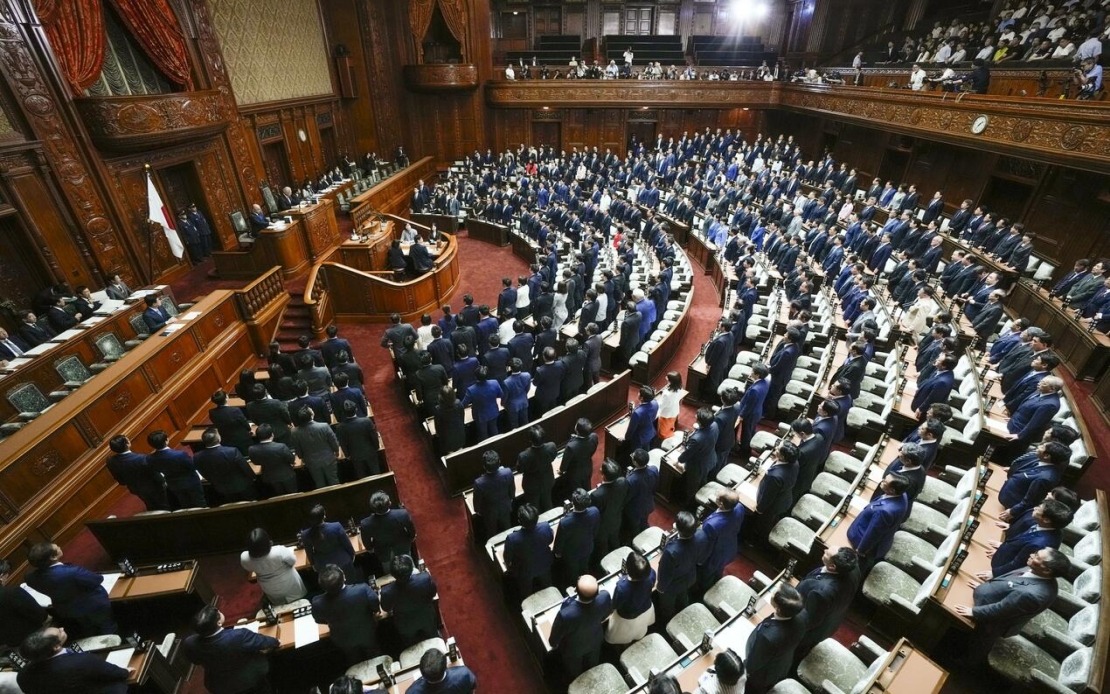
Japan has cleared a significant constitutional hurdle with the lower house's passage of sweeping legislation to reshape the imperial succession system, marking the first meaningful overhaul of the Imperial House Law in over seven decades. The parliamentary chamber approved the bill on Friday following a single day of debate, moving ahead an agenda that Prime Minister Sanae Takaichi's administration prioritized after months of political deadlock. The ruling Liberal Democratic Party and its coalition partner, the Japan Innovation Party, now seek upper house endorsement before the current parliamentary session concludes on July 17, with their combined supermajority positioning them favourably for final enactment.
The legislative gridlock that had consumed parliament since late June represented a broader power struggle over governance and accountability. Opposition parties had refused to engage on multiple government initiatives, including the imperial succession bill, demanding intensive questioning of Prime Minister Takaichi regarding allegations that her political camp had produced and disseminated online videos attacking opponents. This impasse finally broke after the ruling coalition agreed to shelve an unpopular plan to reduce lower house seats, demonstrating the interconnected nature of parliamentary politics in Tokyo. The concession allowed deliberations on imperial matters to proceed, though tensions remain evident in the compressed timeline for debate.
At the heart of the legislation lies a demographic crisis that has quietly threatened Japan's ancient institution. The imperial family has experienced a precipitous decline in eligible male successors, a consequence of restrictive succession rules that permit only those descended patrilineally from emperors to ascend the throne. Simultaneously, the overall size of the imperial household has shrunk dramatically, as female family members forfeit their imperial status upon marrying outside the family. These dual pressures created an unsustainable trajectory that policymakers could no longer ignore, though the solution crafted represents a careful middle path rather than a wholesale reimagining of imperial rules.
The bill's centrepiece involves creating a pathway for male descendants of former imperial branch families to rejoin the main household through adoption. Specifically, the legislation permits the adoption of males aged fifteen or older who trace their lineage through the male line to emperors of historical branch families that were dissolved during the post-war period. This mechanism would substantially expand the pool of eligible male successors without fundamentally altering the patrilineal principle that has underpinned imperial succession. However, the law explicitly prohibits adopted members themselves from ascending the throne, restricting their potential role to that of strengthening the family structure and enabling their male-line descendants to claim succession rights.
Parallel to the succession question, the legislation addresses the crisis of imperial family depletion by allowing female members to maintain their imperial status following marriage to commoners. This represents a historic departure from centuries of custom, yet it operates within carefully circumscribed boundaries. While women may now retain imperial identity and remain part of official household structures, the fundamental barrier preventing them from ascending the throne remains unaltered. This selective modernization reflects the conservative nature of the political consensus that coalesced around the reform, prioritizing stability and institutional continuity over comprehensive gender equality in succession matters.
The gap between this legislation and broader public sentiment on imperial succession reveals the tension between reform and tradition in contemporary Japan. Polling data has consistently demonstrated majority support for permitting female or maternal-line emperors as solutions to the succession challenge, yet parliament deliberately excluded both concepts from the final bill. Opposition parties criticized the legislation for incorporating expansions not present in the preliminary proposal drafted by bipartisan parliamentary committee leadership, such as the explicit eligibility of adopted males' male-line descendants for the throne. These additions suggest the final law extends further than the cautious consensus framework initially assembled, raising questions about whether the process adequately incorporated all parliamentary perspectives.
Prime Minister Takaichi's administration submitted the bill in late June, but its passage required navigating the fractured parliamentary landscape where opposition confidence had eroded following allegations of coordinated online attacks against political adversaries. The compromise agreement that unfroze legislative business included scheduling of one-on-one debate sessions between the prime minister and opposition leaders, reverting to a parliamentary practice suspended since May. These accountability sessions, scheduled for Wednesday afternoon, represent an attempt to rebuild working relationships and restore procedural normalcy after weeks of confrontational posturing. The restoration of dialogue mechanisms suggests that passage of the imperial law, while significant, operates within a broader context of parliamentary strain requiring ongoing negotiation.
For Malaysian and Southeast Asian observers, Japan's handling of the imperial succession question offers insights into how mature democracies balance institutional preservation with evolving social values. The deliberate exclusion of female succession from the legislation, despite public support, demonstrates how traditional power structures can resist comprehensive change even within systems that permit extensive public participation in governance. The compressed debate schedule—examining constitutional matters affecting an institution spanning nearly two millennia in a single day—reflects parliamentary time pressures that increasingly characterize even established democracies. The coalition's two-thirds supermajority enabled this accelerated process, bypassing the more extensive deliberation that constitutional matters typically warrant.
The legislation's eventual passage through the upper house appears virtually assured given the coalition's numerical advantage, yet the political controversy surrounding its content and process suggests the imperial succession question remains incompletely resolved. The decision to permit adoption while maintaining the patrilineal succession principle addresses the immediate demographic crisis through a conservative mechanism, yet leaves unresolved the deeper question of female imperial succession that public opinion increasingly supports. Future parliaments may well revisit these constraints, particularly if the adopted-family strategy fails to produce sufficient male-line heirs to sustain succession stability across generational transitions.
The imperial reform's advancement also signals the restoration of normal parliamentary function following the extended deadlock, though underlying tensions regarding government accountability and procedural fairness persist. The negotiated resolution, in which the ruling coalition abandoned the unpopular seat-reduction bill in exchange for opposition cooperation on imperial matters, exemplifies the compromise-based governance that characterizes coalition politics. However, the continued allegations regarding online political attacks and their relationship to parliamentary oversight remain unresolved issues that will likely resurface in scheduled accountability sessions. The imperial law's passage thus represents a qualified victory for the Takaichi administration, advancing a carefully constrained reform while the broader question of governance legitimacy continues to simmer beneath the surface of parliamentary proceedings.

