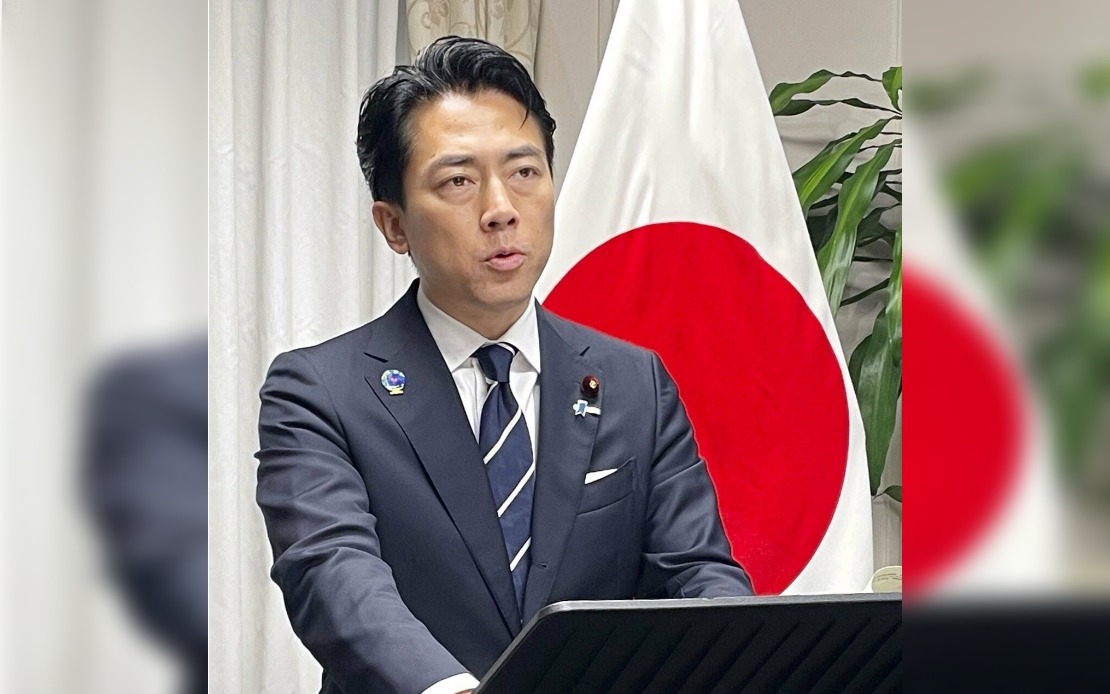
Japan's Defence Minister Shinjiro Koizumi has sparked a significant policy conversation by arguing that his country must engage in substantive public discussion about nuclear weapons, marking a notable shift in how Tokyo approaches one of its most sensitive defence questions. Speaking through an online programme released Friday, Koizumi suggested that Japan "cannot avoid touching" the nuclear issue, signalling that the government intends to reconsider longstanding taboos around this topic as it prepares to revise three critical national security documents by year-end.
Koizumi's remarks arrive at a time when Japan's strategic calculus is undergoing profound recalibration. The Defence Minister pointed specifically to France and Finland as examples of European nations moving toward more robust nuclear deterrence frameworks, reasoning that Japan must grapple with similar security imperatives. France's President Emmanuel Macron declared in March that Paris would expand its nuclear warhead arsenal, while Finland's parliament approved legislation in June permitting nuclear weapons deployment on Finnish territory—a dramatic policy reversal for a country that had previously maintained strict non-nuclear positions.
These European precedents carry particular weight for Tokyo policymakers. France and Finland are not rogue states or revisionist powers; they are established democracies and NATO allies whose nuclear decisions reflect genuine assessments of threat environments. Their moves suggest that even traditionally cautious nations now view nuclear deterrence as unavoidable in an era marked by great-power competition and regional instability. For Japan, geographically positioned between China's expanding military capabilities and North Korea's persistent nuclear programme, such calculations gain immediate relevance.
Yet Japan occupies a unique historical and moral position that complicates any shift toward nuclear weapons. The country remains the sole nation to have experienced atomic bombing during wartime, suffering devastating civilian casualties at Hiroshima and Nagasaki in 1945. This lived experience has anchored Japan's three non-nuclear principles—pledging not to produce, possess, or permit nuclear weapons on its soil—as foundational pillars of postwar Japanese identity and policy. These principles have endured across multiple governments and enjoy deep public support, making any departure extraordinarily sensitive both domestically and internationally.
Currently, Japan shelters under America's extended nuclear umbrella, a security arrangement that has provided strategic stability for nearly eight decades. The US nuclear guarantee theoretically deters major adversaries from attacking Japanese territory by threatening catastrophic retaliation. This arrangement has allowed Japan to maintain its non-nuclear posture while still benefiting from nuclear deterrence. However, recent debates within Japanese policy circles have questioned whether this arrangement remains adequate as American commitment to defending distant allies faces mounting scepticism in Washington.
Koizumi's intervention reflects broader anxieties within Japan's security establishment about the durability of postwar arrangements. In December last year, a government official involved in security policy formulation under Prime Minister Sanae Takaichi's administration suggested that Japan should acquire nuclear weapons. The proposal triggered fierce criticism from opposition politicians and international condemnation, yet the fact that such arguments emerged from within official circles signals shifting elite opinion. Similarly, former Defence Minister Itsunori Onodera argued late last year that Japan must seriously examine the future viability of its non-nuclear principles.
The Defence Minister framed this debate as a matter of intellectual and political freedom rather than an endorsement of proliferation. Koizumi contended that Japan's security environment has grown measurably harsher and that the country must move beyond treating nuclear issues as conversational forbidden territory. This framing seeks to distinguish between opening debate and abandoning existing policy—a crucial distinction that acknowledges widespread Japanese and international opposition to nuclear acquisition while asserting that rational discourse cannot remain permanently foreclosed.
For Malaysia and broader Southeast Asia, Japan's nuclear reconsideration carries significant implications. Any Japanese nuclear weapons programme would fundamentally alter regional security dynamics, potentially triggering cascading proliferation pressures across Asia-Pacific. Countries like South Korea, Taiwan, and Philippines might face renewed domestic pressures to develop independent nuclear capabilities if Japan abandoned its non-nuclear stance. Such proliferation would complicate ASEAN's efforts to maintain strategic autonomy and could undermine the region's arms control architecture.
The timing of this debate also warrants attention. Japan's security document revisions occur as China expands its military modernisation, North Korea accelerates weapons testing, and Russia's Ukraine invasion demonstrates the dangers of great-power conflict. These circumstances create genuine strategic pressures that Japanese officials must address, yet they also tempt policymakers toward security solutions that could generate unintended consequences. The nuclear weapons debate thus represents not merely a technical defence question but a fundamental reassessment of postwar East Asian security assumptions.
International observers will closely monitor whether Koizumi's position attracts broader government support or remains the opinion of individual officials. Any movement toward revising non-nuclear principles would require legislative action and potentially constitutional consideration, processes that would generate intense domestic scrutiny. Public opinion, currently supportive of the non-nuclear stance, would ultimately constrain how far the government could proceed in this direction. Nevertheless, the emergence of this debate signals that even Japan's most established security commitments face reconsideration in today's unstable geopolitical environment.

