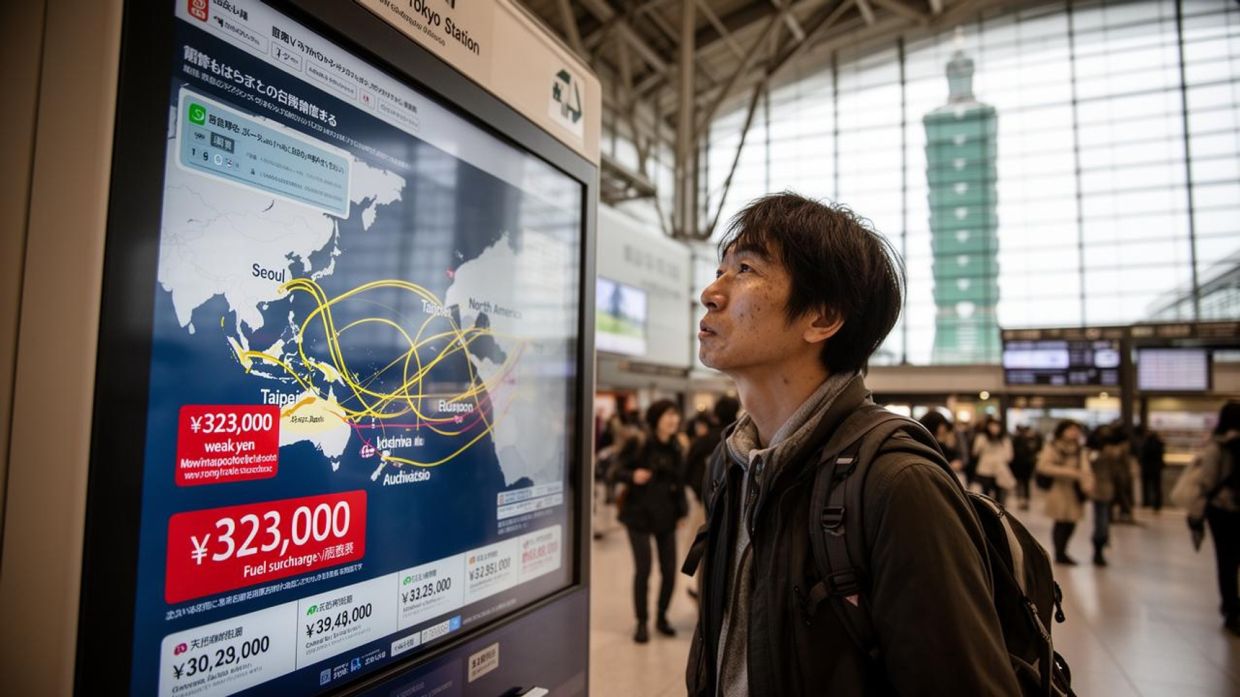
Japan's overseas travel market faces its first significant contraction since pandemic recovery as the weakened yen currency combines with elevated operational costs to discourage extended holiday journeys. Major travel agency JTB Corp projects that international trips departing during the July 15 to August 31 summer period will total 2.17 million, representing an 8.8 per cent decrease from the prior year. This reversal marks a notable turning point for the Japanese travel industry, which has enjoyed robust growth momentum since international borders reopened fully in 2023.
The currency headwind lies at the heart of this slowdown. Japan's persistently weak yen has made outbound travel increasingly expensive for Japanese consumers, even as they face mounting domestic cost pressures from broader inflation. When Japanese travellers exchange yen for foreign currencies, they receive less purchasing power than in previous years, effectively raising the nominal cost of everything from flights to accommodation to meals abroad. This currency disadvantage arrives at a particularly inopportune moment, when Japanese households are already adjusting spending patterns to cope with higher living expenses at home.
Airline fuel surcharges have compounded the economic burden on travellers. Recent volatility in global aviation fuel prices, exacerbated by geopolitical tensions in West Asia, has prompted carriers to impose substantial additional fees on long-haul international routes. These charges can represent a meaningful portion of total ticket prices, particularly for flights to distant destinations. Combined with the currency headwinds, fuel surcharges are effectively pricing Japanese tourists out of traditional long-haul markets such as North America and Australia, which typically commanded substantial market share in previous summer seasons.
The cost dynamics have fundamentally reshaped travel preferences among Japanese holidaymakers. According to JTB's analysis, nearby regional destinations offering competitive airfare pricing have captured growing market share. South Korea emerges as the clear frontrunner among international destinations, accounting for 26.2 per cent of projected overseas trips. Taiwan follows at 16.2 per cent, with both countries benefiting from shorter flight durations, lower fuel surcharges, and generally more affordable accommodation and dining options relative to long-haul destinations. This shift underscores how price sensitivity is now driving destination selection in ways that were less pronounced during the immediate post-pandemic travel boom.
Travel to mainland China, historically a significant market for Japanese tourists, faces particular headwinds beyond the economic sphere. JTB forecasts that visits to China will plummet to just 10.1 per cent of the total international market share, representing barely half the volume from the previous year. The sharp decline reflects more than simple cost considerations. Diplomatic tensions between Tokyo and Beijing, particularly following Prime Minister Sanae Takaichi's November remarks regarding Taiwan, have contributed to cooling sentiment around China-bound travel. Political frictions can subtly but meaningfully influence travel decisions, as prospective tourists factor in both personal sentiment and practical concerns about the travel environment.
Domestic travel within Japan faces its own headwinds despite the broader shift away from international trips. Total domestic journeys are anticipated to decrease 4.4 per cent year-on-year to approximately 69 million trips. While this decline is less severe than the international contraction, it nonetheless indicates that Japanese consumers are exercising greater restraint across all leisure travel categories. The prevailing economic uncertainty has apparently encouraged some households to forgo or curtail holiday plans entirely rather than simply redirecting spending toward domestic alternatives. However, per-person spending on domestic trips is projected to increase 3.2 per cent to 48,500 yen, suggesting that those who do travel domestically may be selecting premium experiences or higher-end accommodation.
Geographic patterns within Japan reveal that established tourism hubs retain their appeal despite overall volume declines. Tokyo and the surrounding Kanto region claim the largest share of domestic travel at 19.0 per cent, reflecting the capital's concentration of attractions and infrastructure. The Kinki region in western Japan, anchored by Osaka and Kyoto, captures 14.9 per cent of domestic journeys, while Hokkaido in the north attracts 11.2 per cent. These leading destinations appear relatively resilient, suggesting that travellers willing to holiday domestically concentrate their spending in recognisable, established locations rather than dispersing across emerging or lesser-known regions.
Underlying these aggregate trends is a pronounced divergence in consumer behaviour that reveals deeper economic anxieties. JTB's assessment notes growing polarisation between cost-conscious travellers who are shortening vacation lengths or scaling back destination ambitions, and a smaller cohort willing to spend aggressively to realise their preferred travel experiences. This bifurcation reflects broader wealth inequality and income distribution patterns within Japanese society. Higher-income households remain capable of absorbing currency fluctuations and fuel surcharges, while middle-income families face genuine constraints when calculating holiday budgets against other financial obligations and inflation-driven cost increases in essentials.
The implications extend beyond Japan's domestic travel industry to regional tourism economies dependent on Japanese visitor spending. Southeast Asian destinations, which typically benefit from the proximity advantages that South Korea and Taiwan currently enjoy, may capture some overflow demand if regional competitors become saturated or if pricing dynamics shift. However, the overall contraction in Japanese outbound travel suggests a smaller total market for regional destinations to compete for, potentially pressuring local tourism operators who have relied on robust Japanese visitor numbers.
JTB conducted its projections based on online survey data collected in June from respondents planning trips lasting at least one night during the defined summer period. While survey methodology introduces inherent uncertainties, the consistency of findings across major travel agencies suggests the underlying trends reflect genuine shifts in consumer intent. The summer travel forecast ultimately reflects Japan's economic moment: a nation managing currency depreciation, inflationary pressures, and subdued consumer confidence simultaneously, with visible consequences for one of the economy's discretionary spending categories.

