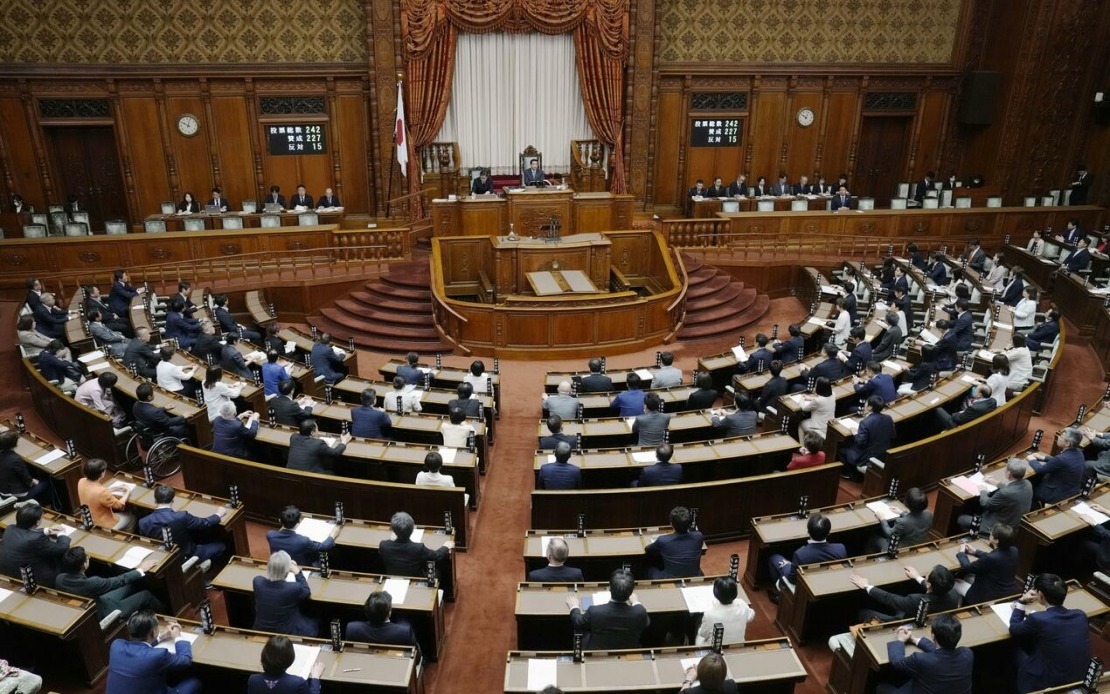
Japan's legislature has passed landmark defence legislation that represents a fundamental shift in how the country approaches national security in an era where space has become as strategically vital as traditional military domains. The reforms, enacted on Friday by the House of Councillors, signal Tokyo's determination to modernise its Self-Defence Forces for emerging threats while maintaining operational readiness across established theatres. The changes will take effect during the fiscal year ending March 2027, marking the beginning of a new chapter in Japan's defence posture.
At the heart of the restructuring is a symbolic yet significant change: the Air Self-Defence Force will be renamed to incorporate space into its official designation, reflecting the growing recognition that orbital and atmospheric domains can no longer be separated in modern military strategy. This institutional reform goes beyond mere nomenclature. The legislation establishes a dedicated space operations group commanded by a lieutenant general, tasked with enhancing Japan's ability to maintain awareness of activities in space and improve satellite surveillance capabilities. This represents Japan's response to the militarisation of space by rival powers and the critical dependence of modern societies on space-based infrastructure.
Defence Minister Shinjiro Koizumi emphasised during a news conference that space technology has become woven into the fabric of civilian life across Japan. Satellite navigation systems guide millions of daily journeys, smartphone mapping applications connect people to their communities, and weather forecasting systems—crucial for a nation prone to typhoons and earthquakes—depend entirely on space-based observation. The minister's framing reflects a broader strategic reality: military space capabilities and civilian infrastructure are increasingly intertwined, making space security a matter that affects not just soldiers but ordinary citizens.
Beyond space, the legislation introduces administrative reforms intended to strengthen Japan's top defence leadership. Parliament has authorised the appointment of a second senior vice defence minister, a position expected to be filled as early as summer. This addition aims to distribute the heavy workload that falls on defence leadership during emergencies and natural disasters, while also facilitating deeper engagement with allied nations. The expanded leadership structure reflects Japan's commitment to maintaining robust defence diplomacy with the United States and other security partners during a period of heightened regional tension.
A pressing concern driving these reforms is the difficulty the Self-Defence Forces face in recruiting and retaining personnel. To address this challenge, the legislation increases post-retirement benefits for SDF members, whose mandatory retirement ages vary depending on rank but typically occur earlier than in civilian government service. This move acknowledges a hard reality: younger Japanese face declining career incentives in military service, and the SDF must compete with civilian opportunities in a contracting labour market. Better benefits may help retain experienced personnel and attract new recruits in a nation with a shrinking working-age population.
Perhaps most directly connected to regional security concerns is the elevation of the Ground Self-Defence Force's 15th Brigade to full divisional status. Based in Naha in Okinawa Prefecture, this unit will gain expanded resources and command authority to oversee Japan's southwestern island chain, where security challenges have intensified dramatically. The upgrade signals Tokyo's seriousness about defending these remote territories, which sit strategically between Japan and Taiwan while facing pressure from China's expanding maritime activities.
China's assertive behaviour in waters surrounding Japanese territory has accelerated Tokyo's focus on island defence. The southwestern archipelago, stretching from Okinawa toward Taiwan, represents Japan's outer defensive perimeter and critical sea lanes. The region has witnessed increased incursions by Chinese military vessels and aircraft, prompting Japan to strengthen its physical presence and military infrastructure. Elevating the 15th Brigade reflects this strategic imperative, ensuring that Japan maintains credible deterrence against potential threats while reassuring both local residents and allied partners of commitment to regional stability.
These defence reforms must be understood within the broader context of Japan's evolving security environment. Tokyo faces multiple simultaneous pressures: China's military modernisation and assertiveness, North Korea's weapons development, Russia's unpredictable behaviour, and Taiwan's precarious status as a linchpin of regional security. The legislation represents Japan's attempt to address these multifaceted challenges through institutional innovation, personnel investment, and technological advancement. Rather than simply spending more on defence—though Japan has been increasing its budget substantially—these reforms attempt to restructure how the military is organised to respond to 21st-century threats.
For Southeast Asian observers, Japan's defence reforms carry significant implications. A well-resourced, effectively organised Japanese military contributes to regional stability and underpins the rules-based order that benefits smaller nations. Japan's space capabilities, in particular, provide surveillance and communications services that benefit the broader region. Additionally, Japan's willingness to invest in its own defence reduces pressure on allied nations to shoulder disproportionate security burdens and demonstrates that established democracies take security seriously.
The legislation also illustrates how major democracies are grappling with space militarisation. Unlike the nuclear era, where deterrence frameworks and arms control agreements eventually developed, space remains largely unregulated. Japan's move to formalise space operations within its military structure may prompt other regional powers to accelerate their own space capabilities, potentially triggering an Asian space race with unpredictable consequences. The challenge of maintaining stability in space while pursuing military advantage remains unresolved, and Japan's restructuring highlights this tension.
Looking ahead, the success of these reforms will depend on implementation quality and whether they achieve their stated objectives of enhancing Japan's deterrent capability and operational effectiveness. The timeline to fiscal 2027 provides adequate preparation time, yet transforming large military organisations is notoriously difficult. Personnel must be trained, new command structures integrated, and space operations doctrine developed. Whether Japan can successfully navigate these challenges while managing budget constraints and demographic pressures will determine whether this defence reorganisation becomes a model for modern military adaptation or merely an organisational shuffling of existing capabilities.

