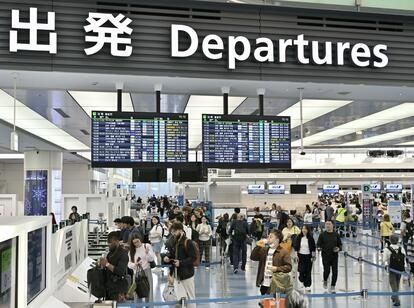
Japan implemented a significant overhaul of its tourism-related levies on Wednesday, July 1, with the government tripling its departure tax to 3,000 yen per person whilst simultaneously raising entry visa fees by a factor of five. The dual policy shift signals Tokyo's determination to address the mounting challenges posed by record-breaking visitor numbers whilst generating funds for targeted infrastructure improvements across the nation. The departure tax, formally known as the international tourist tax, now stands at 3,000 yen—a threefold increase from the previous 1,000 yen—and will be collected at the point of ticket purchase regardless of passenger nationality.
The visa fee restructuring, meanwhile, marks the first adjustment to Japan's entry charges in nearly five decades. Single-entry visas for foreign visitors now cost 15,000 yen, up from the earlier 3,000 yen, whilst multiple-entry visas have jumped to 30,000 yen from 6,000 yen. Foreign Minister Toshimitsu Motegi indicated that these increases reflect accumulated inflation and adjustments for the yen's long-term depreciation against major currencies. Notably, Motegi suggested the government does not anticipate an immediate dampening effect on tourist arrivals, indicating the fee levels remain competitive within regional and international contexts. Japan's visa charges had previously been considered among the lowest in the developed world, with comparable nations in the Group of Seven charging substantially higher amounts for entry documentation.
To offset the additional financial strain on Japanese nationals, the government simultaneously reduced domestic passport application fees. Applicants aged 18 and above seeking a ten-year passport through counter services at passport centres will now pay 9,300 yen, down from 16,300 yen—a reduction of approximately 43 percent. Five-year passants for younger applicants have been standardised at 4,800 yen. The government further incentivised digital applications by offering additional discounts: online applicants can obtain ten-year passports for 8,900 yen and five-year passports for 4,400 yen. These reductions represent a deliberate policy choice to boost passport ownership rates among Japanese citizens, which remain notably lower than comparable figures in other wealthy nations.
The revenues generated from the departure tax hike will be directed toward mitigating the most visible manifestations of overtourism. The government intends to establish designated zones at iconic photography locations where visitor congestion has become acute, effectively managing foot traffic and preserving the experience for all travellers. Beyond crowd management at specific sites, the funding will support broader regional tourism development initiatives designed to distribute visitor flows away from saturated urban centres. Railway operators in less-visited prefectures will receive investment to position their services as tourist attractions, whilst funding will support renovation projects at regional railway stations to enhance their appeal and accessibility to international visitors.
The departure tax collection system operates through airlines, cruise lines, and travel agencies, which remit payments to the government upon ticket purchase. Certain categories of travellers remain exempt from the levy: passengers in transit through Japan who remain in the country for fewer than 24 hours, as well as children under two years old. Passengers who purchased their tickets before the Wednesday implementation date were charged at the previous 1,000 yen rate, providing a transition window for those with advance bookings. The international tourist tax proved remarkably productive in its first full fiscal year, generating approximately 49 billion yen in fiscal 2025, with projections suggesting that revenues will climb to around 130 billion yen in fiscal 2026—a demonstrable consequence of both increased visitor volumes and the higher rate.
For Malaysian and Southeast Asian readers, these changes carry notable implications. Malaysia maintains significant commercial aviation connections with Japan, and the increased departure tax will modestly raise the cost of travel for business professionals and leisure tourists. Malaysian nationals visiting Japan for tourism, business conferences, or cultural exchanges will face higher visa expenses unless they qualify for visa-exempt entry through bilateral agreements. The measures underscore how Japan, despite its relatively modest tourism tax compared with some regional competitors, continues to recalibrate its approach as it confronts the practical limits of its tourism infrastructure. The philosophy underlying these policies—encouraging visitor distribution beyond Tokyo and other primary destinations—may offer lessons for Southeast Asian nations managing comparable tourism pressures in Bali, Phuket, and other regional hotspots.
The fiscal implications of Japan's approach warrant attention for other tourism-dependent economies. By linking tax increases explicitly to infrastructure investment rather than general revenue, Japan frames the charges as investments in the visitor experience itself. This framing may prove more politically palatable than conventional tourism taxes and could influence policy discussions across the Association of Southeast Asian Nations, where several member states struggle with balancing tourism revenues against environmental and social costs. The deposit tax expansion also reflects Japan's confidence that demand for travel to Japan remains sufficiently robust to absorb modestly higher costs without dramatic contraction. This confidence may be justified given Japan's unique cultural positioning, but it remains an empirical proposition that will become clearer as booking patterns evolve through the remainder of 2024 and into 2025.
The government's simultaneous reduction of passport fees for citizens reflects a strategic imperative to increase overseas travel among Japanese nationals, countering a historical pattern of relatively low passport ownership. This outbound travel expansion has implications for tourism-receiving economies throughout Southeast Asia. Increased numbers of Japanese tourists visiting Cambodia, Vietnam, Thailand, and other regional destinations could generate welcome revenue whilst also creating competitive pressures on Japan-specific tourism products and services. For Malaysian hospitality and tourism businesses, understanding Japan's evolving travel dynamics becomes increasingly important as the nation's demographic profile shifts and younger Japanese populations adopt travel patterns at different frequencies than their predecessors.
The technical implementation of the new departure tax and visa fee structure proceeded smoothly on July 1, with minimal disruption reported to air and sea travel operations. Airline booking systems and travel agency procedures were updated to incorporate the new rates, whilst immigration and visa processing facilities adapted their fee collection procedures. The phased approach—with tickets purchased before the deadline charged at the old rate—provided a brief adjustment period for the travel industry. As the financial quarters progress and more data accumulates regarding booking patterns, revenue generation, and the effectiveness of the crowd management initiatives, Japan's tourism ministry will likely assess whether further adjustments prove necessary.

