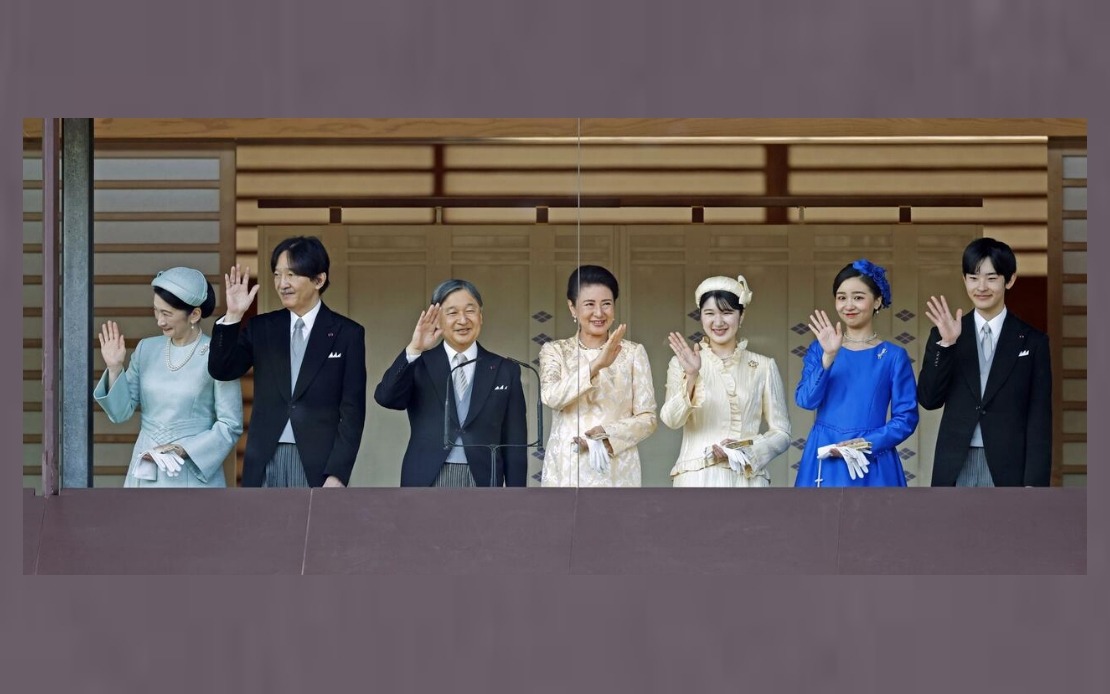
Japan's parliament has taken a significant step toward modernising the imperial succession system, approving revisions to the Imperial House Law on Friday in a bid to tackle the kingdom's dwindling royal lineage. Yet despite these reforms, Prime Minister Sanae Takaichi's government has held firm to the centuries-old convention that only men can inherit the Chrysanthemum Throne, a stance that diverges sharply from public sentiment on the question of female emperors.
The revised law introduces two meaningful changes to Japan's foundational 1947 imperial legislation. First, it now permits the adoption of unmarried males aged 15 and older who descend from former branch families that trace their lineage through the male line back to past emperors. Second, female members of the imperial household may now retain their status and privileges even after marrying people outside the royal family—a provision that previously would have resulted in automatic loss of imperial rank. These reforms represent the first substantive overhaul of the law since the post-World War II era, when Japan was rebuilding under American occupation.
The scale of the succession challenge facing Japan cannot be understated. The nation currently has only three male heirs to Emperor Naruhito, a precarious position for a hereditary system that has ruled continuously for over 2,600 years. The situation grew acute enough that addressing it became a government priority, prompting Takaichi to champion the reform effort. By reopening the door to the 11 former branch families—whose 51 members were stripped of imperial status in 1947—the revised law theoretically expands the pool of eligible male successors who could one day occupy the throne.
For Southeast Asian observers, Japan's wrestling with hereditary succession norms offers instructive parallels. The region itself grapples with similar questions around monarchical continuity, female representation in power, and how ancient institutions adapt to modern realities. Japan's cautious, incremental approach—preserving the patrilineal principle while expanding the talent pool—reflects a broader conservative orientation among many Asian monarchies when confronting pressure for reform.
However, the legislative process that produced this outcome has drawn sharp criticism from opposition parliamentarians who argue that deliberations were insufficient and rushed. More fundamentally, critics contend that the ruling coalition, comprising the long-dominant Liberal Democratic Party and its junior partner the Japan Innovation Party, sidestepped the core question of female succession. The government framed the adoption mechanism as a complete solution to Japan's succession vulnerability, but this framing ignores the reality that adopted males might not solve the problem if the supply of eligible male descendants dries up in future generations.
The original 1947 Imperial House Law, enacted during American occupation, codified an unambiguous succession rule: the throne "shall be succeeded to by a male offspring in the male line belonging to the Imperial Lineage." This language remains unchanged in the latest revision. While the government insists that male descendants of newly adopted members can ascend the throne, the law makes absolutely no allowance for female emperors or succession through maternal lineage—a considerable constraint that some observers view as leaving the long-term question unresolved.
Public opinion, however, tells a starkly different story about where Japanese society stands on this question. A Kyodo News poll conducted in May revealed that 83.0 percent of respondents backed the idea of permitting female emperors, with only 13.1 percent opposed. This overwhelming consensus underscores a significant gap between what ordinary Japanese citizens believe the succession system should be and what their government has codified in law. Notably, Takaichi herself represents a historic departure from male leadership—she is Japan's first female prime minister—yet her administration has steered clear of extending that principle to the imperial throne.
The months of cross-party negotiations that preceded this reform generated a legislative "consensus" reflecting the views of 13 parliamentary parties and groups. Yet this consensus deliberately sidestepped the succession question, suggesting either deep disagreement on female succession or a pragmatic decision to leave the contentious issue for a future parliament. This approach allowed the government to claim a bipartisan achievement while punting the harder question down the road.
For Malaysian and broader Southeast Asian readers, Japan's reform illustrates how even the world's most stable and developed monarchies struggle with the intersection of tradition, gender equity, and institutional sustainability. The Japanese case demonstrates that formal law and public preference need not align, and that governments can pursue gradualist change—adopting members from former branches—while resisting more fundamental transformation. Whether this balancing act proves sufficient to ensure the imperial line's continuity beyond the next few generations remains an open question that will likely occupy Japanese policymakers for years to come.
The revision signals Japan's recognition that pure preservation of the status quo is untenable, yet also reveals the deep reluctance to fundamentally alter a succession system that has endured for millennia. The adoption pathway buys time and broadens the eligible candidate pool, but it does not conclusively resolve whether a future Japan might face a succession crisis if the male line becomes exhausted. As Southeast Asian monarchies observe Japan's cautious approach, they may draw lessons about both the possibilities and the limits of incremental institutional reform in the face of demographic and social change.

