Navigating George Town, Penang becomes intuitive once you understand its geography and character. The Unesco Historic Site encompasses major arteries like Beach Street, Armenian Street and Lebuh Carnavon, where restored colonial buildings and heritage attractions draw most international visitors. Yet the city's culinary reputation—particularly its celebrated nasi kandar culture and Michelin-recognized eateries—offers an alternative lens for exploring the destination, one that increasingly attracts food-conscious travellers seeking both authenticity and accolade. With 74 Michelin-recognized establishments across Penang, including two one-star venues, 33 Bib Gourmand listings and 39 Michelin Selected stalls, the distinction between heritage tourism and gastronomic discovery has become remarkably blurred in George Town.
Jalan Burma, stretching nearly 5km from the heritage zone's border toward the upscale Pulau Tikus neighbourhood, exemplifies this convergence. The road itself carries multiple identities, each rooted in Penang's layered past. Originally christened Burmah Road on colonial-era maps and signboards, it served as a water transport route, earning names like Jalan Tarek Ayer or Water Cart Road in Malay, and similarly evocative designations in Hokkien and Cantonese. A thriving Burmese settlement established in the 19th century along Pulau Tikus eventually gave the thoroughfare its enduring name, cementing cultural bonds reflected today in nearby Burmese landmarks including the two-century-old Dhammikarama Burmese Temple and street names such as Rangoon Road and Mandalay Close.
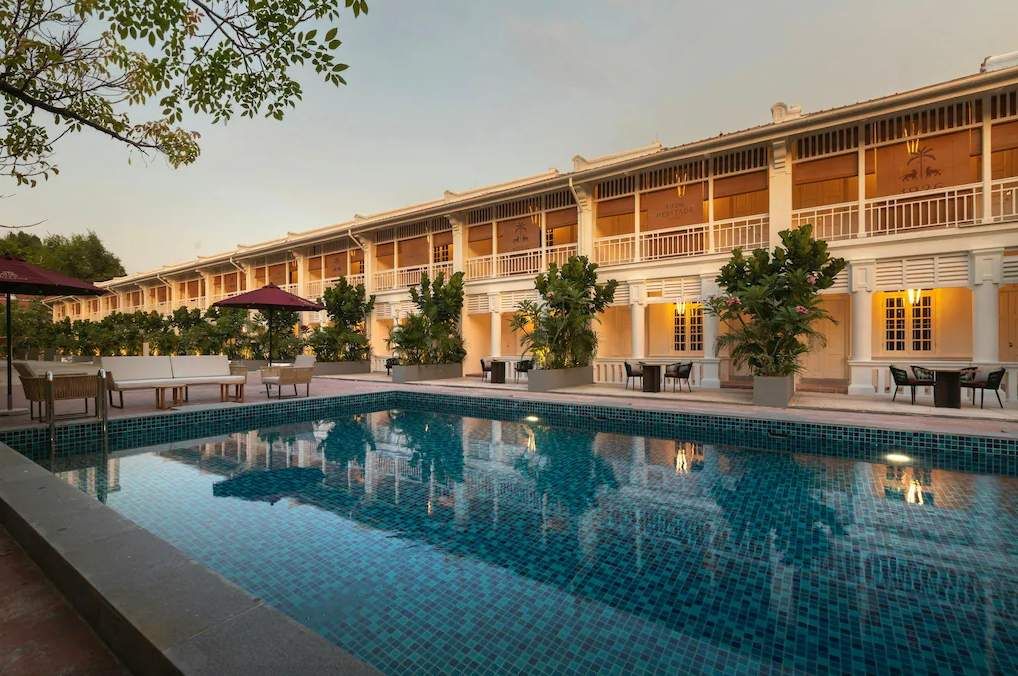
The architectural centrepiece of contemporary Jalan Burma is undoubtedly the heritage hotel situated on the street, a building that reached its centennial in 2026. Constructed in 1926 as residential quarters for British and local administrative personnel, the structure embodies the Anglo-Malay architectural vocabulary characteristic of early twentieth-century George Town. Originally comprising 24 interconnected terrace houses, the property underwent transformation in 1999 when the Penang Development Corporation converted it into a hotel, maintaining the integrity of its linked-house configuration while introducing modern hospitality infrastructure. Today the establishment operates 78 rooms and suites distributed across the original 24 structures, offering six room categories ranging from the Heritage Room—designed for solo travellers seeking intimate quarters—to the Straits Suite, the property's most expansive offering.
Yet Jalan Burma's contemporary reputation rests as much on its modest food stalls as its heritage credentials. Duck Blood Curry Mee, situated along the street's length, represents the category of unassuming neighbourhood eatery that characterizes Penang's gastronomic identity. Nearby stands Restoran Old Green House, the original home of Green House Prawn Mee & Loh Mee, a Bib Gourmand-listed establishment that exemplifies how Penang's informal food culture intersects with international recognition. The existence of a second Green House location further down Jalan Burma toward Komtar illustrates the complexity of Penang's food ecosystem: while locals maintain that both outlets operate under the same ownership and conceptually represent the same establishment, the original maintains cultural primacy in the local consciousness. This phenomenon—where an eatery's foundational location commands loyalty independent of identical offerings elsewhere—reflects how Penang residents navigate food recommendations through genealogy and authenticity rather than menu consistency.
Michelin recognition, while increasingly influential among international visitors, represents a relatively recent layer in George Town's tourism fabric. The acknowledgement of 33 stalls through Bib Gourmand status—a designation honouring simple, quality cuisine at reasonable prices—has legitimized the pursuit of hawker-centre dining and coffeeshop meals as vacation activities rather than mere sustenance. For visitors accustomed to fine-dining tourism in other destinations, exploring Michelin-selected venues in George Town offers sensory engagement fundamentally distinct from restaurant dining. The visual spectacle of cooks assembling dishes in real time, the olfactory complexity of multiple food courts' combined aromas, and the democratized seating arrangements of coffeeshop culture create an experiential texture that curated restaurant environments cannot replicate. This accessibility may explain Michelin recognition's particular resonance in Penang's context, where culinary excellence historically emerged from pragmatic necessity rather than culinary ambition.
The physical walk along Jalan Burma, while achievable within a day's itinerary, demands intentionality in planning. Spanning approximately 5km from the heritage zone's threshold to Pulau Tikus, the street offers predominantly safe passage, though sections lack formal pedestrian infrastructure. For visitors plotting circuits between Jalan Burma's attractions and the heritage zone's concentration along Lebuh Campbell, Lebuh Kimberley and Beach Street, the cumulative walking distance—potentially exceeding 4km return—requires preparation suited to Penang's tropical climate. The Komtar Octopus Pedestrian Bridge serves as a useful navigational landmark, while signage explaining Jalan Burma's nomenclatural history remains accessible for those seeking contextual understanding.
The hotel's positioning on Jalan Burma creates a notable advantage for visitors pursuing both heritage and culinary exploration. Guests benefit from proximity to acclaimed food stalls while enjoying air-conditioned reprieve and high-specification amenities—including rooms equipped with networked water filtration systems—that contrast sharply with the modest, open-air dining environments adjacent to the property. This juxtaposition reflects George Town's broader character: a destination where sophisticated restoration coexists with unchanged street-food culture, where international certification validates local enterprise without necessitating transformation. The hotel's own dining offering, such as Root House by Gen serving contemporary Chinese cuisine, provides further layering, enabling guests to calibrate their gastronomic engagement along a spectrum from hawker-stall authenticity to chef-driven reinterpretation.
Beyond Jalan Burma's immediate offerings, George Town's broader weekend cultural calendar extends the exploration template. The Hin Bus Depot, a heritage marketplace operating on weekends, aggregates local artisans, vendors and performers within a curated space that balances commercialism with cultural expression. The marketplace's offerings—ranging from homemade foodstuffs and beverages to curated handicrafts, artworks and caricature services—supplement Jalan Burma's focus on culinary pilgrimage and structural heritage with creative and craft dimensions. This ecosystem permits multi-day visitors to distribute their time across thematic explorations: hawker tours informed by Michelin guidance, architectural appreciation within designated heritage zones, weekend artisan markets, and residential district walks observing living George Town beyond tourist corridors.
The convergence of heritage hospitality, Michelin-recognized street food, and historical Burmese cultural presence makes Jalan Burma representative of contemporary George Town's identity. The street functions simultaneously as tourist destination, neighbourhood commercial artery, and custodian of colonial and pre-colonial history. For visitors accustomed to heritage tourism's typical separation from culinary exploration—where historic sites and acclaimed restaurants occupy distinct precincts—Jalan Burma offers integration that feels organic rather than manufactured. The 1926 heritage hotel, the modest food stalls bearing international recognition, and the Burmese temples and street names occupying nearby lanes represent different temporal layers of Penang's development converging within single walking distance, each maintaining distinct character while occupying shared geography.
%22%2F%3E%3C%2Fpattern%3E%3C%2Fdefs%3E%3Crect%20width%3D%22100%25%22%20height%3D%22100%25%22%20fill%3D%22url(%23ph14rfdg)%22%2F%3E%3Crect%20width%3D%22100%25%22%20height%3D%22100%25%22%20fill%3D%22url(%23ph14rfdp)%22%2F%3E%3Ctext%20x%3D%2250%25%22%20y%3D%2250%25%22%20text-anchor%3D%22middle%22%20dominant-baseline%3D%22central%22%20fill%3D%22rgba(255%2C255%2C255%2C0.95)%22%20font-family%3D%22Georgia%2C%20'Times%20New%20Roman'%2C%20serif%22%20font-weight%3D%22700%22%20font-size%3D%22272%22%20letter-spacing%3D%22-0.02em%22%3EAnwar%3C%2Ftext%3E%3C%2Fsvg%3E)