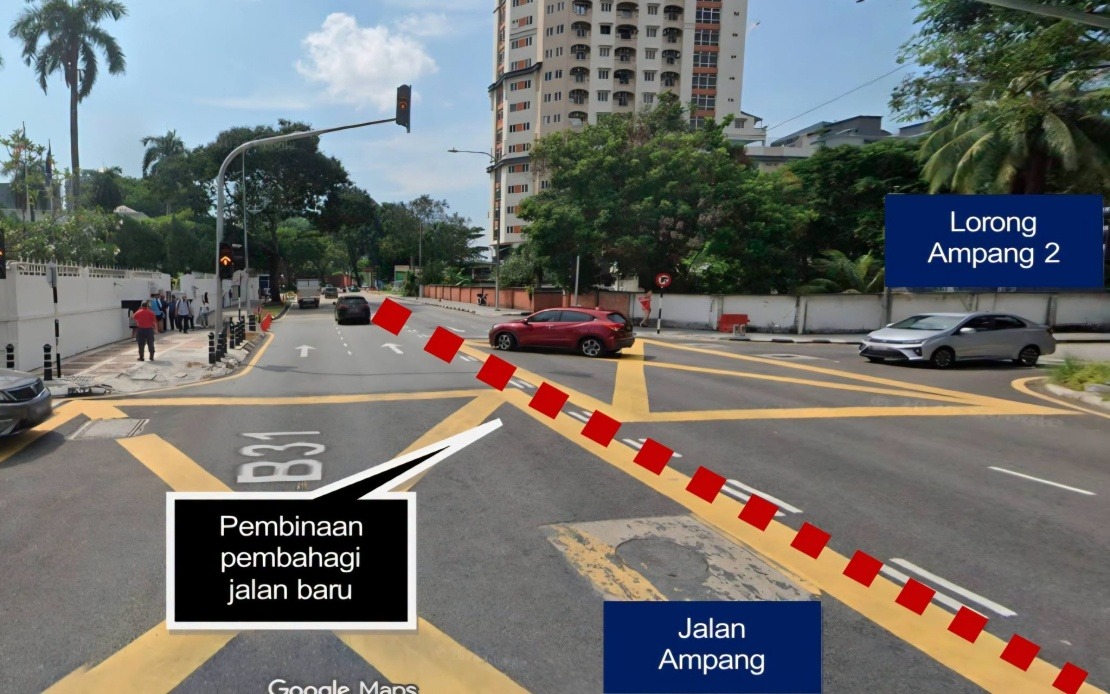
Starting today, traffic heading along Jalan Ampang will need to adjust to significant changes as Kuala Lumpur City Hall (DBKL) permanently closes two traffic light intersections on the heavily-used corridor. The affected junctions—one in front of the Royal Thai Embassy and another at Lorong Ampang 2—have been shut down to facilitate the broader Jalan Ampang upgrade initiative, a development that city authorities argue is essential for modernising one of Kuala Lumpur's vital arterial routes.
The closure marks the practical commencement of a 3.2-kilometre upgrade spanning from the Jalan Tun Razak intersection through to Middle Ring Road 2 (MRR2). This comprehensive enhancement programme reflects DBKL's commitment to reimagining traffic management along a corridor that experiences significant daily congestion. The upgrade targets three key improvement areas: heightened safety standards for all road users, increased network efficiency, and a more consistent traffic flow pattern throughout the designated stretch.
Beyond merely removing intersections, the project represents a fundamental restructuring of how traffic moves through this section of Ampang. DBKL's infrastructure improvements include systematic installation of physical road dividers, conversion of the roadway into a consistent two-way four-lane configuration, and comprehensive upgrades to pedestrian facilities. The authority is simultaneously investing in enhanced street lighting, recognising that visibility and safety extend beyond daytime hours and affect how residents and commuters perceive the area's security.
The strategic rationale behind closing these intersections centres on reducing what traffic engineers term "weaving conflicts"—the complicated manoeuvres that occur when multiple traffic streams cross or merge. By eliminating traffic light intersections that create concentrated decision points and bottlenecks, DBKL anticipates a cascading benefit: fewer delays, smoother progression of vehicles, and ultimately reduced journey times for the thousands who transit this corridor daily. This approach aligns with modern traffic engineering philosophy that favours grade separation and streamlined junction design over traditional signalised crossings.
For commuters accustomed to the current network, DBKL has implemented alternative routing systems to mitigate disruption during the transition period. Drivers previously turning right at the Royal Thai Embassy intersection can now execute a U-turn at Jalan Tun Razak and approach from the northern direction towards Ampang. Conversely, those heading towards Kuala Lumpur's city centre are redirected to perform their turnarounds at Jalan Ampang Hilir, effectively creating new traffic patterns that will require adjustment from the motoring public.
The project's timing and scope carry broader implications for Malaysia's approach to urban mobility. With Kuala Lumpur experiencing persistent congestion challenges, infrastructure projects like this represent the municipal authority's attempt to balance development with traffic management rather than simply adding road capacity. This philosophy—often termed "traffic demand management"—seeks to optimise existing infrastructure before pursuing expansion, a principle increasingly adopted across Southeast Asia's congested metropolitan areas.
For businesses operating along Jalan Ampang, particularly those near the closed intersections, the short-term impact may be challenging as customer accessibility changes and traffic patterns shift. However, DBKL's rationale suggests that improved traffic flow and enhanced pedestrian infrastructure should ultimately benefit commercial establishments by making the corridor more accessible and attractive over the medium and long term. The improved streetscape and lighting may also enhance the area's evening viability.
The closure also reflects broader municipal priorities regarding pedestrian safety. The inclusion of expanded and improved walkways demonstrates recognition that modern road infrastructure must accommodate all users, not merely vehicular traffic. For Malaysian cities wrestling with pedestrian safety concerns, this integration of enhanced walkways alongside vehicular improvements represents a balanced approach to urban corridor development.
Communication and compliance will prove critical to the project's success. DBKL's emphasis on public adherence to newly-installed traffic signage underscores the authority's understanding that even well-designed infrastructure improvements depend on driver cooperation and awareness. Commuters unfamiliar with the revised routes and signage patterns may initially experience confusion, making clear communication essential during the transition phase.
The Jalan Ampang upgrade project exemplifies how Malaysian cities are tackling traffic congestion not purely through expansion but through intelligent redesign. While the permanent closure of these intersections may initially frustrate some road users, the underlying strategy—creating more systematic, safer, and efficient traffic movement—addresses longstanding challenges on this critical corridor. As Kuala Lumpur continues evolving, such infrastructure interventions will increasingly define the quality of urban mobility for millions of daily commuters across the Klang Valley and beyond.

