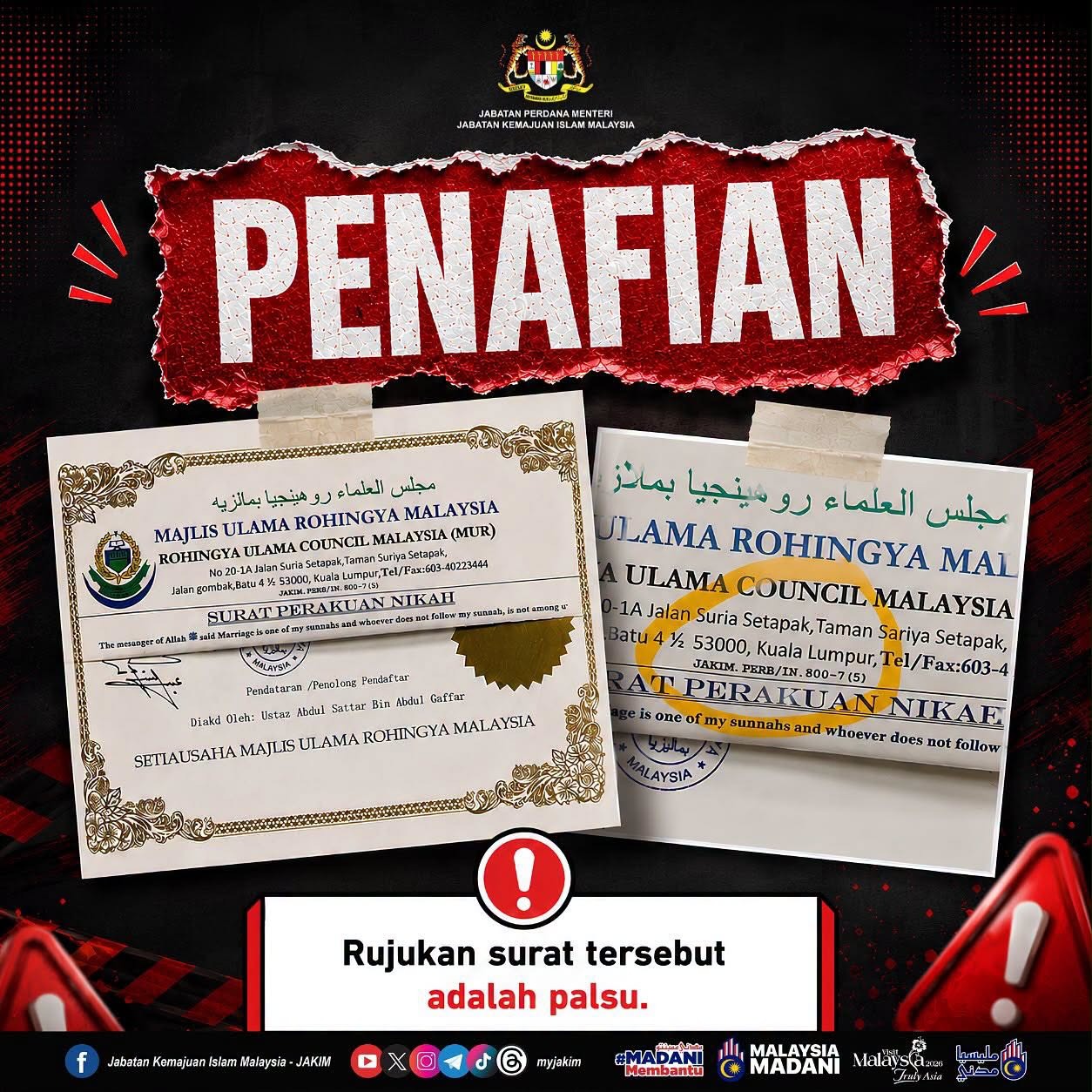
Malaysia's Islamic development authorities have moved to counter misinformation after a counterfeit document claiming to recognize an organization for marriage matters circulated widely on social media platforms. The Department of Islamic Development Malaysia (JAKIM) issued a formal statement on July 15 confirming that a marriage declaration letter attributed to the Malaysia Rohingya Ulama Council bore a false reference number and was never issued by any legitimate Islamic religious authority in the country.
The fraudulent document displayed the reference number "JAKIM.PERH/LN.800-7(5)," which initially appeared to lend official credibility to the correspondence. However, JAKIM's investigation determined that this reference code has no connection to the department's systems or records. The discovery highlights growing concerns about the proliferation of forged religious documents in Malaysia's digital ecosystem, where such materials can spread rapidly across messaging applications and social networks before verification occurs.
In its official statement published on Facebook, JAKIM clarified that neither the department nor any state Islamic religious councils have authorized any external organization to manage or certify marriage-related matters on their behalf. This represents a significant point of clarification for a nation where marriage registration and validation carry substantial legal and religious weight. The department emphasized that it operates a highly controlled system for marriage documentation, and any deviation from established protocols should immediately raise red flags for discerning citizens.
The circulation of counterfeit religious documents poses particular risks within Malaysia's multicommunal society, where interfaith marriages and immigration-related matters often require verified documentation. Unscrupulous individuals or organizations might exploit such forgeries to facilitate illegal activities, bypass proper registration procedures, or extract money from vulnerable populations seeking quick marriage legitimization. The Malaysia Rohingya Ulama Council incident suggests that marginalized communities, including refugee populations, may be especially susceptible to such schemes.
Minister in the Prime Minister's Department (Religious Affairs) Dr Zulkifli Hasan acknowledged the seriousness of the matter, announcing that full investigations would commence once comprehensive information had been gathered. His intervention signals that the government views document forgery affecting religious institutions as a priority concern requiring coordination between multiple agencies. Such collaboration becomes essential when combating sophisticated fraud schemes that exploit the authority and legitimacy associated with Islamic religious institutions.
JAKIM's public advisory urging citizens to independently verify questionable religious documents represents a measured response aimed at building public skepticism toward unverified materials. Rather than relying solely on enforcement actions, the department recognized that educating citizens about proper verification channels offers long-term protection against similar deceptions. The department specifically directed the public toward JAKIM headquarters or relevant state-level Islamic religious authorities as trusted sources for document authentication.
The incident reflects broader challenges facing regulatory authorities across Southeast Asia as digital communication platforms enable rapid dissemination of misinformation and forged documents. Malaysia's experience provides cautionary lessons for neighbouring countries managing similar issues within their Islamic religious administrative frameworks. The speed at which the false document achieved viral status demonstrates how quickly fraudulent materials can undermine public confidence in official institutions, even when those institutions move swiftly to deny involvement.
For Malaysian citizens and residents, the practical implications are straightforward: all marriage-related documentation should be obtained directly from recognized Islamic religious authorities or verified through official channels before being relied upon for legal or administrative purposes. This includes marriage declarations, certificates, and any communications purporting to recognize external organizations as authorized agents in marriage matters. The JAKIM clarification serves as an important reminder that legitimate religious institutions maintain strict control over documentary processes and do not delegate such responsibilities to external actors without explicit public announcement.
The Malaysia Rohingya Ulama Council situation also underscores vulnerabilities within communities with limited access to official information or with language barriers that might prevent clear communication of authentic procedures. As Malaysia continues hosting significant numbers of Rohingya refugees and other vulnerable migrant populations, ensuring these communities understand proper documentation channels becomes increasingly important for protecting them from exploitation. Religious organizations serving these populations bear responsibility for clearly communicating legitimate processes and warning members against fraudulent actors.
Moving forward, the incident may prompt JAKIM and state Islamic religious councils to enhance public communication strategies around proper documentation procedures. Enhanced digital presence, multilingual outreach, and clear explanations of how legitimate documents should appear could help the public more readily identify forgeries. Building institutional transparency about document issuance procedures itself becomes a form of fraud prevention, as citizens become more familiar with genuine protocols.

