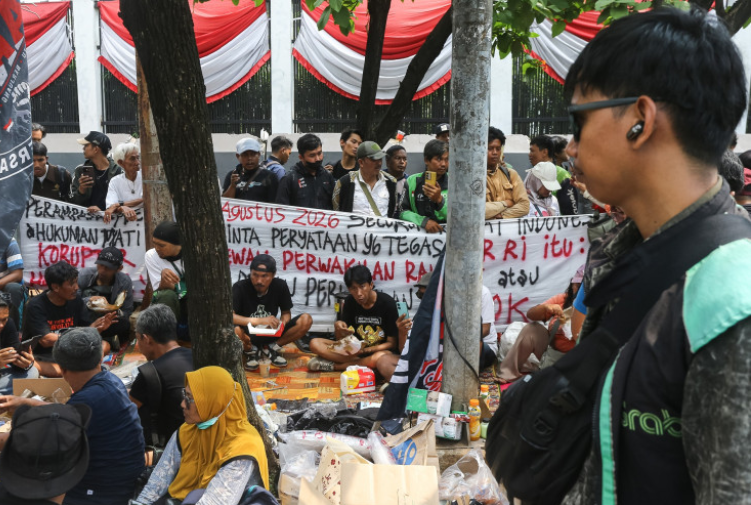
Demonstrations swept through Jakarta's Senayan Legislative Complex on Thursday morning as multiple advocacy groups converged to pressure lawmakers on anti-corruption measures and cost-of-living concerns. The United Pati People's Alliance (AMPB), representing residents from the Central Java regency, organised the largest contingent, having mobilised supporters since the previous week to travel hundreds of kilometres to the capital. Their demands reflected broader public frustration: capital punishment for officials convicted of graft, immediate legislative action on asset forfeiture, and government intervention to address spiralling prices for essential goods that have strained household budgets across the archipelago.
The journey to Jakarta itself became emblematic of the obstacles facing ordinary Indonesians seeking political change. Police halted several buses transporting AMPB supporters en route to the capital, while Bank Mandiri, a state-owned financial institution, froze the personal account of movement coordinator Supriyono without public explanation. The banking intervention triggered widespread condemnation online and prompted organised calls for public boycotts of the lender, underscoring how state apparatus actions can backfire when perceived as suppressing civic engagement. Yet such pressure proved insufficient to dampen momentum. Supriyono announced that additional transport had been secured through public donations, with five more buses expected to arrive, demonstrating the movement's grassroots financial resilience and expanding support base beyond initial organisers.
Security preparations transformed central Jakarta into a controlled demonstration zone by Thursday's dawn. Police implemented comprehensive traffic management across the Gatot Subroto corridor, blocking both directions of the major thoroughfare from Senayan Park through to the legislative building entrance. Dozens of uniformed and plainclothes officers established perimeter controls, with Metropolitan Police spokesperson Sr. Comr. Budi Hermanto estimating initial turnout at five hundred participants, though acknowledging that groups from surrounding regions might substantially enlarge the crowd. The visible security apparatus reflected official determination to maintain order while simultaneously managing the political narrative around large-scale public dissent targeting Parliament itself.
Officials struck a cautious diplomatic tone, attempting to balance security concerns with acknowledgment of legitimate grievances. Budi urged protesters to avoid property damage and respect ongoing commercial and educational activities throughout the capital, appealing to patriotic sentiment by emphasising Indonesia's need for safety and stability. This messaging strategy suggested authorities recognised the demonstrators' moral authority on anti-corruption issues while seeking to limit disruption and forestall escalation. The approach reflected evolving police doctrine in managing civil demonstrations where suppression risks generating negative media coverage and strengthening activist narratives about government unresponsiveness.
The asset forfeiture bill catalysing Thursday's mobilisation represents a long-stalled anti-corruption initiative with paradoxical implications for Indonesian governance. First introduced in 2008, the legislation would enable state seizure of assets suspected or definitively traced to criminal activity, bypassing the lengthy conviction process that typically precedes asset recovery. For proponents, this addresses a critical gap allowing high-level officials to obscure or transfer wealth before judicial proceedings conclude, effectively insulating stolen fortunes from state recovery. However, legal scholars and civil society organisations have consistently warned that such mechanisms, lacking robust procedural safeguards, could facilitate targeting of political rivals, enable extortionate behaviour by enforcement officials, and undermine due process protections fundamental to rule of law.
Parliamentary momentum on the bill recently accelerated following sustained public pressure. The House of Representatives began formal drafting processes in January and received Pati delegations on Monday, offering assurances that legislative approval would materialise by December at the latest. Gerindra Party lawmaker Habiburokhman, chairing the House Commission III responsible for legal affairs, publicly stated that approximately eight weeks of deliberation remained before finalisation. This timeline suggests parliamentary leadership recognises political capital benefits from demonstrating decisive anti-corruption action ahead of the year's conclusion, particularly given Prabowo Subianto's administration has publicly committed to supporting rapid passage.
President Prabowo's government positioning itself as champion of swift anti-corruption legislation carries significant implications for presidential agenda-setting and political coalition management. Government Communications Agency head Muhammad Qodari's statement that the administration supports expedited passage whilst noting responsibility now rests with the legislature represents a carefully calibrated appeal to civil society whilst subtly pressuring House members to demonstrate commitment. This rhetoric allows the executive branch to claim anti-corruption credentials whilst deferring responsibility for any delays to Parliament, a familiar dynamic in Indonesian governance where institutional finger-pointing deflects public scrutiny.
The Pati movement's emergence as a driving force for asset forfeiture legislation reflects changing dynamics of Indonesian civic activism. Unlike earlier anti-corruption movements concentrated in Jakarta, this provincial mobilisation demonstrates how grassroots organisations outside the capital can generate sufficient political pressure to accelerate legislative processes. The AMPB's success in organising mass transport despite administrative obstacles and securing public donations suggests emerging capacity within regional civil society to project political influence nationally. For Malaysian and Southeast Asian observers, the Pati movement exemplifies how sustained local organising can challenge national governance priorities, particularly on issues like corruption where popular legitimacy transcends regional boundaries.
The concurrent demands for cost-of-living relief reflected in Thursday's demonstrations underscore interconnections between anti-corruption agendas and economic grievances in contemporary Indonesia. Protesters linked official malfeasance to diminished public resources for essential services and subsidies, framing corruption as both moral failure and economic drain that directly impoverishes ordinary families. This fusion of anti-graft and pro-welfare messaging resonates powerfully across lower-income constituencies where inflation-driven price increases have compressed purchasing power. The convergence suggests that future Indonesian political mobilisations will increasingly integrate anti-corruption demands with socioeconomic concerns, creating complex coalitions that parties and government must simultaneously address.
Looking ahead, asset forfeiture legislation's passage would represent Indonesia's most significant procedural shift in anti-corruption governance since the establishment of specialised corruption courts two decades ago. Implementation challenges will prove formidable, requiring training of enforcement agencies, development of verification protocols, and establishment of judicial review mechanisms preventing abuse. Regional neighbours like Malaysia and Singapore, which have experimented with civil asset forfeiture mechanisms, offer cautionary examples of how even well-intentioned legislation can become weaponised in partisan political contexts. Indonesia's demonstrated capacity to learn from regional experiences whilst adapting frameworks to local institutional realities will substantially determine whether December legislation becomes transformative governance reform or another anti-corruption initiative yielding disappointing results.

