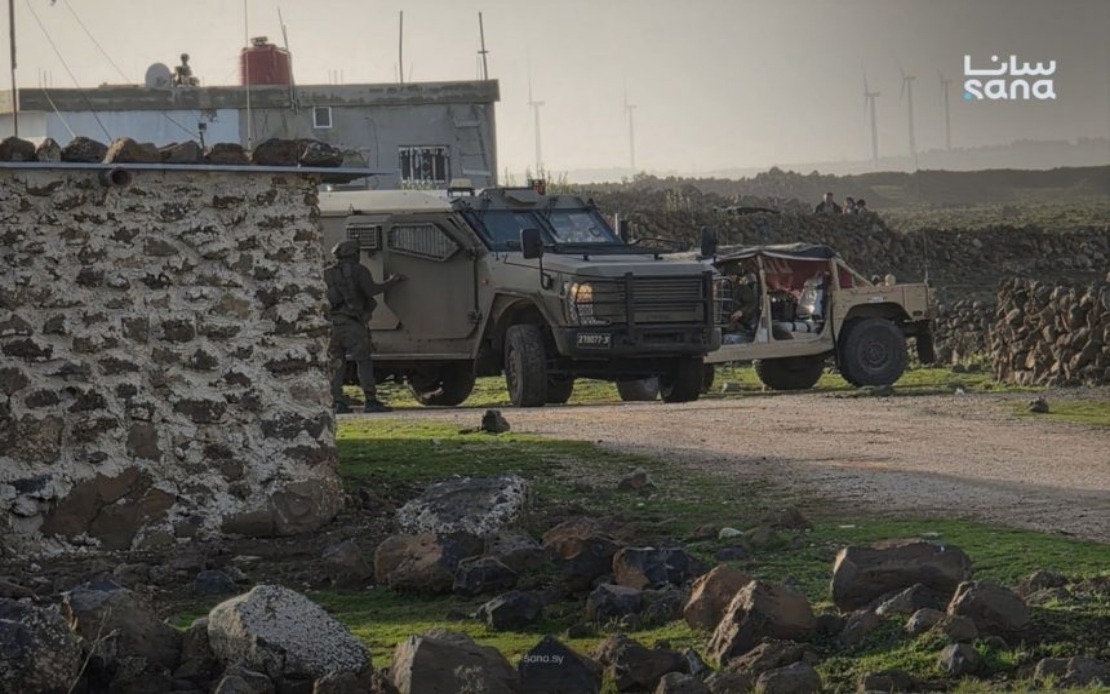
Israeli military forces comprising six vehicles crossed into Syria's southwestern Quneitra province on Saturday, according to reporting by the Syrian Arab News Agency (SANA). The incursion saw the vehicles advance toward the Kudna Dam in the central Quneitra countryside, accompanied by aerial surveillance operations, marking another breach of Syrian territorial boundaries in a region increasingly destabilized by external military activity.
The crossing represents a continuation of military pressure on Syria's southwestern border regions, which have become a focal point of Israeli operations over recent months. These activities have expanded significantly since the dramatic collapse of Bashar al-Assad's regime in December 2024, fundamentally altering the security dynamics in a region that had previously been characterized by a fragile, albeit maintained, ceasefire arrangement. The fall of Assad's government created a power vacuum that external actors, particularly Israel, have sought to exploit and control.
Israel's justification for increased military activity in southern Syria stems from its December 2024 decision to abandon the 1974 disengagement agreement, a Cold War-era accord that had established a demilitarized buffer zone between Israeli and Syrian forces on the Golan Heights. By formally renouncing this agreement, Israel effectively declared its intent to exert direct military control over the region, a shift that has fundamentally recalibrated the strategic balance in the area and created new vulnerabilities for Syrian territorial integrity.
The pattern of Israeli incursions has intensified dramatically since Assad's departure, transforming southern Syria into a zone of repeated military operations. Beyond the vehicle crossings and aerial surveillance documented in recent weeks, Israeli forces have conducted raids targeting Syrian military assets, executed arrest operations against individuals deemed threatening, established military checkpoints to control movement and commerce, and seized strategic infrastructure. These actions collectively represent a comprehensive military occupation of Syrian border regions, undertaken without any governing authority in Damascus capable of mounting effective resistance.
For Malaysian and Southeast Asian observers, this escalating militarization of Syria's southwestern territories carries significant implications for regional stability and international law. The repeated violations of Syrian sovereignty, occurring in the absence of a functioning central government, demonstrate how state collapse can create opportunities for military powers to reshape territorial arrangements and expand spheres of influence. This pattern parallels concerns in Southeast Asia regarding maritime disputes and the importance of maintaining respect for internationally recognized borders and agreements.
The involvement of unmanned aerial systems alongside ground vehicles reflects modern military tactics that combine surveillance capabilities with rapid ground response. The drones flying over the Quneitra region provide Israeli forces with real-time intelligence while simultaneously signaling Israeli air dominance in the region. This technological asymmetry means that whatever Syrian military remnants or opposition forces remain lack the capacity to challenge Israeli operations, rendering the incursions effectively uncontested.
The strategic significance of the Kudna Dam and surrounding central Quneitra countryside extends beyond immediate military considerations. Control of water infrastructure in the region carries both practical and symbolic importance, allowing external actors to influence local populations dependent on these resources while consolidating territorial control. The positioning of Israeli vehicles toward this infrastructure suggests intent to secure critical assets that could provide leverage in future negotiations or arrangements regarding Syria's administrative future.
Syria's southwestern provinces, particularly Quneitra and adjacent areas, have experienced chronic instability for over a decade. The Syrian civil war that erupted in 2011 created conditions for external intervention, and Israel's operations have intensified as various armed factions and international powers maneuvered for advantage. Assad's government, despite receiving Russian and Iranian military support, could not prevent Israeli strikes on occasions it deemed threatening to Israeli security. The regime's collapse has eliminated even this minimal deterrent capacity.
The absence of a unified Syrian government capable of resisting or negotiating these incursions leaves the population of Quneitra in a precarious position. Civilians in affected areas face uncertainty regarding security, resource access, and governance structures. International humanitarian organizations have expressed concern about the implications of expanded Israeli military operations for civilian welfare, though the scope and nature of humanitarian impacts remain incompletely documented due to restricted access to the region.
The international community's response to Israel's actions has been muted, particularly given the ambiguous status of Syria's transitional government and the complexities of recognizing successor authorities. Regional powers, including Turkey, Iran, and Russia, maintain competing interests in Syria, and none has effectively challenged Israeli military operations. This geopolitical fragmentation permits Israel considerable latitude in pursuing its military objectives without significant diplomatic or military consequences.
For Malaysia and other Southeast Asian nations, the Syria situation underscores the vulnerabilities created when central state authority collapses and the risks that emerge when military powers operate without multilateral oversight or constraint. The case demonstrates why regional organizations, international law frameworks, and respect for territorial sovereignty remain essential safeguards against unilateral military expansion, lessons particularly relevant for Southeast Asia given ongoing maritime disputes and geopolitical competitions.
The trajectory of Israeli operations in southern Syria suggests that further incursions are likely absent significant changes in the regional balance of power or international pressure. The establishment of military checkpoints and the ongoing nature of reported operations indicate Israel is moving beyond temporary incursions toward more permanent presence arrangements. These developments will shape Syria's immediate future and may influence how other regional actors assess opportunities and risks in their own strategic environments.

