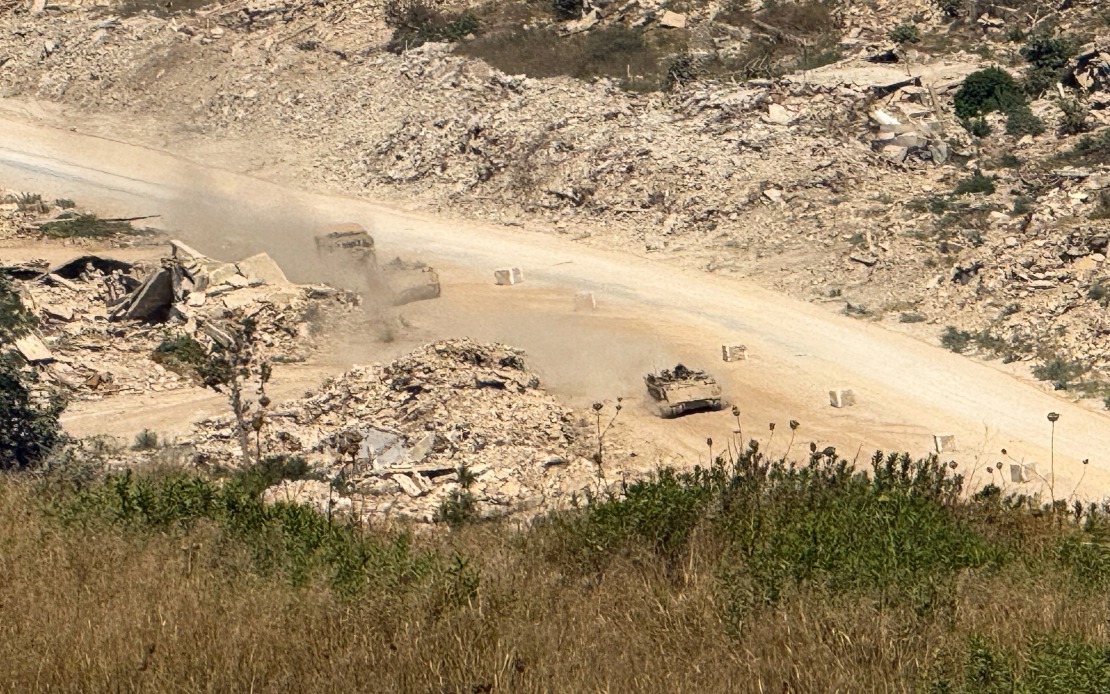
Israeli forces launched a fresh round of military operations across southern Lebanon on Monday, striking multiple locations with artillery fire, explosions, and ground incursions while burning civilian homes, Lebanese state media reported. The attacks represent the latest in a pattern of contested military actions that persist even as diplomatic representatives from Israel and Lebanon engage in negotiations aimed at ending a conflict that has reshaped the region's security landscape and displaced over one million people.
The Israeli military targeted at least seven separate locations across the southern Lebanese region, according to Lebanon's National News Agency. In Nabatieh governorate, machine gun fire struck Wadi al-Salouqi while Mansouri town sustained overnight shelling followed by two explosive detonations. Israeli forces also detonated ordnance in the Kfar Tebnit area, with artillery fire subsequently sweeping the outskirts of Nabatieh al-Fawqa. Meanwhile, settlements in Khiam came under assault as troops burned multiple residential structures, and Israeli units advanced into the western approaches of Mays al-Jabal under covering fire. The Lebanese agency additionally reported low-altitude drone sorties over the Zahrani zone, further demonstrating the breadth of Monday's operations.
The timing of these military actions compounds the complexity of ceasefire negotiations that concluded just days earlier. Lebanese and Israeli representatives participated in their seventh round of formal talks in Rome on Thursday, sponsored by the United States and centred on implementation mechanisms for a framework agreement initially signed on June 26. Lebanese President Joseph Aoun remarked following those discussions that his nation had achieved meaningful advancement on questions of territorial borders and the disposition of detainees, signalling at least rhetorical progress toward eventual resolution. Yet the apparent disconnect between diplomatic overtures and battlefield reality—with military operations continuing even as negotiators discuss withdrawal timelines and security arrangements—underscores the fragility of current arrangements and the deep mistrust between the parties.
The framework agreement itself envisages a structured Israeli withdrawal from occupied Lebanese territory through a phased approach beginning with designated "pilot zones." In exchange, Lebanon would deploy its own military forces into formerly contested areas and undertake disarmament of armed groups, primarily Hezbollah. This arrangement, negotiated with American mediation, theoretically offers both sides a path toward reduced confrontation: Israel achieves security assurances and removal of a hostile militia infrastructure along its northern border, while Lebanon reasserts state control over its own territory and ends foreign military occupation. The logic is reasonable on paper, yet the continuous Israeli military operations—whether characterised as responses to ceasefire violations, security precautions, or outright violations themselves—create operational facts on the ground that complicate diplomatic progress.
For Malaysia and other Southeast Asian observers, the Lebanon situation illustrates the enduring challenge of converting military standoffs into durable peace frameworks. The region's experience with prolonged conflicts and multiple ceasefire agreements, including mechanisms in the southern Philippines and Myanmar, demonstrates that military deescalation without addressing underlying security asymmetries or grievances often proves temporary. The Lebanese case additionally demonstrates how regional powers maintain leverage through military presence even during negotiations, a dynamic relevant to understanding security competitions in Southeast Asia where maritime boundaries, trade routes, and military capabilities create similar tensions between dialogue and demonstration.
The broader context reveals an asymmetry in military capability and occupation that colours these talks. Israeli forces have occupied portions of southern Lebanon for decades, with additional territorial control established during the recent 2023-2024 campaign and subsequent operations. Current incursions have penetrated more than 10 kilometres into Lebanese territory, creating a security buffer that Israel shows little inclination to relinquish voluntarily. This reality gives Israeli negotiators structural advantages, as they can sustain military pressure while discussing terms, whereas Lebanese representatives negotiate under conditions of active occupation and displacement affecting their population.
The human cost of the conflict continues accumulating despite diplomatic efforts. Lebanese authorities document 4,335 deaths and 12,277 wounded since March 2 when the current campaign commenced, with the displacement figure exceeding one million persons—representing a catastrophic humanitarian outcome for a nation already struggling with economic collapse, governmental dysfunction, and recovery from the 2020 Beirut port explosion. These figures contextualise the urgency Lebanese negotiators feel in pursuing agreement, yet they simultaneously highlight why ceasefire terms must address not merely military withdrawal but reconstruction, humanitarian access, and accountability for destruction.
Israel's broader territorial footprint extends beyond Lebanon, encompassing Palestinian territories and Syrian areas of the Golan Heights, neither of which Israel has indicated willingness to vacate. Israeli authorities have consistently rejected international calls for Palestinian statehood articulated through United Nations resolutions, instead maintaining military control and settlement expansion in the West Bank whilst governing Gaza through a de facto blockade. This wider pattern of territorial retention shapes how observers interpret Israeli intentions regarding Lebanon—whether current negotiations represent genuine commitment to withdrawal or are designed to secure tactical advantages pending future military action.
The ceasefire framework, despite its recent discussions and stated progress on border and detainee issues, confronts a credibility problem exacerbated by continued military operations. Each Israeli strike, even if claimed as defensive or responsive to ceasefire breaches, risks triggering Lebanese counter-escalation or triggering Hezbollah resumption of cross-border attacks from which it has largely refrained during negotiations. The delicate balance depends upon both parties honouring implicit understandings about acceptable conduct, yet Monday's operations suggest Israeli commanders may assess that military pressure supports rather than undermines their negotiating position—a calculation that could prove strategically dangerous if Lebanese patience erodes.
Moving forward, the success or failure of the Rome framework hinges on three interconnected questions: whether Israel will genuinely withdraw from Lebanese territory on agreed timelines, whether Lebanon can effectively disarm Hezbollah and prevent its remilitarisation, and whether both nations' political leaderships command sufficient domestic support to maintain agreements amid nationalist pressures and security anxieties. For Malaysia and Southeast Asia, the Lebanon negotiations provide a cautionary case study in conflict resolution, demonstrating that diplomatic frameworks require not merely signed agreements but also political will, international enforcement mechanisms, and addressing the security dilemmas that motivate continued military operations. Without genuine commitment to implementation from both sides, further escalation appears more probable than durable peace.

