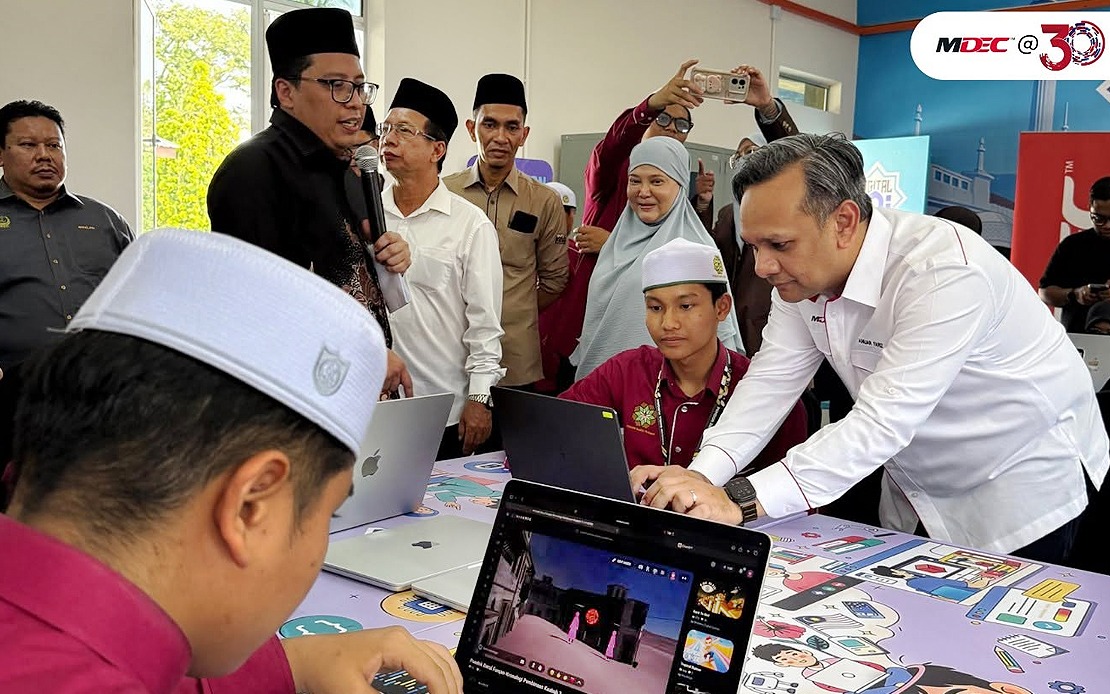
The Malaysia Digital Economy Corporation (MDEC) has formally handed over a Digital Maker Hub to Pondok Darul Furqan in Tambun, Ipoh, marking a significant expansion of technology access within Malaysia's Islamic education sector. The facility represents a strategic effort to bridge the digital divide in religious boarding schools, ensuring that students and educators in these institutions develop competencies essential for participating in the modern knowledge economy. The timing of this initiative reflects growing recognition that technological literacy cannot remain confined to conventional schools if the nation is to realise its broader economic objectives.
The newly established hub functions as an interactive learning environment stocked with contemporary equipment including laptops, high-speed internet connectivity, smartboards, robotics kits, and microcontroller assemblies. According to MDEC chief executive officer Anuar Fariz Fadzil, these resources are designed to facilitate hands-on engagement with emerging technologies rather than passive consumption of information. The infrastructure enables students to move beyond theoretical understanding into practical experimentation and prototype development, a pedagogical shift increasingly recognised as crucial for cultivating innovation mindsets among young people.
This initiative emerges under the Islamic Education Institution Digital Transformation Programme, commonly referred to as Digital IPI, a collaborative effort between MDEC and the Department of Islamic Development Malaysia (JAKIM). The partnership structure itself signals important institutional coordination, uniting Malaysia's digital economy policymakers with religious education authorities. Such collaboration acknowledges that Islamic institutions occupy a distinct space within Malaysia's educational ecosystem and require tailored approaches rather than generic digital transformation strategies applied uniformly across all school types.
Government messaging emphasises Malaysia's aspiration to establish itself as an Artificial Intelligence Nation by 2030, a target that underpins the rationale for the Digital IPI programme. Anuar Fariz Fadzil articulated this connection explicitly, contending that comprehensive digital talent development across all societal segments, including religious institutions, remains indispensable for achieving this vision. The framing suggests that technological capacity-building transcends sectoral boundaries and cannot be pursued selectively among particular school categories if national competitiveness goals are to be met.
Integration of digital skills with Islamic values represents a distinctive feature of this approach. Rather than treating technology and religious education as separate domains, the programme endeavours to demonstrate how digital tools and methodologies can reinforce principles such as trustworthiness and integrity. This conceptual framework carries particular significance for Malaysian Islamic institutions, where curriculum design has traditionally emphasised moral development alongside intellectual growth. The Digital IPI model attempts to extend this integrated approach into the technology sphere.
During the programme's launch phase at Pondok Darul Furqan, thirty students and five educators participated in the MetaSkool Metaverse Programme, an intensive two-day workshop introducing immersive virtual environments through experiential learning. Rather than classroom lectures about metaverse technology, participants engaged in interactive activities designed to stimulate creative thinking and exploration of innovative applications. This pedagogical method reflects contemporary understanding that technology adoption proceeds more effectively when learners develop direct familiarity with tools rather than encountering them as abstract concepts.
The pilot phase will extend beyond Ipoh, with five additional Islamic education institutions in Kedah, Kelantan, Negeri Sembilan, Pahang, and Penang scheduled to receive Digital Maker Hubs. This geographic distribution spans diverse regions representing Malaysia's multicultural federation, suggesting intention to establish digital access across varied demographic and socioeconomic contexts. The selection of these particular states indicates efforts to ensure representation across peninsular Malaysia's different development corridors.
Prime Minister Datuk Seri Anwar Ibrahim launched the Digital IPI programme in March, providing high-level political endorsement for the initiative. Expectations have been calibrated around substantial scale: the programme is projected to benefit over 3,000 students and 50 teachers through structured training modules. The curriculum covers digital literacy, artificial intelligence fundamentals, digital creativity applications, immersive learning platforms, metaverse technology, and digital content development. This breadth suggests recognition that digital competency encompasses multiple dimensions rather than reducing to basic computer operation skills.
For Malaysian regional context, this development carries implications extending beyond individual institutions. Islamic boarding schools enrol thousands of students who subsequently enter the workforce, and their digital preparation directly influences Malaysia's human capital composition. Enhanced technological literacy among graduates from these institutions expands the available talent pool for digital economy sectors, addressing longstanding concerns about skills shortages in emerging technology fields. The initiative therefore represents investment in human capital accessibility rather than mere institutional modernisation.
The partnership between MDEC and JAKIM also demonstrates institutional innovation in policy implementation. Rather than treating religious and secular education spheres as entirely distinct domains requiring separate governance approaches, the collaboration creates mechanisms for technology diffusion across institutional boundaries. This model potentially offers lessons for other Southeast Asian nations grappling with similar questions about integrating technological advancement into religiously-oriented educational systems.
Challenges remain regarding sustained implementation and meaningful pedagogical integration. Providing equipment represents necessary but insufficient condition for genuine digital transformation. Teacher professional development, curriculum revision, and institutional cultures supportive of experimentation require sustained attention and resources. The five-state pilot phase will generate evidence regarding actual uptake and educational outcomes, informing whether the model merits broader scaling.
Moving forward, monitoring whether these hubs catalyse genuine innovation capacity or function primarily as technology showcases will prove essential. Success criteria should extend beyond equipment installation metrics to encompass measures of student engagement, learning outcomes, and ultimately employment readiness in digital sectors. For Malaysia and Southeast Asia's broader digital economy aspirations, the experiences of Pondok Darul Furqan and its peer institutions will provide valuable insights into how technological capacity-building can authentically occur within culturally and religiously-grounded educational environments.

