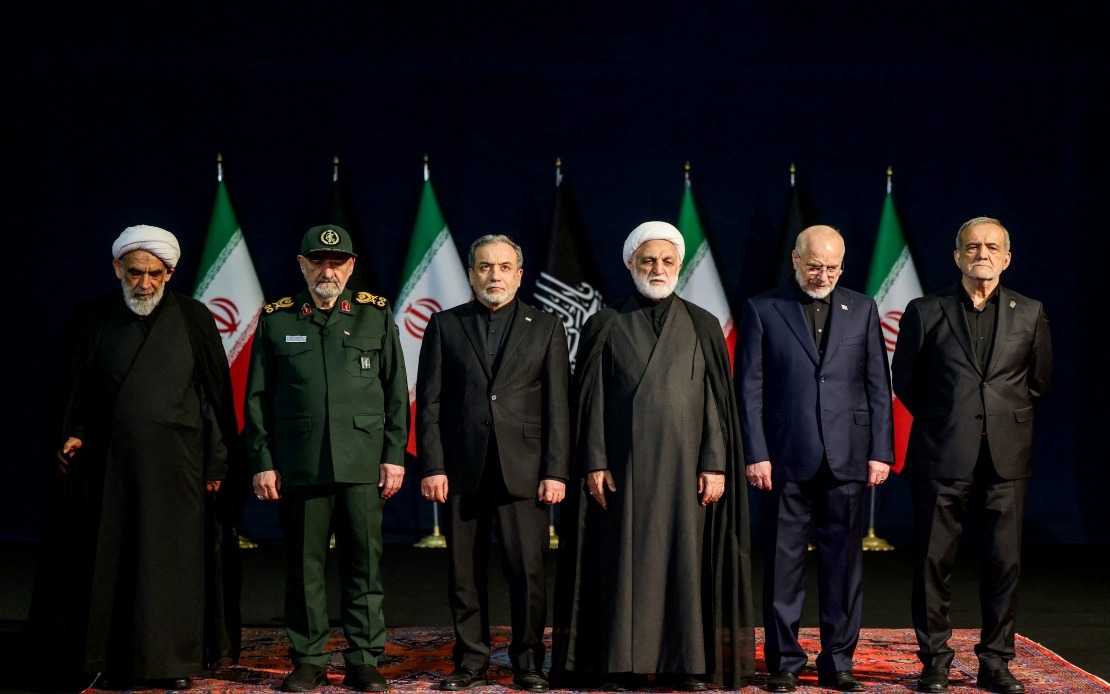
Iran's leadership and an unusual gathering of international dignitaries converged on Tehran on Friday to pay formal respects to the nation's late Supreme Leader Ayatollah Ali Khamenei. The tribute ceremony, held at Imam Khomeini's Mosalla prayer hall in central Tehran, represented one of the most significant state occasions in recent Iranian history and underscored the geopolitical importance of Khamenei's passing. The ceremony commenced in the morning and continued throughout the day, drawing a cross-section of Iran's political establishment alongside an array of foreign delegations that reflected Tehran's diplomatic standing across Asia and the Middle East.
The Iranian side fielded its most senior officials in attendance. President Masoud Pezeshkian, who took office following Khamenei's death, participated alongside Parliament Speaker Mohammad Baqer Qalibaf and Judiciary Chief Gholamhossein Mohseni-Ejei. The presence of Sadeq Amoli Larijani, who chairs the Expediency Discernment Council—a powerful body that mediates disputes between Iran's legislative and executive branches—underscored the ceremonial weight the Islamic Republic placed on the occasion. The attendance of these figures illustrated how Khamenei's death had triggered a period of institutional realignment across Iran's complex power structure, even as the nation formally mourned its supreme leader.
The international representation at the ceremony demonstrated Tehran's sustained diplomatic influence despite decades of Western sanctions and isolation. Pakistan dispatched both its Prime Minister Shehbaz Sharif and Chief of Army Staff Field Marshal Syed Asim Munir, signalling the strategic importance Islamabad places on ties with Iran amid broader South Asian security calculations. The presence of Armenian Prime Minister Nikol Pashinyan and Georgian President Mikheil Kavelashvili reflected Iran's role as a stabilizing regional actor in the Caucasus. Iraqi officials attended in significant numbers, including President Nizar Amedi and Nechirvan Barzani, head of Iraq's Kurdistan Region, highlighting Iran's deep involvement in Iraqi affairs and the Shia-led networks that link the two countries.
Central Asian representation came through Tajik President Emomali Rahmon, underscoring Iran's continued engagement with former Soviet republics along its northern frontier. Delegations from China and Russia attended at senior levels, reflecting the three nations' shared interests in counterbalancing Western influence and their deepening strategic partnerships. The breadth of this foreign attendance suggested that despite the shock of Khamenei's assassination, the international system had already begun adapting to the transition in Iranian leadership.
Beyond politicians and dignitaries, the ceremony drew religious scholars, tribal leaders, and influential clerical figures from across Iran. This diverse assembly reflected the multifaceted nature of Khamenei's role in Iranian life—not merely as a political leader but as a source of religious authority and cultural significance within the Islamic Republic's framework. The participation of such varied constituencies indicated an effort by Iranian authorities to project unity and legitimacy during what could have been a destabilizing moment.
Iranian officials have structured an extended mourning period that extends through July 9, with major processions planned for Tehran, Qom, and Mashhad—cities with profound religious significance in Shia Islam. These processions, which traditionally draw millions of Iranians, serve both as expressions of public grief and as demonstrations of regime stability and popular support. Additional funeral rites are scheduled to take place in Iraq, reflecting the transnational dimensions of Khamenei's influence and the interconnected nature of Shia religious and political networks across the region.
Government authorities implemented unprecedented security and logistical measures to manage the funeral proceedings. Closures and airspace restrictions have been announced for Tehran and Mashhad on key dates, with Thursday designated as a national day of mourning. These steps, while ostensibly necessary for managing crowds and security threats, also served to concentrate state control over the narrative surrounding Khamenei's death and the transition of power.
Khamenei's death resulted from a US and Israeli strike on Tehran on February 28, an operation that dramatically escalated regional tensions and forced Iran's leadership to navigate both domestic succession and international repercussions. The assassination of such a prominent figure normally capable of commanding a military response presented Iranian decision-makers with a complex calculus between projecting strength and managing the risks of wider escalation. The disciplined and organized nature of the funeral proceedings suggested that Iran's new leadership—with Mojtaba Khamenei, the late supreme leader's son, selected as his successor in March—sought to demonstrate institutional continuity and control.
For Malaysian and Southeast Asian observers, the funeral ceremony offers insights into how major regional powers manage succession crises and diplomatic transitions. The international attendance pattern highlights the centrality of Iran to broader Asian geopolitical configurations, even as nations maintain careful distance from openly supporting Tehran's positions. The ceremony's careful orchestration reflects the Islamic Republic's long experience in managing legitimacy across religious and political dimensions—a challenge that transcends Iran's borders and carries implications for how other states in the region approach governance and succession.

