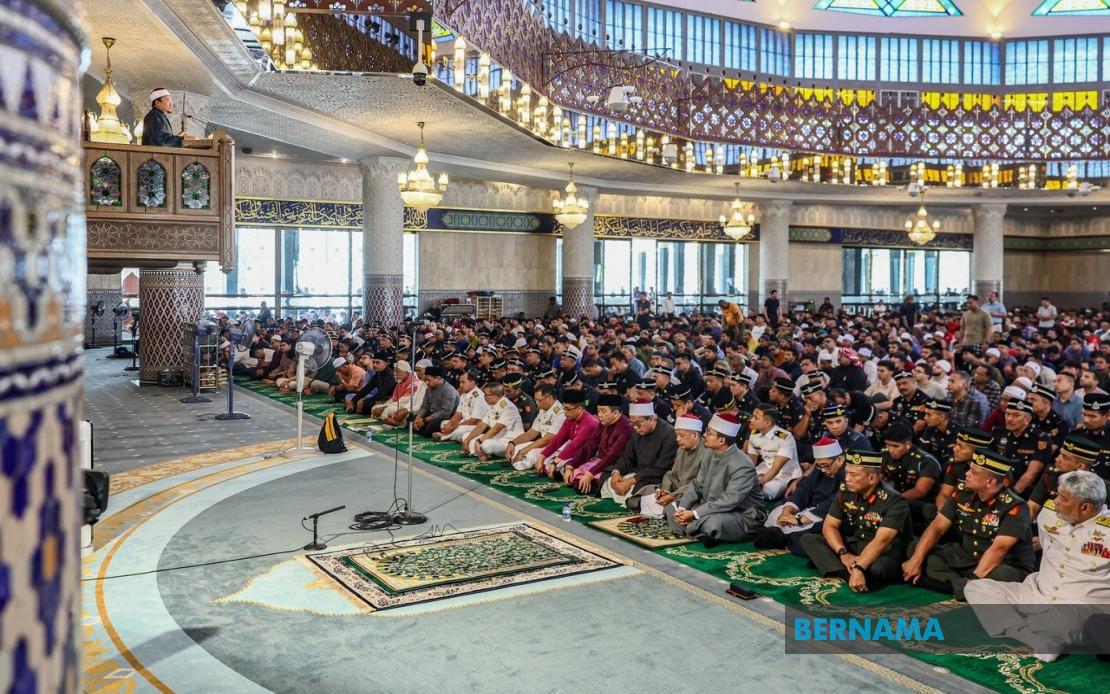
National resilience rests fundamentally on the moral character of both ordinary citizens and those in positions of authority, according to Datuk Dr Amru Alhaz Adnan, Grand Imam of Masjid Negara, who delivered this message during Friday prayers on July 31 in conjunction with Warriors' Day observances. Addressing a congregation that included Malaysia's top military leadership, he argued that contemporary debates about defence often overlook a crucial dimension: the ethical foundation upon which true security is built.
The traditional understanding of national defence centres on hardware, military capabilities, and strategic positioning at borders and coastlines. Yet Dr Amru Alhaz presented a contrasting perspective, contending that institutional strength emerges through daily choices made by millions of people across society. When individuals fulfil their obligations responsibly, when leaders demonstrate trustworthiness in governance, and when civil servants uphold their duties with integrity, the nation fortifies itself against far more insidious threats than external military aggression.
This framing carries particular resonance in Malaysia's contemporary context, where public discourse increasingly grapples with questions of institutional credibility and governance standards. Corruption, mismanagement, and breaches of public trust erode the social cohesion that underpins effective statehood. The Grand Imam's message suggested that Warriors' Day commemorations should prompt broader national introspection beyond military parades and ceremonial remembrance, extending to how ordinary Malaysians conduct themselves in commerce, family life, and professional duties.
The sermon outlined concentric circles of responsibility, each contributing to national wellbeing. Traders who conduct honest business dealings protect consumers and maintain market confidence. Parents who guide their children towards ethical behaviour invest in the nation's moral future. Muslim citizens who honour their personal trusts before Allah demonstrate alignment between individual conscience and collective good. Civil servants who resist corruption preserve the functionality of state institutions. This comprehensive vision treats national defence as a shared responsibility extending far beyond the ranks of the military.
The presence of senior Malaysian Armed Forces (MAF) leadership—including Chief of Defence Forces Gen Tan Sri Malek Razak Sulaiman, Chief of Army Gen Tan Sri Azhan Md Othman, Chief of Navy Adm Tan Sri Dr Zulhelmy Ithnain, and Chief of Air Force Gen Tan Sri Muhamad Norazlan Aris—underscored official recognition of this philosophical framework. Their attendance signalled that military leadership endorses a conception of defence extending beyond conventional security metrics to encompass the ethical infrastructure supporting state legitimacy.
Warriors' Day, observed annually on July 31, commemorates the sacrifices of Malaysia's security forces who have served the nation across decades. The commemoration typically emphasizes gratitude for their service and recognition of those who have fallen in duty. However, Dr Amru Alhaz reframed the occasion as an opportunity for citizens to examine their own roles in preserving national stability and prosperity, inviting reflection on how individual conduct contributes to or detracts from collective strength.
The Grand Imam explicitly called upon Malaysian Muslims to honour national heroes through concrete behavioural commitments: maintaining personal integrity, observing discipline, resisting corruption, and actively preserving social unity. This framing transforms Warriors' Day from a ceremonial recognition of past sacrifice into an imperative for present action, suggesting that honouring those who have served requires present-day citizens to embody the values those service members defended.
The emphasis on rejecting corruption carries particular significance given Malaysia's ongoing efforts to strengthen governance standards and rebuild institutional trust following high-profile scandals in recent years. The sermon's call for civil servants to uphold integrity represents explicit advocacy for improved public administration standards. Similarly, the exhortation for traders to avoid deception addresses persistent concerns about commercial malpractice and consumer protection that affect ordinary Malaysians' daily experience of the economy.
The theological dimension of the sermon—grounding ethical obligations in Islamic principles, particularly the concept of trusteeship before Allah—provides moral and spiritual anchoring for these secular governance concerns. By connecting individual integrity to religious duty, the Grand Imam appeals to the conscience of Muslim citizens, suggesting that ethical conduct transcends political or pragmatic calculation to become a spiritual obligation.
This message resonates across Southeast Asia's broader context of democratic governance and institutional reform. Nations throughout the region grapple with balancing rapid economic development, security challenges, and expectations for transparent, accountable governance. Malaysia's strategic position—as a major regional economy with significant military capabilities and multi-religious diversity—makes the integration of ethical governance with security concerns particularly consequential. The Grand Imam's sermon suggests that sustained national strength depends less on military expenditure or technological advancement than on the cumulative moral choices made throughout society.
For Malaysian policymakers and citizens alike, the Warriors' Day sermon offers a conceptual framework positioning integrity not as an idealistic luxury but as foundational infrastructure for genuine security and prosperity. As Malaysia navigates complex regional security challenges and seeks to strengthen its competitive position globally, this emphasis on the ethical dimension of national resilience merits serious consideration. The strength of a nation ultimately reflects not the sophistication of its weapons systems but the character of its people.

