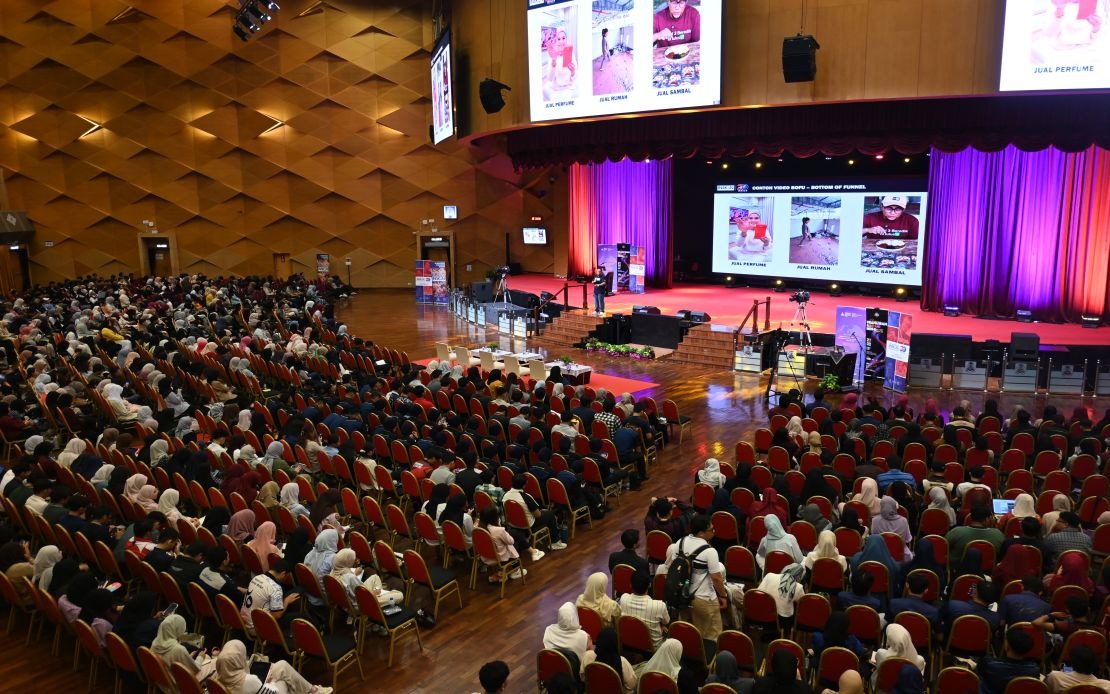
Malaysia's entrepreneurship movement gained significant momentum on June 23 when the Usahawan MADANI Mega 2026 seminar convened nearly 7,000 students both in-person and online at UiTM Shah Alam, securing formal recognition from the Malaysia Book of Records as the nation's largest student-attended entrepreneurship seminar. The landmark gathering reflected mounting enthusiasm among university students for business creation as a career trajectory, even as Malaysia navigates an increasingly complex economic environment requiring fresh innovation and job generation.
Organised by the National Entrepreneurship Institute (INSKEN) in partnership with the Malaysian Academy of SME and Entrepreneurship Development (MASMED) and Universiti Teknologi MARA (UiTM), the event brought together students from institutions across the country to engage in structured knowledge-sharing, capability development, and professional networking tailored to emerging entrepreneurs. The scale of participation underscored a shift in how Malaysia's higher education sector is cultivating entrepreneurial thinking among its graduates, recognising that traditional employment pathways alone cannot absorb the nation's talent pool or drive adequate economic diversification.
The presence of Datuk Mohamad Alamin, deputy minister for Entrepreneur and Cooperatives Development, highlighted government commitment to fostering business creation. He remarked that the strong turnout demonstrates entrepreneurship has transitioned from a niche pursuit to a mainstream aspiration for young Malaysians seeking meaningful and autonomous career futures. The observation carries weight given Malaysia's ongoing efforts to transition toward higher-value industries and knowledge-based production, areas where locally-grown entrepreneurs can catalyse sectoral transformation.
Beyond career choice, the government views entrepreneurship as foundational infrastructure for broader economic resilience. Through the Ministry of Entrepreneur and Cooperatives Development (KUSKOP), the MADANI administration has prioritised comprehensive ecosystem support spanning financing mechanisms, capacity-building programmes, market access facilitation, digitalisation assistance, and tailored business development resources. This multi-faceted approach reflects recognition that entrepreneurial success depends not merely on individual ambition but on systemic enablers—regulatory clarity, credit availability, supply-chain integration, and technology adoption—that permit startups to scale sustainably.
Datak Mustaffa Kamil Ayub, chairman of INSKEN's Board of Trustees and a UiTM board member, characterised the overwhelming response as evidence of deepening entrepreneurial culture within Malaysian society, particularly among younger cohorts. He emphasised that entrepreneurship transcends occupational selection, constituting instead a worldview, an institutional practice, and a national movement capable of driving economic growth and social mobility. This reframing is significant for Southeast Asian policymakers, as it positions entrepreneurship not as individual risk-taking but as a collective endeavour embedded in educational systems, cultural values, and policy architecture.
Central to the seminar's practical curriculum was the MOFA framework, an instructional model emphasising four critical business dimensions: marketing, operations, finance, and administration. By disaggregating entrepreneurship into these competency areas, the programme equips participants with concrete tactical knowledge applicable across sectors and business scales. This structured approach addresses a common gap in entrepreneurship education, which often emphasises ideation and vision-setting while underweighting the operational disciplines required to sustain ventures through early growth phases and market volatility.
SUM MEGA 2026 serves explicitly as an incubator for the next generation of entrepreneurs, innovators, employers, and industry leaders essential to Malaysia's competitive positioning. The seminar format facilitates peer learning, exposure to practitioner insights, and connections with potential mentors, investors, and collaborators—all elements that accelerate learning curves and expand opportunity networks for student entrepreneurs. The hybrid delivery model, accommodating both physical and online participation, also reflects post-pandemic norms in professional development, ensuring geographic and accessibility barriers do not exclude capable candidates from underrepresented regions.
INSKEN's broader portfolio of programmes—including the INSKEN Masterclass, BANGKIT, and PROTÉGÉ initiatives—extends entrepreneurship support beyond singular events into sustained development pathways. This longitudinal approach acknowledges that entrepreneurial capability evolves incrementally through repeated exposure, mentorship, and iterative refinement rather than sudden transformation. For Malaysian policymakers, such sustained pipelines represent investments in human capital and innovation capacity that yield multiplicative returns across employment creation, tax generation, and sectoral competitiveness.
The seminar equally functioned as a convening mechanism bridging government agencies, tertiary institutions, industry actors, financial providers, entrepreneur development bodies, and the broader business ecosystem. This collaborative architecture aligns with the National Entrepreneurship Policy 2030, which articulates a vision of coordinated stakeholder action toward cultivating resilient, competitive, and high-impact entrepreneurial enterprises. In the Southeast Asian context, such inter-institutional alignment proves critical, as fragmented policies and misaligned incentives often undermine entrepreneurship support despite substantial resource allocation.
For Malaysian and regional observers, SUM MEGA 2026's record attendance carries implications extending beyond ceremonial achievement. The event signals that younger generations view business ownership and creation as legitimate, desirable, and achievable career paths—a perception shift that could reshape labour market dynamics and sectoral composition over the coming decade. As automation, artificial intelligence, and reshoring pressures reshape traditional employment, entrepreneurship's role as an economic stabiliser and mobility engine becomes increasingly salient for middle-income Southeast Asian economies navigating structural economic transitions.