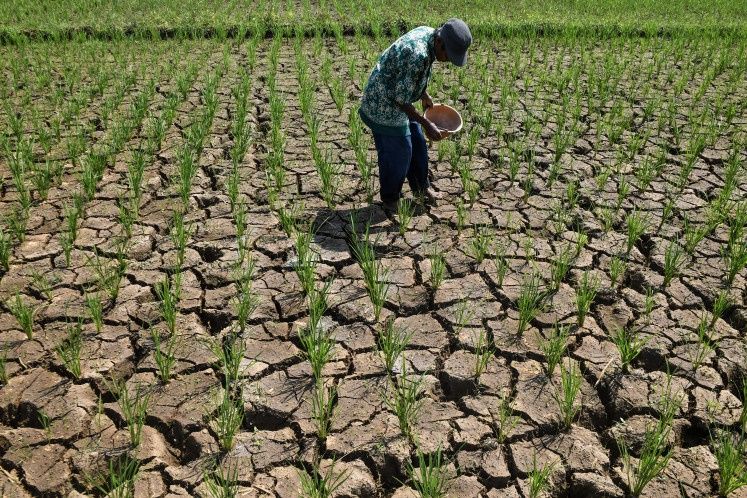
The drought gripping Indonesia is spreading into new territories as El Niño conditions strengthen and below-normal rainfall persists across the archipelago, placing unprecedented strain on water supplies and agricultural systems. The National Disaster Mitigation Agency expanded its drought alert this week, identifying Gunungkidul in Yogyakarta, Semarang in Central Java, and Jember in East Java as newly critical zones, each confronting immediate water access crises affecting hundreds of households. This expansion reflects a broader pattern of regional water stress that has already claimed over 7,100 households in established crisis areas stretching from Central Java's Cilacap and Klaten regions to West Java's Karawang and Tasikmalaya, with emergency tanker deliveries now standard practice across affected communities.
The climate pattern driving this intensification originates in the Pacific Ocean, where El Niño's warming surface temperatures are reshaping global weather systems with particular severity across Southeast Asia. Indonesia's Meteorology, Climatology and Geophysics Agency has characterised this year's dry season as potentially extreme, with forecasts indicating that more than 80 per cent of the archipelago will experience below-normal precipitation during the critical July to September peak period. By mid-June, over one-third of Indonesia's climate zones had already transitioned into the dry season, positioning the nation's agricultural calendar under considerable strain before peak drought conditions arrive.
Response mechanisms at the provincial level have moved swiftly, with several regions implementing 90-day drought alert protocols designed to expedite emergency interventions. Gunungkidul established its alert status in June, while West Java declared drought conditions this month, enabling accelerated water distribution protocols through regional administrations. In West Nusa Tenggara, authorities in West Lombok activated a drought emergency declaration on June 15 after approximately 3,600 households were identified as lacking secure water access. These administrative designations represent more than bureaucratic formality; they fundamentally reshape resource allocation priorities and unlock emergency funding mechanisms that permit rapid response before conditions deteriorate further.
The immediate human impact reverberates across rural communities where water infrastructure remains fragmented and dependent upon seasonal rainfall patterns. Thousands of residents across affected regencies have endured weeks without precipitation, creating acute shortages of drinking water and irrigation supplies simultaneously. The National Disaster Mitigation Agency spokesperson Abdul Muhari issued urgent appeals for regional governments to strengthen drought preparation systems, simultaneously calling upon the public to conserve water consumption and avoid land-clearing practices that intensify fire risks during dry periods. These dual-focused messages underscore the cascading nature of drought impacts, which extend beyond water scarcity to encompass forest fire threats and ecosystem degradation.
Agriculture emerges as the sector facing the most profound consequences from prolonged drought conditions, with implications extending directly toward national food security and consumer prices. The Meteorology, Climatology and Geophysics Agency's deputy for climatology Ardhasena Sopaheluwakan outlined necessary immediate interventions, including strategic planting schedule adjustments, expanded cultivation of drought-tolerant crop varieties, and crop diversification strategies. These technical measures represent essential adaptations for the 2024 growing season, yet experts have previously warned that severe, sustained drought could trigger rice price spikes reaching historical levels if water supply infrastructure cannot be sufficiently secured across agricultural zones.
Government responses at the ministry level indicate substantial preparedness, with Agriculture Minister Amran Sulaiman announcing acceleration of mitigation measures encompassing expanded irrigation pump deployment to maintain water availability during the critical growing season. The government maintains that national rice reserves occupy historically elevated levels, potentially sufficient to meet domestic demand through the following year, effectively buffering against immediate food supply disruptions. However, this assurance addresses symptoms rather than underlying structural vulnerabilities that emerge during each successive drought cycle. The House of Representatives' Commission IV, overseeing agricultural and food production matters, has pushed for intensified government assistance targeting vulnerable regions through seed distribution, fertilizer provision, farming equipment availability, and livestock feed supplies.
Beyond emergency responses, however, substantial gaps persist in Indonesia's long-term water security framework, particularly in drought-prone areas where clean water access remains fundamentally inadequate. Bagas Yusuf Kausan, a researcher specialising in water policy at the Yayasan Amerta Air Indonesia think tank, contends that Indonesia requires sustained investment in water infrastructure through regional water utilities offering piped water services, potentially subsidised to ensure affordability for vulnerable communities. This perspective shifts analysis from cyclical crisis management toward structural solutions capable of transforming persistent vulnerability into resilient systems. Without such infrastructure development, communities face recurring hardship patterns driven by climatic events that, while natural in origin, interact with existing weaknesses to produce preventable human suffering.
Underlying the surface-level climate explanation lies a more complex environmental reality rooted in human activities that have progressively degraded Indonesia's water retention capacity. Land conversion practices, particularly in water catchment zones, have systematically reduced the landscape's ability to capture and store precipitation, while groundwater depletion from excessive extraction has exhausted subsurface reserves that previously sustained communities during dry seasons. Kausan argues that these human-driven degradation patterns, rather than purely climatic factors, explain why Indonesia experiences recurrent, intensifying drought impacts despite being situated in a tropical region receiving substantial annual precipitation. This insight suggests that El Niño serves as a stress test exposing vulnerabilities created through decades of inadequately regulated land use and resource extraction practices.
The policy implications of this analysis propose that governments should fundamentally reconceptualise drought responses, treating El Niño-driven dry seasons as opportunities for institutional strengthening rather than temporary crises requiring only emergency water tanker distribution. Specifically, Kausan recommends tightened restrictions on land conversion, particularly within water catchment areas where ecosystem function directly determines dry-season water availability. Such measures represent preventive approaches addressing root causes rather than repeatedly deploying emergency interventions for predictable recurring crises. For Malaysia and other Southeast Asian nations observing Indonesia's experience, this pattern offers cautionary lessons regarding the necessity of integrating environmental protection policies with water security planning before drought conditions expose inadequacies in existing governance frameworks.

