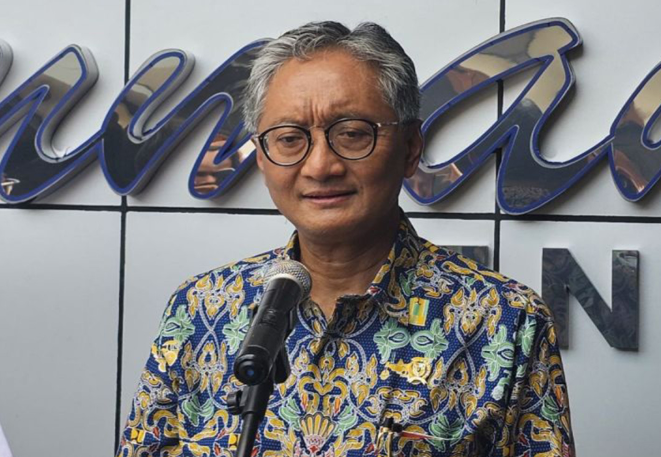
Indonesia's Public Works Ministry is grappling with fresh institutional discord after a confidential travel document circulated online last month, revealing that Minister Dody Hanggodo had listed his wife Irma Hermawati and daughter Aurellia Tsabitha Meidirama among delegates scheduled to attend a United Nations-organised meeting in New York from July 13 to 19. The disclosure, which appeared across social media platforms following its leak in early July, prompted immediate public backlash over the apparent misappropriation of state resources and triggered a cascade of allegations that the minister subsequently punished officials responsible for the breach through strategic personnel transfers.
The contentious document, formally issued by the ministry's secretary-general Apri Artoto on June 29, listed eight delegates designated for the overseas visit, with the UN meeting scheduled for July 16 and 17. The inclusion of Hanggodo's family members sparked widespread criticism that ultimately forced cancellation of the trip. Ministry officials subsequently defended the decision to include family members, claiming such arrangements were procedurally necessary to facilitate visa processing through the Foreign Ministry and asserting that no state funds would be deployed for their participation, yet these explanations failed to quell public scrutiny or internal speculation about the decision-making process.
Within days of the document's viral spread, Indonesian social media platforms erupted with unconfirmed claims that Hanggodo had orchestrated the reassignment of multiple ministry officials to regional positions predominantly situated outside Java as retaliation for the leak. The timing and geographical targeting of these transfers deepened perceptions of punitive action, though the minister categorically denied such motivations when addressing journalists on Wednesday. Speaking to the press, Hanggodo questioned the logic of the allegations, noting his administrative authority over 38,600 employees and asserting his discretion to deploy personnel reassignments as standard management practice rather than retribution.
The uproar surrounding the leaked document represents merely the latest turbulence in what has become a pattern of aggressive institutional restructuring since Hanggodo assumed ministerial duties in October 2024. The 60-year-old former engineer and Democratic Party politician, who maintains business connections to South Kalimantan entrepreneur Andi "Haji Isam" Syamsuddin Arsyad, has orchestrated multiple rounds of personnel reorganisation that collectively affected over 100 civil servants. These reshuffles have ranged across hierarchical levels, encompassing both senior director-general positions and lower-ranking administrative roles, creating an environment of institutional instability that extends beyond normal organisational adjustment.
Most significantly, Hanggodo engineered a comprehensive reshuffle in May that elevated Apri to the position of secretary-general, displacing his predecessor Wida Nurfaida, who had occupied the post for less than a year following an earlier shake-up in July 2025. This pattern of rapid turnover in critical administrative positions has generated mounting unease among members of parliament overseeing the ministry's operations. During a June legislative session, Yasto Soepredjo Mokoagow of the House of Representatives Commission V, which supervises infrastructure matters, articulated concerns that disciplinary measures and demotions of senior directors to nonstructural positions have cultivated pervasive anxiety throughout the ministry's workforce.
The psychological toll of continuous institutional upheaval has manifested in operational consequences that extend beyond internal morale concerns. Mokoagow, representing the Indonesian Democratic Party of Struggle, warned that civil servants have become hesitant to implement programmes, fearing potential career jeopardy. His observations during the June 11 legislative meeting underscored a fundamental tension between management assertiveness and bureaucratic functionality, suggesting that excessive personnel turbulence may paradoxically undermine the very institutional capacity necessary for effective governance and programme delivery. This dynamic reflects a broader challenge facing many developing nation bureaucracies where leadership transitions and restructuring initiatives risk compromising operational continuity.
Hanggodo has justified his aggressive restructuring agenda by invoking an allegory of institutional decay, repeatedly characterising what he labels a "deep state" within the ministry as termites systematically corroding institutional integrity. This characterisation serves as his rationale for persistent bureaucratic upheaval and elevated personnel turnover, positioning himself as an institutional reformer combating entrenched dysfunction. However, the minister's interpretation of appropriate remedial action diverges sharply from legislative assessments of governance best practices, creating friction between executive decision-making and parliamentary oversight.
Simultaneously, the ministry confronts a serious corruption investigation that has ensnared multiple senior officials and potentially lends credibility to the minister's claims regarding institutional misconduct. The Jakarta High Prosecutor's Office designated several suspects in June, including former water resources director-general Dwi Purwantoro and former acting irrigation and swamp director Yosiandi Radi Wicaksono, in connection with investigations into water resources project irregularities. Hanggodo responded to the suspect nominations by pledging non-interference with law enforcement proceedings and publicly committing to pursue accountability regardless of subordinates' ranks or connections, positioning himself as aligned with anti-corruption efforts.
Yet the minister's institutional credibility has suffered additional damage through separate incidents amplified via social media, including video footage from an April visit to a school construction site in East Java where Hanggodo was filmed reprimanding an employee and employing harsh language, including the description "dumb excuses" during finger-pointing admonition. Such interpersonal conduct, captured and disseminated digitally, has reinforced perceptions among observers that the ministry's internal culture has deteriorated under Hanggodo's leadership, regardless of substantive merit underlying his restructuring rationale.
For Malaysian and broader Southeast Asian policymakers, Indonesia's Public Works Ministry presents instructive lessons regarding the balance between institutional reform and operational stability. While corruption and bureaucratic dysfunction legitimately warrant corrective action, the apparent scale and frequency of personnel reshuffles raise questions about whether remedial approaches have achieved optimal calibration. The ministry's situation illustrates how leadership decisions intended to combat institutional problems may inadvertently generate secondary disruptions that impede the very governance functions such reforms ostensibly seek to improve. As regional governments navigate their own infrastructure sector challenges, the Indonesian case demonstrates that effective institutional transformation requires mechanisms for addressing misconduct while simultaneously preserving the organisational cohesion necessary for sustained programme implementation and public service delivery.

