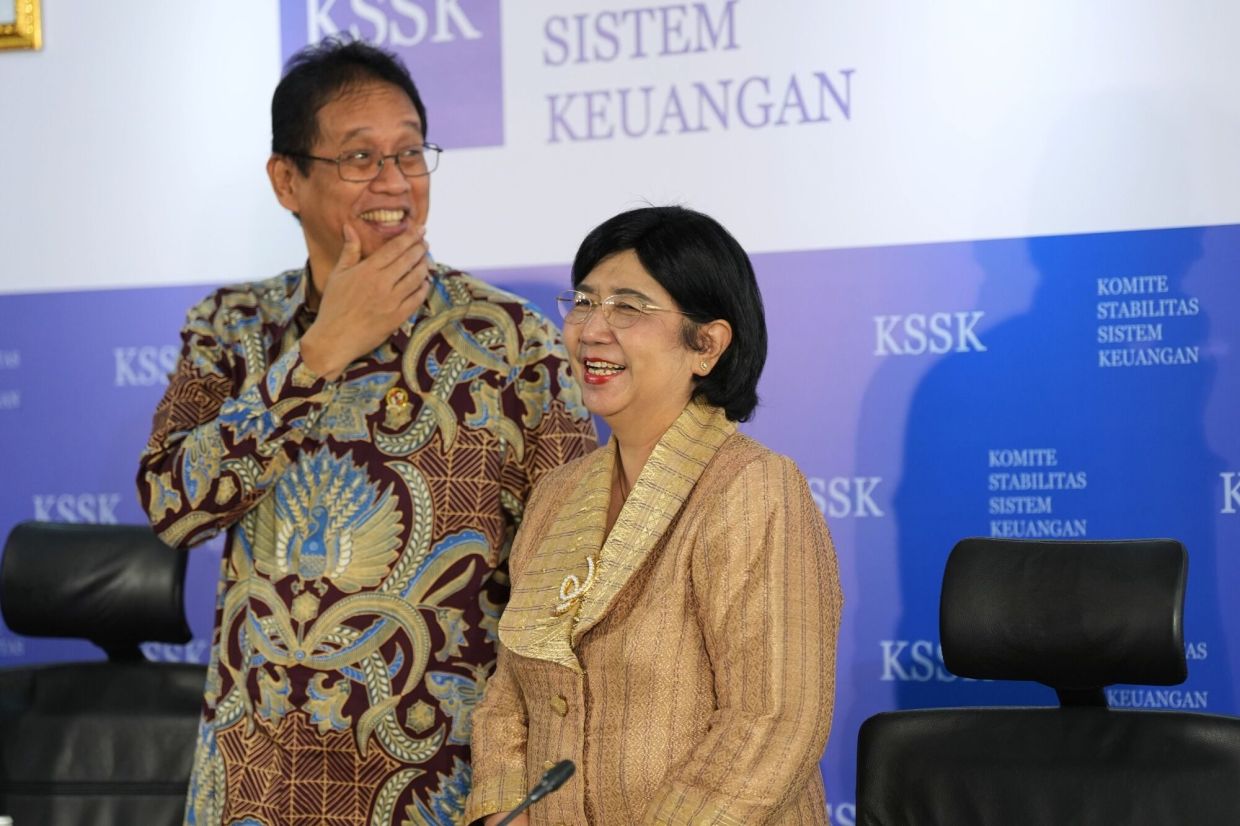
Destry Damayanti's appointment as Indonesia's acting central bank governor just over two weeks ago immediately signalled a shift in how the nation's monetary authority will engage with its political leadership. Within hours of her appointment, she made a strategic visit to Finance Minister Purbaya Yudhi Sadewa's office before heading to meet President Prabowo Subianto at the presidential palace, a deliberate choreography that underscored her commitment to closer fiscal and monetary policy alignment. Days later, Destry and Purbaya appeared together at a public press briefing, exchanging handshakes and warm interactions in a display of institutional harmony that contrasted sharply with the more formal, distant relationship her predecessor maintained.
This visible warmth between the acting governor and the finance minister marks a notable departure from the tenure of Perry Warjiyo, whose interactions with Purbaya were typically confined to broader policy forums held at the president's palace or regulatory committee meetings. The pair's sole documented one-on-one meeting occurred at Bank Indonesia's offices in September 2025, suggesting a deliberate separation between monetary and fiscal authorities. Destry, who served as Warjiyo's deputy since 2019, appears poised to reshape this dynamic, at least in terms of public-facing coordination, though the implications for institutional independence remain a critical concern for observers of Indonesia's financial stability.
Prabowo has now formally nominated Destry as the sole candidate to serve as governor of Bank Indonesia, a decision that reflects his apparent strategy of seeking a technocrat with orthodox economic credentials who is simultaneously attuned to his administration's development priorities. The president's growth agenda, targeting an acceleration to 8% by 2029, has characterised his first year in office and drives much of the government's spending and commodity-control policies. For Destry, the central challenge will be demonstrating to domestic and international investors that she can meaningfully contribute to these growth objectives while preserving the operational and policy independence that Bank Indonesia requires to fulfil its core mandate of maintaining monetary and financial stability.
Market sentiment regarding Destry's appointment has been cautiously optimistic. When her nomination was announced on Monday, the rupiah strengthened to its best level in a month, outperforming most other Asian currencies in a sign that investors initially viewed her appointment as reassuring. Economists and analysts have broadly welcomed the decision, anticipating continuity in monetary policy and a sustained commitment to currency stability. Helmi Arman, an economist at Citigroup Inc., noted that improved communication between Bank Indonesia and the government should strengthen policy coordination going forward, though he cautioned that the broader environment for institutional credibility remains fluid and subject to change. Her nomination still requires parliamentary approval, a procedural hurdle that is unlikely to present serious obstacles.
Investor confidence in Indonesia's economic management has been tested significantly over the past year. President Prabowo's populist policy initiatives, including free school meals and expanded state control of commodity markets, have generated concern among both domestic and international financial market participants about the durability of prudent economic governance. The rupiah has depreciated approximately 6% against the United States dollar year-to-date, making it the worst-performing currency in Asia and reflecting broader anxiety about Indonesia's policy trajectory. Credit rating agencies have responded accordingly: Fitch Ratings and Moody's Ratings have placed Indonesia's sovereign credit ratings on negative watch, explicitly citing policy uncertainty as their primary concern, although S&P Global Ratings has maintained a stable outlook.
Under Warjiyo's leadership, Bank Indonesia deployed a multifaceted toolkit to manage conflicting policy objectives. Since May of last year, the central bank has raised its benchmark interest rate on three separate occasions while simultaneously conducting direct intervention in foreign exchange markets to prevent excessive rupiah weakness. In parallel, the institution has employed non-rate policy instruments to sustain credit flows and support domestic economic activity. This balancing act reflects the fundamental tension inherent in emerging-market monetary policy: the need to support growth while anchoring inflation and currency stability in an environment of rising global interest rates and persistent external pressures. The question now facing Destry is whether she will maintain or even strengthen this stance.
The rupiah faces mounting external headwinds that will test her resolve. Global interest rates remain elevated, and the strength of the United States dollar continues to create downward pressure on emerging-market currencies, including Indonesia's. Paradoxically, domestic inflation has remained reasonably well-contained, complicating the traditional case for aggressive interest rate increases. Yet Prabowo's ambitious growth targets of 8% by 2029 implicitly require accommodative monetary conditions, setting up a potential conflict between the finance ministry's preferences and the orthodox monetary policy that currency stability would seem to demand. Irman Faiz, chief economist at PT Bank Danamon, has stressed that investors will be closely monitoring whether the central bank maintains its willingness to raise rates when necessary and whether liquidity decisions continue to be grounded in assessments of inflation, currency movements, and financial stability rather than growth considerations.
Destry's educational and professional credentials appear robust for the role. She holds a bachelor's degree in economics from the University of Indonesia and completed a master's degree in regional science at Cornell University, combining local understanding with international academic exposure. Before joining Bank Indonesia as deputy governor, she served as chief economist at PT Bank Mandiri, one of Indonesia's largest state-owned lenders, and held a commissioner position at the Indonesia Deposit Insurance Corp., an institution previously led by Finance Minister Purbaya. Her familiarity with the investor and analyst community, developed through years of regular engagement on central bank matters, has earned her respect within financial markets and positioning her as a credible interlocutor with both international observers and domestic stakeholders.
The relationship between Destry and Purbaya is likely to facilitate smoother policy dialogue between Bank Indonesia and the Finance Ministry, though observers stress that closer coordination cannot come at the expense of the central bank's policy autonomy. Faiz articulated this distinction precisely: "Coordination is necessary, but policy subordination is not." This formulation captures the critical balance that Destry must maintain. Indonesia's experience with monetary authorities that lacked sufficient independence has historically resulted in currency instability, inflation spikes, and loss of investor confidence, patterns the nation cannot afford to repeat given its regional economic importance and the ongoing sensitivity of emerging markets to shifts in global financial conditions.
Beyond simply preserving the stability achieved in recent years, some analysts argue that Bank Indonesia should enter a new phase of more proactive financial deepening. Fakhrul Fulvian, chief economist at PT Trimegah Sekuritas Indonesia, contends that Destry's term should focus on translating existing stability into improved liquidity conditions, a more normalised yield curve that reflects genuine market conditions, stronger transmission of monetary policy changes into the real economy, and renewed confidence among private-sector investors and entrepreneurs. These objectives align broadly with growth ambitions but require careful management to prevent financial excesses from emerging. The global interest-rate environment, the rupiah's vulnerability to sudden capital outflows, and Indonesia's experience with previous financial instability episodes all argue for a cautious, evidence-based approach that prioritises long-term credibility over short-term convenience.

