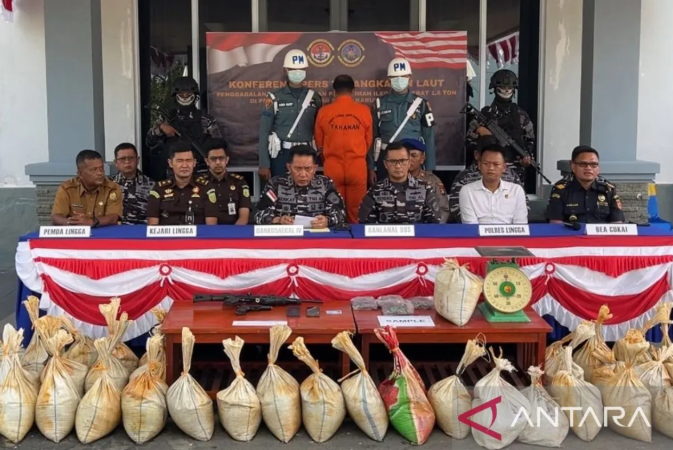
Indonesia's military has disrupted a significant smuggling operation involving illegally extracted tin sand from the Bangka Belitung Islands, with authorities recovering approximately 75.7 tonnes of material valued at Rp76.04 billion (US$79,300) destined for Malaysia. The discovery marks the latest in a series of enforcement actions targeting illicit mineral extraction in one of Southeast Asia's historically rich tin-producing regions, an issue that has long troubled both Indonesian authorities and regional trading partners concerned about environmental degradation and revenue loss.
The operation came to light on August 2 when Indonesian Navy personnel discovered a truck laden with about eight tonnes of tin sand at a jetty in East Belitung. The initial interception, rather than concluding the matter, became the starting point for an expanded investigation that would ultimately uncover a more extensive network. Vice Admiral Denih Hendrata, commanding Indonesia's Fleet Command, oversaw a coordinated series of raids across multiple locations that systematically dismantled what appeared to be an organized smuggling arrangement.
Following the initial seizure, naval teams conducted targeted raids that progressively revealed the scope of the operation. On August 3, authorities recovered approximately 50 tonnes of tin sand stockpiled in Lenggang village, suggesting the material had been accumulated at various collection points. A day later, officers discovered an additional ten tonnes of the mineral carefully packed into 200 sacks, indicating professional handling and preparation for transport. On August 8, a final five-tonne haul was secured, bringing the total recovered amount to the substantial figure that captured regional attention.
The methodical approach taken by Indonesian authorities reflects a strategic understanding that initial seizures often represent merely the visible portion of smuggling networks. Rather than treating the first interception as an isolated incident, commanders authorized follow-up operations designed to trace the supply chain backwards to extraction sources and forwards to intended recipients. This investigative philosophy has proven effective in combating organized smuggling in resource-rich regions, though it requires coordination across multiple agencies and sustained commitment to follow leads wherever they lead.
According to Vice Admiral Denih, the investigation has now expanded to encompass five separate locations across the region, indicating that the smuggling operation likely involved multiple stakeholders and collection points. The scale of the recovery and the geographic distribution of seizures suggest this was not an ad hoc operation by small-time smugglers, but rather a more organized effort to extract and transport illegally mined minerals across international borders. The involvement of transportation infrastructure like jetties and the use of trucks and sacks indicates a level of logistical sophistication.
Authorities have not yet identified or named specific suspects in connection with the operation, though investigations remain active and ongoing. The absence of arrest announcements at this preliminary stage may reflect ongoing surveillance and intelligence gathering, as authorities work to understand the full scope of the network before making formal accusations. This measured approach, while sometimes frustrating to observers seeking swift justice, often yields more comprehensive prosecutions with better chances of conviction.
Laboratory analysis has been initiated to determine the precise mineral content and quality of the recovered tin sand, a technical necessity for assessing the commercial value and establishing evidence for legal proceedings. Such testing is standard procedure in mineral smuggling cases, providing objective data that can withstand judicial scrutiny and helping authorities understand what specific mineral products or concentrations were being trafficked. The analysis will also help determine whether the material originated from legitimate mining operations that was illegally diverted, or whether it came entirely from unlicensed mining activities.
The geographic context of the Bangka Belitung Islands is crucial to understanding why this region remains a focal point for smuggling activities. Historically one of the world's most significant tin-producing areas, the islands have experienced decades of intensive mining that has created both established mining infrastructure and experienced smuggling networks. The proximity to Malaysia and established maritime routes between the two countries provide convenient pathways for illicit trade, while the long coastline and numerous jetties create enforcement challenges for authorities tasked with monitoring all potential smuggling points.
Vice Admiral Denih indicated that effective resolution of the case would require cross-border cooperation between Indonesian and Malaysian authorities. Such interstate collaboration is essential for tracing smuggling networks that by definition span multiple jurisdictions, and for identifying the ultimate recipients and end markets for illegally extracted minerals. The willingness of Indonesian commanders to explicitly acknowledge the need for Malaysian involvement suggests a professional recognition that unilateral action, while valuable, cannot fully address transnational smuggling operations. This reflects improving diplomatic cooperation on law enforcement matters between the two nations, though implementation challenges frequently arise in practice.
The recovery of such a substantial quantity of illegal tin sand carries implications beyond the immediate law enforcement context. Smuggling of mineral resources represents lost government revenue that could otherwise fund development, while also undermining legitimate mining operations and creating competitive disadvantages for law-abiding extractors. Environmental costs from unregulated mining operations further compound the problem, as illegal extraction typically ignores safety and environmental protocols, leaving degraded landscapes and contaminated water sources in mining areas across the Bangka Belitung region.
For Malaysia, the interception of the smuggling attempt highlights the ongoing challenge of controlling illegal mineral imports and maintaining integrity in supply chains. Receiving nations face their own enforcement responsibilities under international law, and Malaysian authorities will likely conduct their own investigations into any domestic recipients or networks involved in attempting to import the contraband materials. The incident underscores how resource smuggling, despite occurring primarily in Indonesian territory, creates regional complications that demand coordinated responses.
The broader context of tin smuggling in Southeast Asia reflects global demand for the metal, which is essential for electronics, solder, and various industrial applications. High international prices for tin create economic incentives for illegal mining and smuggling, particularly in regions with weak governance and enforcement capacity. Addressing the root causes requires not just successful interceptions like this one, but also addressing the economic factors that make smuggling profitable and the regulatory gaps that allow it to flourish.
As the investigation progresses and authorities work to expand their understanding of the smuggling network, the case will likely become a test case for bilateral cooperation between Indonesia and Malaysia in combating resource crime. The outcome could establish precedents for how the two nations handle future discoveries and may influence the development of joint protocols for investigating and prosecuting transnational smuggling operations. Success in identifying and prosecuting the key actors could have a deterrent effect on other potential smugglers, though enforcement experts note that without addressing underlying economic incentives and regulatory gaps, such victories often prove temporary.

