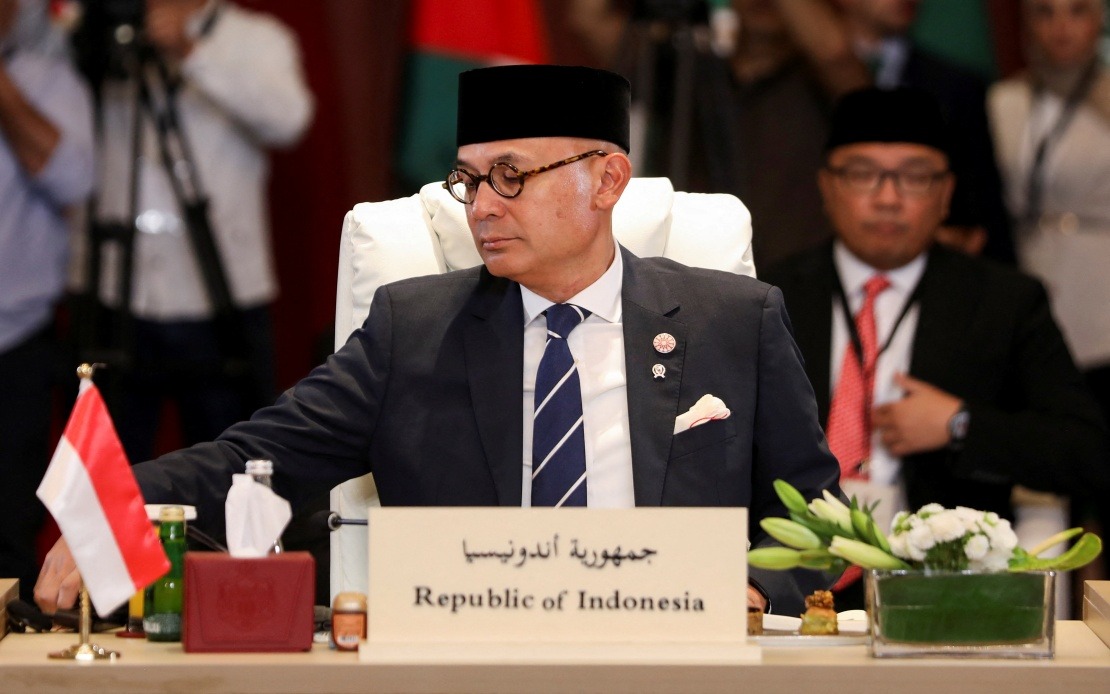
Indonesia has issued a forceful call for the international community to abandon fragmented approaches to the Palestinian question and instead construct a cohesive global coalition capable of mounting a sustained, unified response. Addressing the Ministerial Meeting on Jerusalem in Amman on Wednesday, Deputy Foreign Minister Arrmanatha Nasir—representing Foreign Minister Sugiono—articulated a strategic diagnosis that division represents the fundamental vulnerability Israel continues to exploit in regional and international diplomacy.
The timing of Indonesia's intervention reflects deepening concern in Southeast Asia's largest nation about the deteriorating security landscape across West Asia. Arrmanatha identified multiple destabilising factors driving the urgency: the expansion of illegal Israeli settlements in the West Bank, intensifying military operations affecting Gaza, Syria and Lebanon, and the escalating confrontation between the United States and Iran. These overlapping crises, he suggested, demand a coordinated international framework that moves beyond traditional ad-hoc responses lacking strategic coherence.
Indonesia's proposal centres on five substantive measures designed to strengthen Palestinian prospects through coordinated action. The framework emphasises developing a common strategy rooted in genuine unity among supporting nations, advancing mechanisms to enforce international law and International Court of Justice rulings, and expanding formal international recognition of Palestine as a sovereign state. These foundational pillars aim to rebuild legitimacy through institutional channels rather than relying on rhetorical support alone.
The remaining components address immediate humanitarian and religious dimensions. Indonesia calls for intensified efforts to protect Al Aqsa Mosque and the broader Al Haram Al Sharif compound, accelerating Gaza's reconstruction through coordinated international support, promoting Palestinian national unity across competing factions, and sustaining the mandate of the United Nations Relief and Works Agency for Palestine Refugees in the Near East. This multi-layered approach recognises that Palestinian state-building requires both diplomatic legitimacy and practical humanitarian foundations.
Indonesia's emphasis on Hashemite Custodianship over Jerusalem's holy sites reflects Jakarta's sophisticated understanding of competing claims and the importance of institutional frameworks in preventing unilateral actions. By reaffirming support for both Palestinian statehood and Jordan's custodial role, Indonesia positions itself as supporting international legal architecture rather than sectarian claims, potentially broadening coalition appeal across Muslim-majority nations with diverse geopolitical interests.
The Amman ministerial gathering itself represented significant diplomatic mobilisation. Foreign ministers and senior representatives from Malaysia, Algeria, Saudi Arabia, Iraq, Egypt, Türkiye, Tunisia, Somalia, Pakistan, Morocco, Palestine and Qatar attended alongside the League of Arab States' Secretary-General. This roster demonstrates regional consensus on the urgency of coordinated response, though the diversity of participants—spanning North Africa, the Arabian Peninsula, and South Asia—underscores both the Palestinian issue's transcontinental resonance and the challenge of maintaining coalition discipline across nations with competing strategic priorities.
The meeting's joint statement articulated specific objections to unilateral actions, particularly the relocation of diplomatic missions to Jerusalem, characterising such moves as violations of international law. This framing proves significant for Southeast Asian observers, as it grounds Palestinian advocacy within universal legal principles rather than particularist religious or ethnic claims, potentially increasing receptivity among non-Muslim constituencies and countries balancing multiple international relationships.
The adopted call for a coordinated media campaign represents an underappreciated dimension of the coalition strategy. Recognition that public awareness shapes policy space suggests the coalition views international opinion as malleable through strategic communication. For Malaysia and other Southeast Asian nations navigating complex ties to Western powers while maintaining constituencies sympathetic to Palestinian causes, such efforts provide frameworks for articulating positions that transcend simple binary alignment.
Indonesia's leadership in this initiative reflects its positioning as Southeast Asia's most influential voice on Middle Eastern affairs. With the region's largest Muslim population and growing diplomatic footprint, Jakarta leverages both soft power and substantial international standing to advocate for institutional solutions. However, the effectiveness of Indonesia's call depends substantially on whether coalition members subordinate competing strategic interests—including relationships with Western powers and Israel's regional partners—to unified Palestinian advocacy.
The challenge facing this coalition mirrors broader regional dynamics. Countries like Malaysia share Indonesia's rhetorical commitment to Palestinian causes yet maintain economic and security relationships limiting radical policy shifts. The gap between summit declarations and implemented policy reveals how international coalitions often function as forums for consensus-building rather than enforcement mechanisms. For Indonesia's five-point framework to gain traction, participating nations must translate diplomatic alignment into concrete support mechanisms, resource commitments, and willingness to coordinate voting patterns across United Nations and international forums.
Looking forward, Indonesia's initiative gains relevance as regional configurations shift. The Abraham Accords, Abraham Frameworks and evolving Gulf-Israel dynamics have complicated traditional coalitions based on religious or anti-Western sentiment. Indonesia's appeal to international law and universal principles attempts to reconstruct Palestinian solidarity on grounds transcending sectarian divides. Success requires persuading nations balancing multiple relationships that coordinated Palestinian advocacy strengthens rather than undermines their broader strategic positions—a proposition increasingly difficult to demonstrate given interconnected global interests.
For Southeast Asian policymakers, Indonesia's Amman intervention signals that Palestinian questions remain central to regional diplomatic identity despite globalisation and economic interdependence. The coalition's ultimate impact will depend on whether diplomatic activism translates into meaningful pressure on the parties themselves and whether coalition cohesion survives the inevitable tensions between rhetorical support and strategic national interest.

