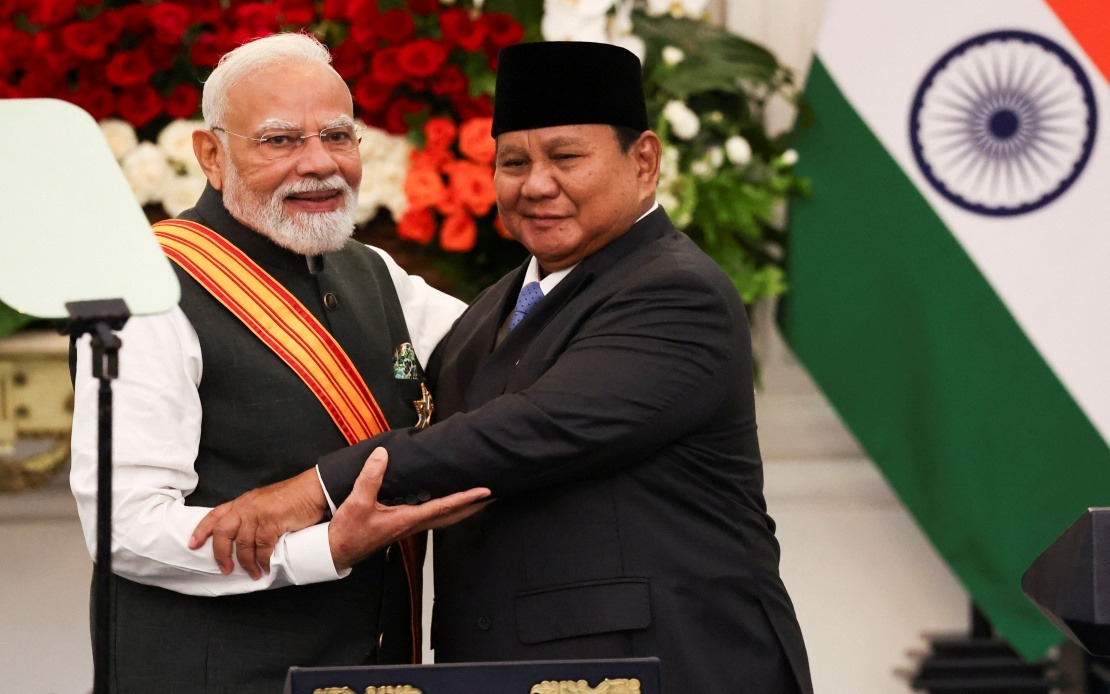
President Prabowo Subianto of Indonesia conferred the country's highest state honour upon Indian Prime Minister Narendra Modi on Tuesday during an official state visit to Jakarta, marking a significant diplomatic milestone in the relationship between two of Asia's largest democracies. The prestigious award, previously granted to only a select few foreign dignitaries, underscores the elevated status Indonesia now accords to India and the personal leadership of Modi in advancing bilateral cooperation.
During a joint press statement at the Merdeka Palace, Prabowo articulated the reasoning behind the honour, framing it as recognition of Modi's stewardship in elevating Indonesia-India relations to the framework of a Comprehensive Strategic Partnership. The Indonesian president emphasised that Modi's tenure has been characterised by tangible efforts to expand cooperation across multiple sectors, moving beyond symbolic gestures to deliver concrete benefits for both nations. Prabowo further highlighted India's sustained backing for various development initiatives and programmes that have contributed meaningfully to Indonesia's progress across infrastructure, technology, and economic domains.
The state visit itself represents reciprocal engagement between the two leaders, as Modi's presence in Jakarta follows President Prabowo's visit to New Delhi earlier in the year. This sequence of high-level exchanges signals a deliberate commitment from both governments to maintain momentum in their strategic partnership, preventing diplomatic engagement from becoming episodic or perfunctory. Such regular bilateral consultations at the presidential level are rare among ASEAN nations and India, indicating the special significance Jakarta and New Delhi place on their relationship.
Prabowo drew historical parallels to reinforce the gravity of Modi's honour, noting that India's first Prime Minister Jawaharlal Nehru had been similarly recognised in earlier decades. Nehru's foundational role in establishing modern India and his pioneering contributions to the Non-Aligned Movement during the Cold War era lent considerable weight to this comparison. By positioning Modi alongside Nehru in Indonesia's pantheon of honoured foreign leaders, Prabowo was essentially acknowledging Modi's comparable stature as a transformational figure reshaping India's regional and global standing.
The Comprehensive Strategic Partnership framework binding the two nations encompasses defence cooperation, maritime security, trade and investment, cultural exchanges, and coordination on international forums. For Southeast Asian nations like Malaysia and neighbouring countries, the strengthening of Indonesia-India ties carries significant implications, as it establishes a powerful geopolitical axis that influences regional balance and shapes responses to emerging challenges from great power competition to transnational threats. Indonesia's elevation of ties with India reflects Jakarta's strategy of cultivating strong partnerships with major powers while maintaining its position as the anchor state of ASEAN.
Prabowo's explicit mention of India's support for Indonesia's permanent membership in BRICS underscores the instrumental value of this partnership in advancing Jakarta's global ambitions. Indonesia's pursuit of BRICS membership represents a strategic pivot toward greater engagement with non-Western institutions and a deliberate diversification of Indonesia's diplomatic and economic partnerships. India's backing for this initiative carries substantial weight within BRICS forums, making Modi's support a tangible demonstration of the depth and utility of bilateral ties.
The Indonesian president also emphasised the deep historical and cultural foundations underpinning contemporary Indonesia-India relations, tracing connections that extend far beyond modern statecraft. The shared Buddhist and Hindu heritage, centuries of maritime trade networks, and cultural influences that flowed across the Indian Ocean have created civilisational bonds that contemporary politicians invoke to justify and legitimise expanded cooperation. This historical dimension provides Indonesia-India partnership with a narrative of continuity and inevitability, suggesting that deepening ties merely restore natural patterns of engagement disrupted by colonial and early post-independence periods.
For Malaysian observers and policymakers, Modi's honoured visit to Jakarta warrants careful attention. As the second-largest economy in Southeast Asia and a fellow ASEAN member, Indonesia's strategic partnerships directly influence the regional environment in which Malaysia operates. A strengthened Indonesia-India axis could enhance security cooperation in the Indian Ocean and Strait of Malacca, areas of critical importance to Malaysian maritime interests. Simultaneously, it may shift the balance of influence within ASEAN discussions, particularly on matters relating to the Quad framework and broader Indo-Pacific strategy, where India plays an increasingly visible role.
The diplomatic choreography surrounding Modi's visit also reflects broader patterns in contemporary Asian geopolitics, wherein middle powers and regional leaders actively court partnerships with major powers while seeking to avoid exclusive alignment. Indonesia's cultivation of India as a strategic partner occurs within a context where Jakarta simultaneously maintains significant partnerships with China, Japan, South Korea, and Western nations. This multipolar approach allows Indonesia to extract maximum benefit from various relationships while preserving strategic autonomy, a model that resonates across ASEAN capitals including Kuala Lumpur.
Prabowo's remarks about preserving friendship and cooperation carry particular resonance given recent shifts in Indonesian foreign policy under his presidency. His administration has signalled interest in deepening engagement with India partly as a counterweight to other regional influences and partly as a recognition of India's growing technological capabilities, manufacturing potential, and strategic location. For Malaysia and other ASEAN nations, monitoring how this partnership evolves will be crucial for calibrating their own diplomatic strategies in an increasingly multipolar Asian region.

