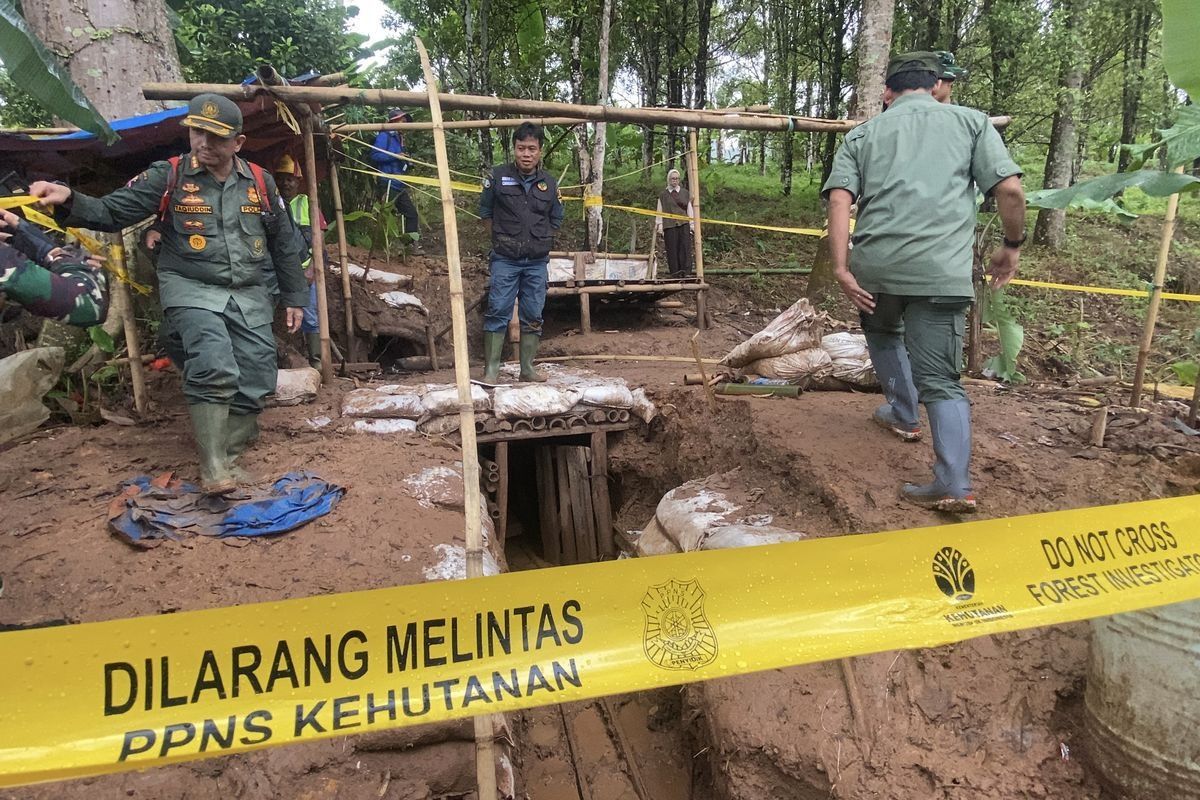
Indonesia's energy ministry has moved forward with criminal charges against 24 foreign nationals accused of orchestrating an unlicensed gold mining operation in the Maluku region, marking another significant enforcement action against the persistent problem of illegal mineral extraction across the archipelago. According to energy ministry official Jeffri Huwae, whose statement was released late on Thursday, June 25, the suspects face allegations related to establishing and operating mining infrastructure in the Gunung Botak area, a location that has become notorious for clandestine gold extraction activities.
The infrastructure development associated with the alleged operation extended beyond simple mining equipment to encompass a more comprehensive operation. The foreign nationals are accused of constructing roads and processing facilities that would have enabled the illegal extraction and preliminary refinement of gold ore extracted from the site. This level of infrastructure investment suggests a sophisticated operation with significant financial backing, rather than a small-scale opportunistic venture. Such developments typically require months of planning and coordination, indicating the suspects likely operated with considerable operational autonomy within the region.
Under Indonesian law, individuals convicted of the violations alleged in this case face maximum prison sentences of five years. While the energy ministry outlined the potential penalties available to prosecutors and courts, it did not disclose additional specifics that could illuminate the investigation's scope. The ministry refrained from identifying the nationalities of the suspects or quantifying the amount of gold that may have been extracted, details that could provide insight into the operation's scale and the financial motivations driving the alleged criminal activity.
State news agency Antara had reported one month prior that 24 Chinese nationals working in the Gunung Botak area under the sponsorship of local company PT Harmoni Alam Manise had been detained for questioning. This earlier reporting provides context for the current charges, suggesting that the investigative process moved from initial detention through interrogation to formal criminal charges over the subsequent weeks. The involvement of a registered local company as the purported sponsoring entity raises questions about the extent to which Indonesian business structures were exploited to facilitate foreign-led illegal mining operations.
The enforcement action reveals a significant enforcement challenge facing Indonesia's authorities. Of the 24 foreign nationals charged, only 12 remain in custody within Indonesian jurisdiction, while the remaining 12 have fled or absconded from the country. This disparity highlights the difficulty in detaining suspects before they can depart, a common problem in cases involving foreign nationals who may have prepared exit routes or operated through networks capable of facilitating rapid departures when law enforcement activity intensifies. The escape of half the suspects underscores gaps in border security or coordination that illegal mining networks may exploit routinely.
Beyond the foreign nationals, Indonesian authorities have also implicated two local citizens as criminal suspects in the operation. The involvement of domestic actors suggests the illegal mining network required local knowledge, connections, and assistance to function effectively. These Indonesian suspects likely provided crucial facilitation in terms of land access, local labour recruitment, or relationships with government officials that permitted the operation to proceed without earlier interference. Their participation indicates that illegal gold mining in Indonesia rarely operates entirely through foreign personnel alone.
Illegal mining involving foreign nationals constitutes a recurring challenge for Indonesia's resource management authorities across multiple regions. The pattern extends beyond Maluku, with enforcement actions occurring in other parts of the country as global demand for gold and the accessibility of Indonesia's geology combine to attract illicit operators. Just last year, police in Papua, Indonesia's easternmost region, arrested four Chinese nationals in Senggi district on similar charges, demonstrating that this phenomenon spans vast geographical distances across the archipelago.
For Southeast Asia more broadly, Indonesia's situation reflects a regional problem where foreign mining networks exploit jurisdictional complexities and porous borders. Malaysia, Thailand, and other nations in the region have documented similar issues, with transnational criminal organisations coordinating illegal extraction across borders. The technical expertise and capital that foreign operators bring often overwhelm local enforcement capacity, particularly in remote regions where government presence remains limited and monitoring infrastructure is inadequate.
The economic incentives driving these operations remain compelling despite enforcement efforts. International gold prices remain elevated, and the operational costs of illegal mining—particularly when environmental compliance is completely disregarded—remain substantially below licensed operations. This cost differential ensures a persistent supply of motivated actors willing to assume legal risks. For criminal syndicates, the potential profits from extracting and smuggling gold out of Indonesia vastly exceed the financial penalties likely to be imposed even upon conviction.
The Maluku region's particular vulnerability to illegal mining activity stems from its combination of gold-bearing geology, relative geographical remoteness from central enforcement authorities, and established smuggling networks. Maluku's maritime geography provides multiple potential extraction points and exit routes for illicit minerals, complicating interdiction efforts. The region's history of mining activity, both legal and illegal, has created existing infrastructure and labour networks that new operations can readily co-opt or build upon.
Government responses to this challenge face structural constraints. Investigations require sustained coordination between energy ministry officials, national police, and potentially international law enforcement partners. Prosecutions demand evidence gathering in remote locations and witness cooperation despite potential intimidation. Border security improvements necessary to prevent suspect flight require resources and coordination that Indonesian authorities have consistently found challenging to maintain at required levels.
The charges against these 24 foreign nationals represent one enforcement victory, yet the persistence of similar cases across multiple regions suggests that individual prosecutions, while important for demonstrating commitment to rule of law, remain insufficient to deter the broader phenomenon. More comprehensive solutions would require addressing the underlying economic incentives, strengthening remote region governance, and developing international cooperation mechanisms capable of disrupting the transnational networks coordinating these operations across Southeast Asia.

