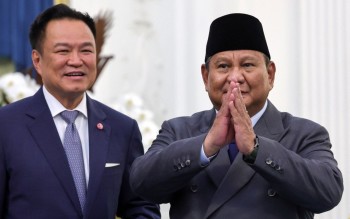
Indonesia is positioning itself for significantly deeper economic integration with Thailand, setting an ambitious bilateral trade target of US$20 billion by 2030 following the formal adoption of a comprehensive strategic partnership roadmap. President Prabowo Subianto and Thai Prime Minister Anutin Charnvirakul sealed the Indonesia-Thailand Strategic Partnership Roadmap 2026-2030 during their second Leaders' Consultation at Merdeka Palace on Monday, marking a watershed moment in bilateral relations that had remained relatively underdeveloped despite the two nations' economic heft within Southeast Asia.
Anutin's arrival in Jakarta represented the first official visit by a Thai prime minister to Indonesia in 15 years, underscoring the historical significance of the diplomatic engagement and signalling a deliberate reset in bilateral relations. The Thai premier, who assumed office as Thailand's 32nd prime minister in September 2025, arrived fresh from consolidating power in Bangkok and appears determined to position Thailand as an active economic player within ASEAN's broader integration framework. This visit follows Prabowo's reciprocal journey to Bangkok in the preceding year, when the two leaders elevated their countries' relationship from a standard bilateral partnership to the more formal Strategic Partnership designation, creating the institutional scaffolding for deeper cooperation.
The roadmap functions as more than symbolic agreement; it establishes a concrete governance structure designed to unlock trade and investment potential between two economies that have underperformed relative to their combined GDP and geographic proximity. Prabowo highlighted during the joint press conference that the partnership would introduce the first-ever Joint Trade Commission in Indonesia-Thailand history, a mechanism specifically tasked with identifying business opportunities and systematically dismantling trade barriers that have historically impeded commerce between the nations. This institutional innovation addresses a genuine gap in bilateral relations, where the absence of regularised high-level trade coordination has allowed transaction costs and regulatory friction to accumulate.
Food security emerged as a cornerstone pillar of the renewed partnership, with both leaders recognising the complementary strengths their countries possess in agricultural production and processing. Anutin committed Thailand to maintaining its role as a dependable supplier of premium rice to Indonesia while simultaneously pushing for expanded market access for Thai agricultural machinery, meat products and dairy items. Critically, the prime minister indicated Thailand's willingness to radically increase imports of Indonesian urea fertiliser from the current baseline of approximately 60,000 tonnes annually to several hundred thousand tonnes, a development that carries significant implications for Indonesian agricultural chemical manufacturers and fertiliser exporters seeking new markets.
The energy cooperation framework represents another dimension through which the two countries intend to strengthen strategic interdependence. Both nations committed to establishing the Indonesia-Thailand Energy Forum as a formal platform for coordinating energy security initiatives and accelerating the transition toward renewable and sustainable energy systems through integrated government-business collaboration. This aligns with broader regional imperatives around climate commitments and energy transition, positioning Indonesia and Thailand as potential anchor economies for Southeast Asian energy integration rather than allowing energy markets to develop in isolation.
Digitalisation of bilateral commerce features prominently in the roadmap, with both governments explicitly endorsing the promotion of local currency transactions between Indonesian and Thai entities. This dimension directly addresses one of ASEAN's longstanding challenges—the continued dominance of US dollar-denominated trade—and reflects growing interest among regional policymakers in building autonomous payment infrastructure that reduces reliance on Western financial systems. Such mechanisms could eventually extend beyond Indonesia-Thailand dyadic relations to encompass broader ASEAN trade facilitation, making this bilateral commitment potentially consequential for regional monetary cooperation.
The halal industry represents an often-overlooked area of comparative advantage for both nations, particularly given Indonesia's position as the world's largest Muslim-majority nation and Thailand's significant halal certification and production capabilities. The roadmap specifically identifies opportunities to develop regional and global halal value chains, with Anutin emphasising the urgency of renewing the mutual recognition agreement on halal certification before its November expiration. This cooperation extends beyond mere trade mechanics to encompass standards harmonisation and supply chain integration that could position Southeast Asia as a dominant player in the rapidly expanding global halal market, currently valued in the hundreds of billions of dollars.
Education and human capital development features in the partnership through a newly signed memorandum of understanding, reflecting recognition that trade and investment flows depend ultimately on workforce capabilities and institutional knowledge transfer. Beyond government-level agreements, the roadmap has already catalysed private sector engagement, as evidenced by tourism and connectivity agreements between the Tourism Authority of Thailand and TransNusa, as well as emerging collaboration on organic waste processing between Bio-Axel and Pro Konsilium. These commercial arrangements suggest the roadmap is functioning effectively as an enabler rather than a mere aspirational framework.
Anutin's observation that Indonesia ranks as Thailand's fourth-largest trading partner within ASEAN, coupled with his assertion that bilateral trade should be substantially higher given both nations' economic scale, captures the essential rationale underlying the strategic pivot. The current underperformance relative to potential reflects decades of insufficient diplomatic attention and institutional coordination rather than any fundamental economic incompatibility. By introducing structured mechanisms like the JTC and establishing thematic cooperation frameworks spanning energy, food security and digitisation, the roadmap addresses this structural gap.
For Malaysian and broader Southeast Asian observers, the Indonesia-Thailand partnership trajectory carries implications for regional balance and integration patterns. Should the two countries successfully achieve their US$20 billion target, they would establish a significant sub-regional economic bloc within ASEAN that might reshape trade and investment flows throughout the region. The emphasis on local currency transactions and autonomous energy coordination suggests these countries are thinking strategically about reducing dependency on external monetary and energy systems, priorities that resonate across Southeast Asia as countries confront great power competition and global economic volatility. The success or failure of this roadmap will therefore offer crucial lessons for other ASEAN member states contemplating similar strategic deepening with neighbours.

