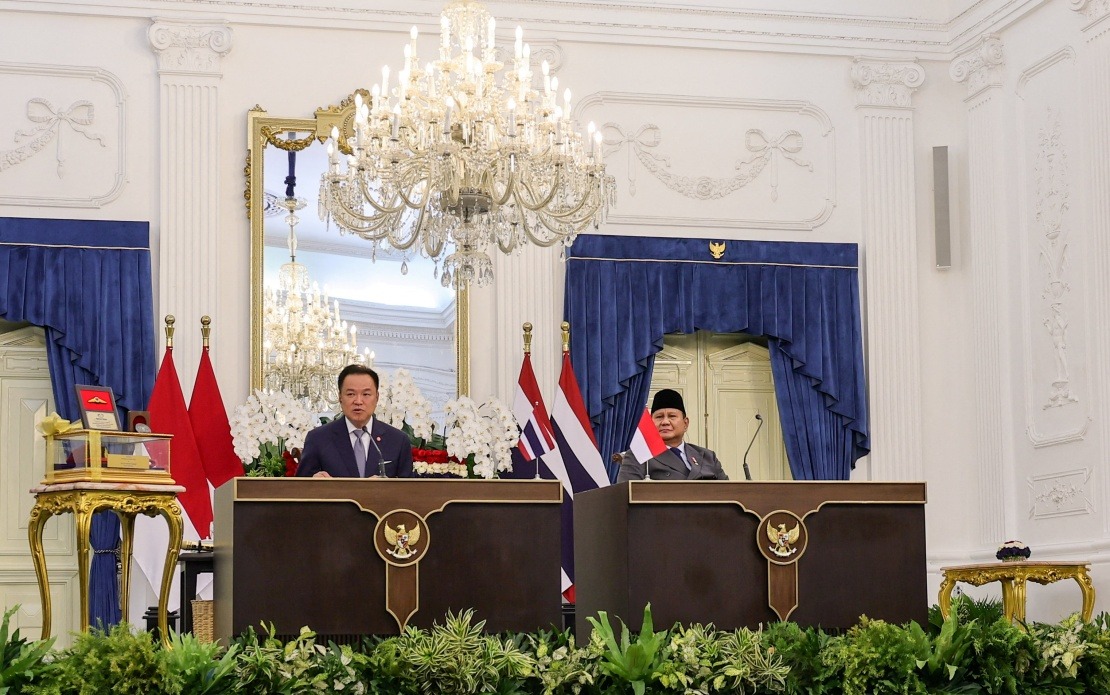
Indonesian President Prabowo Subianto and Thai Prime Minister Anutin Charnvirakul have renewed their nations' resolve to support ASEAN-led initiatives aimed at bringing stability to Myanmar, during a high-level consultation held in Jakarta. The two leaders, meeting at the Merdeka Palace, emphasised their shared commitment to advancing the implementation of ASEAN's Five-Point Consensus through sustained dialogue among all stakeholders, humanitarian relief measures, and concrete efforts to reduce armed conflict across Myanmar's fractured landscape.
The gathering was significant not merely for its focus on Myanmar, but also as a demonstration of the personal relationship between the two leaders and their determination to strengthen the bilateral partnership at a critical juncture for Southeast Asia. Prabowo underscored that maintaining ASEAN's collective unity and its central role in regional affairs remains essential to any meaningful progress toward peace and development across the association. This emphasis reflects Jakarta's view that Myanmar's instability poses broader risks to ASEAN cohesion and the region's strategic trajectory.
Beyond Myanmar, both governments recognised that transnational criminal networks—particularly sophisticated online scam operations—present increasingly urgent security threats that transcend borders and demand coordinated regional responses. Indonesia and Thailand committed to substantially intensifying their defence and security cooperation through expanded intelligence-sharing arrangements, joint law enforcement investigations, financial tracking mechanisms, and coordinated efforts to dismantle criminal syndicates operating across their territories and throughout Southeast Asia. This operational commitment marks a notable escalation from previous bilateral security agreements.
The scope of cooperation covers a diverse array of non-traditional security challenges that have grown more complex and harder to counter through conventional means. Online scam networks, which often operate across multiple countries with sophisticated technological infrastructure, have become a major concern for both nations. Prabowo acknowledged Thailand's crucial role in facilitating the repatriation of nearly 1,000 Indonesian victims of online fraud schemes, recognising this as both a humanitarian achievement and evidence of productive bilateral cooperation. The agreement to develop a Transnational Referral Mechanism signals both governments' intention to systematise victim identification, protection, and safe repatriation processes.
Thailand's Prime Minister Anutin outlined additional proposals to strengthen the defence relationship, including expanded military training exchanges, enhanced maritime security collaboration, and notably, the supply of 36 amphibious wheeled armoured vehicles to Indonesia. This defence procurement element suggests both nations see value in deepening military interoperability and operational capacity. Beyond hardware, Anutin emphasised his government's readiness to coordinate on human trafficking and drug trafficking operations, two persistent challenges that destabilise communities across Southeast Asia and require intelligence-sharing and cross-border enforcement capacity.
The consultation also highlighted Thailand's commitment to supporting broader ASEAN efforts against online criminal networks and wildlife trafficking, positioning Bangkok as an active participant in regional security architecture. This framing is important for understanding Thailand's evolving role within ASEAN at a time when the association faces questions about its ability to respond decisively to transnational challenges and enforce collective agreements. Both nations appear to recognise that meaningful progress on Myanmar requires strong bilateral partnerships that can model effective regional cooperation.
Anutin's visit to Indonesia constituted his first official trip to the country since assuming the office of Thailand's 32nd prime minister in September 2025, and remarkably, it marked the first visit by a Thai premier to Indonesia in 15 years. This extended gap in high-level bilateral visits underscores the significance of the current engagement and suggests a deliberate effort to revitalise ties that may have atrophied during the interim period. The timing and emphasis of this consultation signal both governments' desire to position themselves as proactive partners in addressing Myanmar's crisis and broader regional security concerns.
For Malaysia and other ASEAN members, the Indonesia-Thailand initiative carries important implications. The intensive focus on combating online scams and transnational crimes suggests that Southeast Asian governments are finally marshalling coordinated resources against criminal enterprises that have victimised thousands throughout the region. Malaysian victims of online fraud syndicates have numbered significantly, making any credible regional enforcement mechanism potentially valuable for Malaysian interests. The bilateral momentum between Jakarta and Bangkok could establish templates for wider ASEAN cooperation.
The emphasis on maintaining ASEAN unity while advancing the Five-Point Consensus on Myanmar reflects Indonesia's continuing diplomatic leadership within the bloc, even as it navigates complex geopolitical shifts. The Myanmar situation remains volatile and the Five-Point Consensus has faced criticism as insufficiently robust, yet Indonesia and Thailand's rededication suggests they believe incremental progress through dialogue remains preferable to regional fragmentation. This approach carries risks if the conflict deteriorates further, but it also preserves space for diplomatic solutions.
The defence cooperation aspects, particularly the acquisition of armoured vehicles and enhanced military training, indicate that both nations view preparedness against internal and transnational security threats as requiring investment in hardware and personnel capability. Maritime security cooperation gains particular relevance given shared interests in the Andaman Sea and surrounding waterways, which remain vulnerable to illegal fishing, human smuggling, and drug trafficking. Such cooperation could yield concrete improvements in surveillance and enforcement capacity.
Looking forward, the success of these initiatives depends substantially on implementation capacity and sustained political commitment as government priorities shift. The Transnational Referral Mechanism will require establishing clear protocols, training enforcement personnel, and securing funding—tasks that often prove more challenging than diplomatic announcements suggest. Similarly, combating sophisticated online scam networks demands continuous updating of investigative techniques and international legal cooperation frameworks. Indonesian and Thai authorities will need to demonstrate tangible results to justify the political capital invested in these partnerships.
For Southeast Asia more broadly, the Indonesia-Thailand consultation illustrates that ASEAN members recognise both the urgency of Myanmar's crisis and the interconnected nature of contemporary security challenges. The willingness to deepen bilateral cooperation on transnational crime, rather than treating such cooperation as ancillary to Myanmar discussions, reflects mature understanding that regional stability encompasses multiple dimensions. Success in one area may create momentum and institutional capacity applicable elsewhere, potentially strengthening ASEAN's overall resilience and operational effectiveness.

