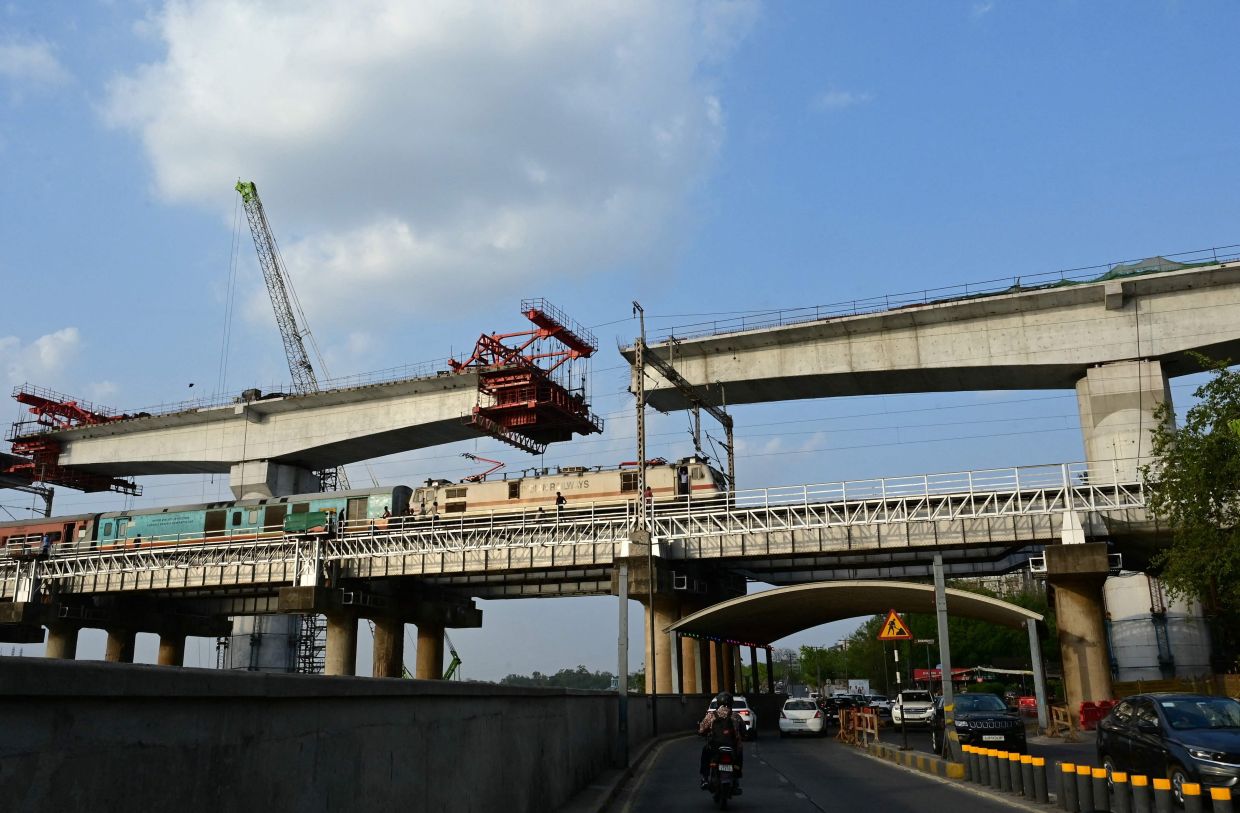
India's railway ministry has confirmed that the country's maiden high-speed bullet train service will commence operations in 2027, marking a significant turning point for a project that has endured repeated delays and cost pressures since its inception. The first operational segment will run between Surat and Vapi, two industrial powerhouses situated roughly 100 kilometres apart on India's western coast. This partial opening represents a decisive break from years of setbacks that have characterised the Mumbai-Ahmedabad High Speed Rail Corridor since work began in the early 2010s.
The project has become emblematic of Prime Minister Narendra Modi's broader vision for transforming India's transportation infrastructure, a commitment he made upon his election in 2014. Launched formally in 2017 during a joint initiative between Modi and then-Japanese Prime Minister Shinzo Abe, the venture was originally scheduled for completion by 2023. That deadline proved wildly optimistic, with numerous obstacles ranging from complex land acquisition processes to unanticipated construction challenges pushing timelines back by years. Railway officials now indicate that the complete corridor linking Mumbai and Ahmedabad should be fully operational by the end of 2028, positioning the route as a centrepiece of India's infrastructure transformation narrative.
The project employs Japan's advanced Shinkansen technology, underscoring India's reliance on international expertise to bridge gaps in domestic high-speed rail capabilities. The Japanese government has extended substantial financial support through the Japan International Cooperation Agency (Jica), covering approximately 81 per cent of the project's budgeted cost of US$17 billion. However, Indian media outlets have raised concerns that mounting expenses related to land acquisition and construction delays may substantially inflate the final bill beyond official estimates, introducing uncertainty into the financial framework.
The partial 2027 opening between Surat and Vapi carries strategic significance beyond mere scheduling achievement. Surat has established itself as the world's leading diamond-cutting hub, while Vapi serves as a major centre for chemical manufacturing and industrial production. Connecting these economically vital cities with high-speed rail infrastructure promises to facilitate greater commercial integration and reduce travel times that currently necessitate lengthy road journeys. This segment effectively functions as a proof-of-concept, demonstrating technological viability and operational feasibility before the system expands to cover the full corridor.
When fully operational, the complete Mumbai-Ahmedabad line will dramatically compress travel duration between India's financial capital and Gujarat's principal city. The current journey via conventional rail requires approximately six hours, whilst air travel involving ground transfers takes four to five hours. The bullet train will accomplish the same distance in just under two hours, operating at speeds reaching 320 kilometres per hour. This transformation carries profound implications for business travel, tourism, and the movement of goods, potentially reshaping economic patterns across western India.
The engineering complexity underlying this project remains formidable, requiring innovations unprecedented in Indian railway history. The route necessitates a 21-kilometre tunnel traversing mountainous terrain, presenting significant technical challenges in construction and safety protocols. More dramatically, the corridor includes India's first undersea railway tunnel, a milestone achievement that remains under construction. These engineering accomplishments position the project as a demonstration of India's expanding capacity to undertake world-class infrastructure development, sending important signals to international investors and development partners.
For Southeast Asia and the broader region, India's bullet train initiative carries considerable implications regarding competition in high-speed rail development. Several Southeast Asian nations, particularly Thailand and Vietnam, have explored similar projects with varying degrees of success and funding certainty. India's progress, however halting, suggests that technology transfer from developed nations can occur within South Asia, potentially influencing regional development patterns and investment flows. The project also reinforces India's strategic partnership with Japan, demonstrating how bilateral cooperation translates into tangible infrastructure outcomes that reshape economic geography.
The full completion timeline coordinates significantly with India's hosting of the 2030 Commonwealth Games in Ahmedabad, an event Modi's government views as preparatory groundwork for bidding to host the 2036 Olympic Games. Successfully delivering the bullet train before these international events would constitute a powerful symbolic statement regarding India's capacity to execute complex modernisation projects and compete at the highest levels of global infrastructure development. The government explicitly frames this connection, viewing major sporting events as catalysts for infrastructure investment and national prestige building.
Beyond the immediate Mumbai-Ahmedabad corridor, India has articulated ambitions for an expansive high-speed rail network spanning approximately 4,000 kilometres across seven proposed corridors. These routes would connect critical economic and strategic centres, including an east-west passage linking New Delhi to Varanasi—Modi's parliamentary constituency and Hinduism's holiest pilgrimage site—extending eastward to Siliguri, which serves as the crucial gateway connecting India's northeastern states to the remainder of the country. A complementary north-south network would link Ahmedabad and Mumbai, subsequently extending southeastward to encompass Pune, Hyderabad, and Chennai, India's major technology hubs.
The government characterises these proposed routes as "growth connectors," framing high-speed rail as fundamental infrastructure for economic integration and regional development. Yet these ambitious plans remain largely aspirational, lacking detailed timelines, confirmed funding mechanisms, or construction schedules. The success of the Mumbai-Ahmedabad project will substantially influence whether these visions transition from government briefing documents into concrete investments. For Malaysia and other Southeast Asian nations, India's trajectory in high-speed rail development warrants close attention, as successful execution could inspire regional governments to pursue comparable infrastructure ambitions and seek Japanese technological partnerships.
India's railway infrastructure has undergone remarkable transformation since the country's first passenger steam train departed from present-day Mumbai in 1853, representing 170 years of continuous development. Contemporary Indian Railways operates one of the world's most extensive networks, carrying 7.41 billion passengers annually along with 1.67 billion tonnes of freight. Approximately 80 per cent of the total 85,000-kilometre network now supports speeds of 110 kilometres per hour and above, reflecting systematic modernisation efforts. The domestically developed Vande Bharat trains, capable of reaching 180 kilometres per hour, have already transported nearly 40 million passengers, proving India's capacity for indigenous high-speed train development.
The bullet train project, despite its delays, remains India's flagship showcase for technological achievement in rail transport. At its design speed of 350 kilometres per hour and operational speed of 320 kilometres per hour, it represents a qualitative leap from existing Indian railway capabilities. Successfully launching this service would validate Modi's long-standing commitment to railway modernisation whilst demonstrating that India can execute world-class infrastructure projects despite the complexities of land acquisition, stakeholder coordination, and engineering challenges. The 2027 partial opening of the Surat-Vapi segment signals that momentum is finally building on a project that has become synonymous with both India's aspirations and the difficulties inherent in transforming ambitious visions into operational reality.

