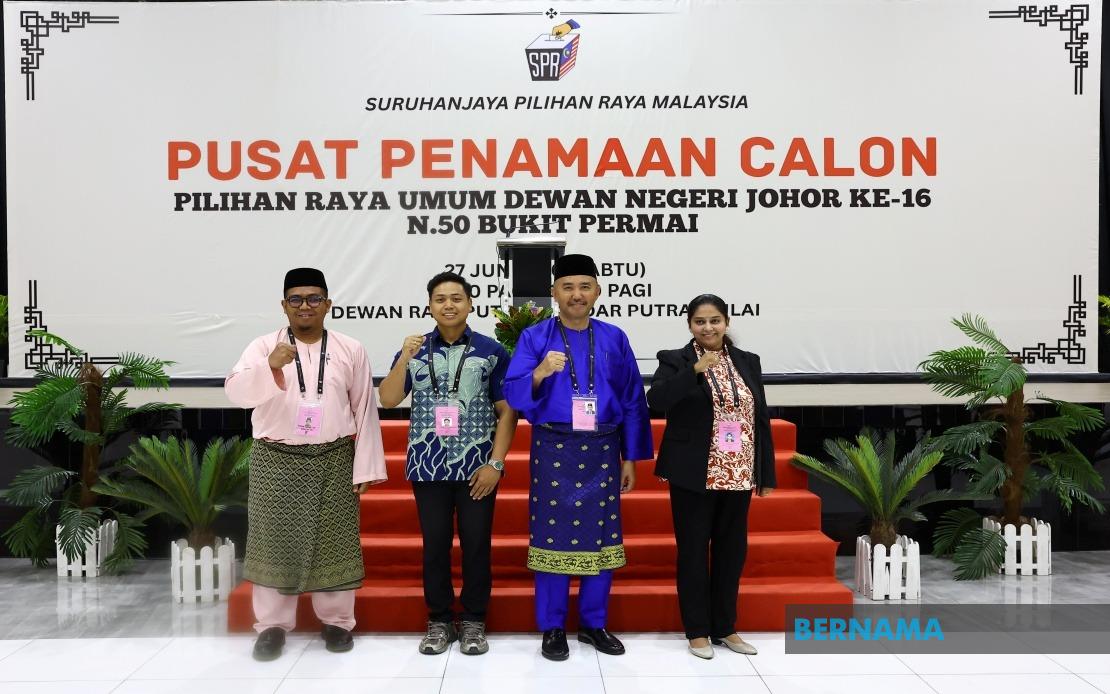
Datuk Mohd Jafni Md Shukor, the sitting Bukit Permai state assemblyman representing Barisan Nasional, will contend with three competing candidates in what promises to be a closely watched contest in the 16th Johor state election. The returning officer, Afzan Azhari, formally confirmed the candidacies at the nomination centre in Dewan Raya Putra at Bandar Putra in Batu Pahat following the closure of nomination at 10 am on June 27, unveiling a four-way battle for the constituency.
The challengers arrayed against the BN incumbent represent the region's major political blocs. Mohamad Shafwan Ani carries the banner of Pakatan Harapan, bringing the opposition coalition's bid to reclaim or expand ground in Johor. Perikatan Nasional has fielded M. Lina Manoh as its standard-bearer, reflecting the Islamist-leaning coalition's push to consolidate support in the southern state. Muhammad Aidil Riduan Mohd Yusof represents Parti Bersama Malaysia, a newer entrant seeking to carve out electoral space in the competitive Johor landscape.
The presence of four candidates reflects the fragmented nature of Malaysian politics, particularly in Johor, where multiple coalitions now compete for voter support. This configuration contrasts sharply with earlier eras dominated by two-cornered contests and demonstrates how the opposition's splintering, combined with Perikatan Nasional's growing presence and the emergence of smaller parties, has reshaped electoral dynamics across the peninsula. For Bukit Permai voters, the multiplicity of choices carries both opportunity and complexity.
Mohd Jafni's track record in the seat provides context for his re-election bid. In the 2022 Johor state election, he secured victory with a commanding majority of 4,755 votes, also in a four-cornered contest. That performance suggested strong support within the constituency and demonstrated BN's ability to consolidate voters even when facing multiple opponents. Whether that coalition can replicate or strengthen such results will depend on shifting voter sentiment across the state and locally specific factors.
The nomination process drew high-profile political figures keen to underscore their coalitions' commitment. Johor DAP chairman Teo Nie Ching arrived at the nomination centre at 8.26 am to accompany Mohamad Shafwan, signalling Pakatan Harapan's serious investment in the constituency. Such gestures serve both symbolic and practical purposes, rallying party machinery and voter confidence while demonstrating coordinated leadership behind candidates.
Bukit Permai's electoral significance extends beyond the constituency itself. As a Batu Pahat seat in Johor's southern corridor, it represents a traditionally important area for BN dominance. How the coalition performs here will offer clues about its broader standing in the state and potentially signal shifts in voter preferences that could reverberate nationally. A weakened BN performance or unexpected gains by opposition or Perikatan Nasional forces would carry implications for federal politics and future coalition configurations.
The election calendar now moves into its final phases. The Election Commission has designated July 7 as early voting day for the Johor election, providing opportunities for voters unable to cast ballots on the main polling day. The election itself will be held on July 11, giving candidates and their campaigns roughly two weeks from nomination to reach voters. That timeline is compressed compared to federal elections, intensifying the campaign period and requiring parties to rapidly mobilise their grassroots networks.
For Malaysian voters in Johor and observers elsewhere in Southeast Asia, this election represents a microcosm of broader democratisation patterns across the region. The presence of multiple competitors, the relative freedom in campaigning and nomination processes, and the orderly administration of electoral procedures reflect Malaysia's established democratic institutions, even as they reveal persistent struggles between competing power centres and ideological visions. The outcome in constituencies like Bukit Permai will shape Johor's government composition and influence the balance of forces affecting federal politics.
The four-cornered contest also reflects evolving voter behaviour and coalition politics. Whereas previous elections saw clear two-way battles between BN and Pakatan Harapan, contemporary Johor presents scenarios where Perikatan Nasional and smaller parties can become kingmakers or spoilers depending on vote distribution. Campaign strategies must therefore account not only for head-to-head matchups but for the possibility that fragmented support could produce unexpected outcomes. Candidates and parties will need to articulate distinctive messages that resonate with constituency-specific concerns while positioning themselves within broader state and national narratives.
The stakes in Bukit Permai extend beyond constituency representation. In a state where political control has shifted and coalition alignments have proven fluid, single-seat contests often receive outsized attention as indicators of momentum. A decisive victory for any contender would bolster that coalition's narrative; a narrow result would fuel debate about shifting sentiment or the role of tactical voting and candidate appeal rather than pure party preference. Such symbolic significance attaches itself to seemingly routine local elections within Malaysia's highly competitive political system.
As campaigns unfold in the weeks ahead, Bukit Permai will showcase the mechanics of contemporary Malaysian democracy: organised competition between established and emerging political forces, intensive mobilisation of supporters, and the fundamental exercise of voter choice. The outcome on July 11 will determine not only who represents the constituency but will contribute to a larger picture of political realignment in Johor and influence calculations about stability and change at the national level.

