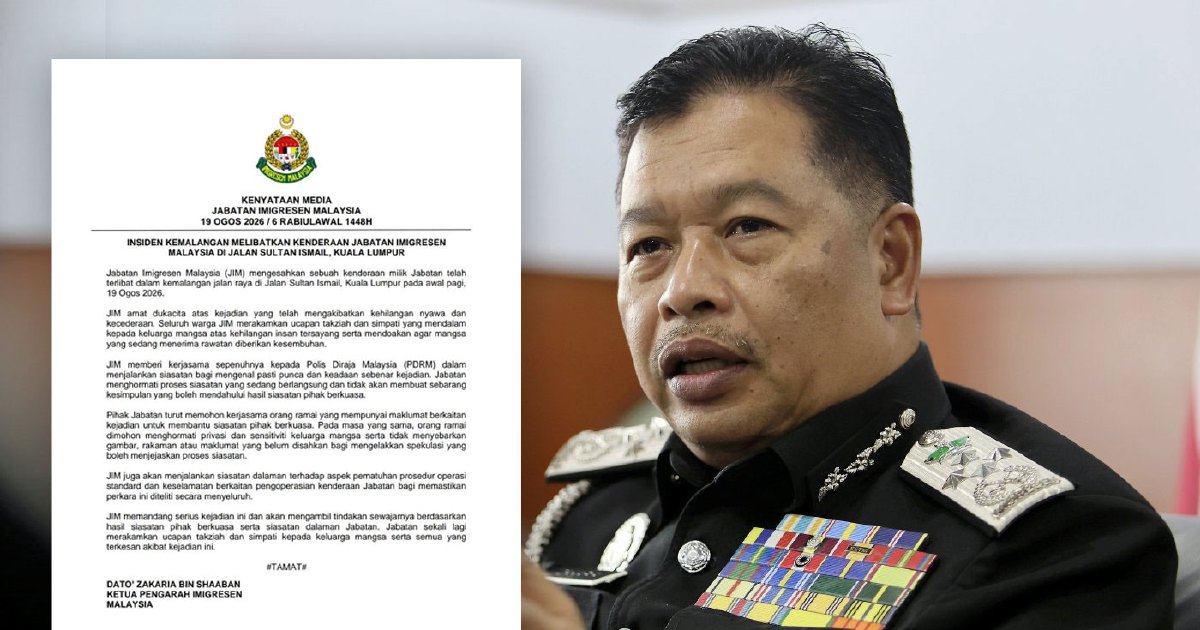
The Immigration Department has announced it will undertake a comprehensive internal review following a deadly traffic collision involving one of its official vehicles that occurred on Jalan Sultan Ismail in the early hours of today, with the investigation focusing on adherence to established safety procedures and operational guidelines.
Fatalities and accidents involving government vehicles often trigger scrutiny of departmental practices, particularly regarding driver protocols and vehicle maintenance standards. This incident marks another instance where a federal agency's transport safety measures face examination, adding to ongoing discussions within Malaysia's public sector about fleet management and occupational safety responsibilities. The department's commitment to launching an internal probe demonstrates an initial willingness to review its own procedures, though such investigations typically require several weeks to complete and publish findings.
The incident occurred along one of Kuala Lumpur's major thoroughfares during the early morning period, when traffic volumes are typically lower but vehicle speeds may be higher. Jalan Sultan Ismail runs through the commercial heart of Malaysia's capital, connecting several important administrative and business districts. The precise circumstances of the collision remain under official review, but the department's decision to examine SOPs suggests questions about whether established safety guidelines were properly followed at the time of the accident.
Standard operating procedures within government departments generally cover vehicle operation, driver qualifications, maintenance schedules, fatigue management, and emergency protocols. The Immigration Department's reference to examining compliance with these SOPs indicates investigators will scrutinise whether departmental standards were upheld, including considerations of driver training, vehicle roadworthiness, and adherence to speed restrictions. For a federal agency handling sensitive border and immigration matters, operational discipline across all divisions reflects institutional capability and public trust.
The fatal nature of the collision underscores the serious consequences when vehicle safety protocols break down. Government departments across Southeast Asia increasingly face pressure to demonstrate robust safety cultures, particularly following high-profile accidents. Malaysia's experience with fatal traffic incidents has led to periodic calls for stricter enforcement of road safety measures and enhanced training for professional drivers operating official vehicles. The Immigration Department's internal investigation may provide insights into whether additional resources or policy refinements are needed.
This incident also carries implications for the broader civil service. When government vehicles are involved in fatal accidents, the responsible department often faces questions about resource allocation, staff training programmes, and whether budget constraints have compromised vehicle maintenance or driver development initiatives. The internal investigation will likely examine whether the Immigration Department has adequate systems to monitor driver behaviour, vehicle condition, and compliance with traffic regulations.
Public sector agencies in Malaysia have increasingly adopted accident investigation protocols that mirror best practices in other nations, involving external oversight where appropriate. The Immigration Department's decision to conduct an internal probe may eventually be supplemented by external investigations, depending on whether criminal liability or regulatory breaches are indicated. Traffic police investigations typically run parallel to departmental reviews, examining mechanical factors, driver conduct, and whether any traffic violations preceded the collision.
For the Immigration Department specifically, any findings regarding operational shortcomings could have ripple effects across the agency's performance review and funding deliberations. As one of Malaysia's key enforcement agencies responsible for passport control, visa processing, and border security, the department's operational effectiveness reflects on the country's overall immigration management. Internal safety investigations thus carry significance beyond the immediate incident, potentially influencing departmental policies and resource priorities.
The investigation's scope extending to safety measures beyond just procedural compliance suggests the department may examine vehicle specifications, driver rest requirements, route safety assessments, and weather or road conditions that contributed to the incident. Modern internal investigations in government agencies typically employ multidisciplinary teams including engineers, safety specialists, and administrative personnel, though smaller departments may rely more heavily on senior management review.
This development also reflects changing expectations around corporate accountability within Malaysia's public sector. Increasingly, government departments are expected to demonstrate transparent investigation processes and willingness to implement corrective measures based on findings. Civil society observers and media scrutiny often focus on whether such internal reviews lead to meaningful institutional change or remain largely procedural exercises.
The timing of this announcement, coming immediately after the incident, suggests the Immigration Department is attempting to signal responsiveness and institutional diligence to the public and to relevant oversight bodies. However, the effectiveness of such responses ultimately depends on the investigation's thoroughness, the transparency of its findings, and whether recommendations are subsequently implemented with appropriate oversight and accountability mechanisms in place.

