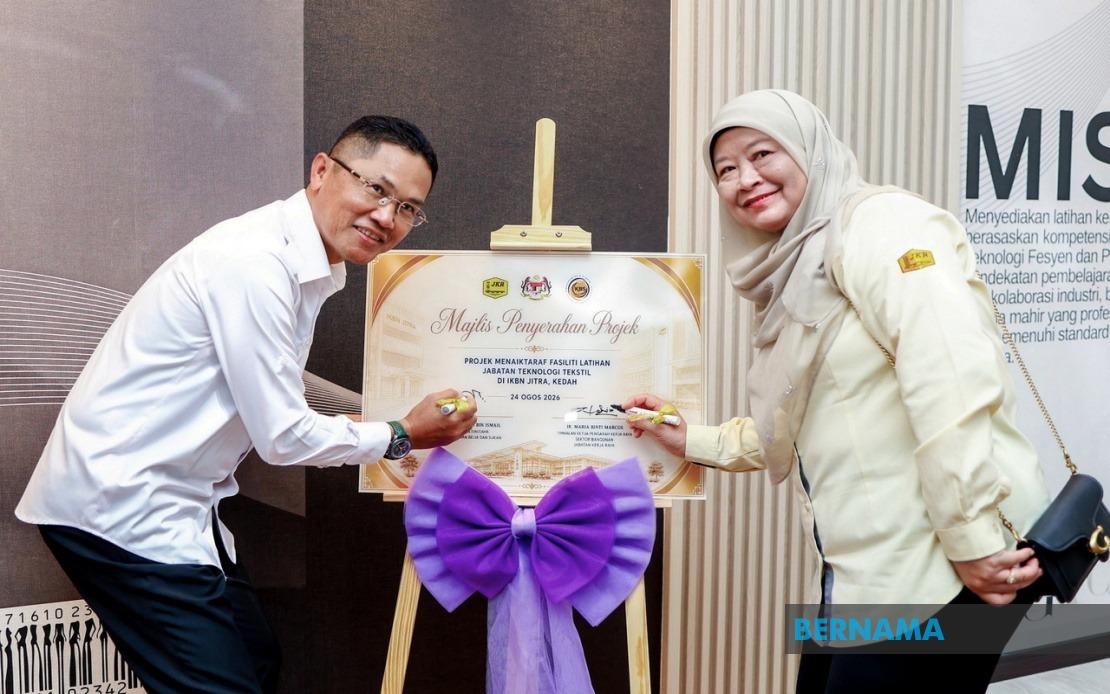
Malaysia's commitment to strengthening vocational and technical education took tangible shape this week with the completion of a RM3.7 million upgrading project at the National Youth Skills Institute (IKBN) in Jitra, Kedah. The initiative, officially handed over by the Youth and Sports Ministry (KBS), underscores the government's recognition that TVET infrastructure requires sustained investment to remain competitive in an increasingly technology-driven training landscape.
The overhaul of the Fashion and Clothing Technology Department represents more than routine maintenance. According to Datuk Rahimi Ismail, the ministry's secretary-general, the project encompassed structural building improvements, acquisition of modern information and communications technology equipment, and refurbishment of teaching spaces. These components work in concert to create training environments that mirror contemporary workplace conditions rather than relying on outdated facilities that divorce students from real-world industry operations.
Funded through Rolling Plan 4 of the 12th Malaysia Plan, the project demonstrates how Malaysia's long-term economic framework incorporates human capital development. The Public Works Department executed the physical construction, which commenced in June 2025 at a contract value of RM1.577 million. The allocation reflects a deliberate policy choice: that producing work-ready graduates justifies significant infrastructure expenditure, particularly in regions like Kedah where TVET institutions serve as crucial pathways for rural and semi-urban youth.
Key improvements include a Level Three fashion workshop equipped with contemporary machinery and a smart classroom incorporating digital learning technologies. These additions address a fundamental challenge facing Malaysian vocational institutions: the gap between classroom instruction and industry requirements. When trainees practice on equipment identical to what they will encounter in factories and design houses, the transition from education to employment becomes substantially smoother, reducing employer retraining costs and accelerating productive contribution.
The fashion and apparel sector holds particular strategic significance for Malaysia's manufacturing economy. It remains a labour-intensive industry where technological innovation—from computer-aided design to digital pattern-making—increasingly determines competitiveness. Institutions like IKBN Jitra that upgrade their capabilities help preserve domestic manufacturing's viability against competition from lower-wage countries, while simultaneously positioning graduates for emerging higher-value segments such as heritage textiles, sustainable fashion, and bespoke production.
Rahimi's remarks emphasised that TVET relevance demands continuous alignment with technological change and market evolution. This sentiment reflects a maturing understanding within government circles that vocational education cannot operate on static curricula. The fashion industry, driven by seasonal trends, consumer preferences, and production innovations, requires that trainers themselves remain updated on emerging techniques and tools. Modern facilities enable institutions to conduct regular capability-building for instructors, ensuring teaching content reflects current industry practice.
The handover ceremony also implicitly acknowledged regional development considerations. Jitra, located in Kedah's northern reaches, is positioned to serve not only local youth but also trainees from surrounding communities in Perlis and northern Perak. By investing in quality TVET infrastructure in provincial locations, the government works to distribute economic opportunity beyond Kuala Lumpur and George Town, potentially reducing rural-urban migration pressures while developing regional manufacturing capacity.
Aspirational language in official statements often masks practical challenges, yet the emphasis on international market penetration deserves scrutiny. Malaysian fashion graduates face intense global competition, and facility upgrades alone cannot guarantee export success. Nevertheless, improved training quality strengthens the foundation upon which such ambitions might be built. Graduates equipped with skills matching international standards possess considerably better prospects for employment in multinational fashion companies operating in Malaysia or for export-oriented entrepreneurship.
The project's timing appears strategic as well. Malaysia continues positioning itself as a regional manufacturing and services hub, and TVET excellence directly supports this objective. When neighbouring countries observe Malaysia investing substantially in vocational infrastructure, it signals a commitment to workforce quality that influences foreign direct investment decisions. Multinational companies seeking Southeast Asian production bases increasingly factor workforce training availability into location choices.
Looking forward, the success of this upgrade initiative will depend partly on how effectively IKBN Jitra integrates its enhanced facilities into curriculum development and partnerships with industry. Modern equipment without industry engagement risks remaining underutilised. Strategic collaborations with fashion retailers, manufacturers, and design companies can ensure that workshop projects align with authentic commercial challenges, providing students with portfolio-building opportunities while addressing genuine business needs.
The Jitra project also sets precedent for similar upgrades across Malaysia's TVET ecosystem. Other institutions will undoubtedly look to replicate this model, seeking comparable infrastructure investments. Whether the government can sustain funding momentum across multiple institutions—given competing budgetary pressures—remains an open question. Nonetheless, this week's handover ceremony demonstrates that policymakers recognise vocational training as deserving priority investment comparable to university infrastructure, a philosophical shift that bodes well for Malaysia's technical workforce development.
For students at IKBN Jitra, the tangible benefit is immediate: access to facilities that prepare them authentically for professional careers. For Malaysia's broader economic strategy, the upgrade reinforces a commitment to skills-based competitiveness that will likely determine regional manufacturing leadership over the coming decade.

