Hungary's political landscape has shifted dramatically as President Tamás Sulyok, a long-time ally of former Prime Minister Viktor Orbán, has capitulated to constitutional proceedings designed to oust him from office. After initially resisting the measure for several days, Sulyok announced he would countersign the constitutional amendments, effectively clearing his path out of the presidency. The decision marks a significant turning point in Hungary's recent political transformation, which began in April when Orbán's government was voted out, fundamentally disrupting a ruling coalition that had dominated Hungarian politics for over a decade.
The constitutional amendment passed through parliament last Monday, with new Prime Minister Péter Magyar subsequently issuing Sulyok a five-day ultimatum: countersign the changes or face impeachment proceedings. Rather than pursue a lengthy legal battle that appeared legally untenable, Sulyok chose to accept his removal, confirming Magyar's assertion that the constitutional changes would take effect and the presidency would become vacant starting Monday. This capitulation prevented what could have been a protracted constitutional crisis and allowed the machinery of governmental transition to proceed without the additional complications of forced impeachment.
During the interim period until a replacement head of state is elected—a process that must occur within 30 days—parliamentary speaker Agnes Forsthoffer will assume the presidential powers. In Hungary's system, the president is elected by the national parliament rather than through direct popular vote, meaning the selection process will unfold through legislative proceedings. This arrangement ensures continuity of executive function while allowing sufficient time for parliament to deliberate on a suitable candidate to fill the vacancy.
Sulyok's acquiescence, though reluctant, reflects the political realities confronting him despite his principled objections to the procedure. In his countersigning announcement, the outgoing president maintained that parliament's decision to remove him violated the constitution, yet he acknowledged the absence of viable legal remedies to contest the amendment. Hungarian constitutional experts had previously concluded that while the constitutional court might have raised formal procedural objections, it possessed no authority to challenge the substance of the parliamentary decision on constitutional grounds. This legal landscape left Sulyok with few realistic options beyond capitulation or a symbolic but ultimately futile impeachment battle.
Prime Minister Magyar has framed the constitutional reforms as fundamentally restorative, arguing they represent the recovery of democratic principles that had eroded during Orbán's extensive tenure. In a Facebook statement, Magyar declared that these changes would restore to the Hungarian people "the certainty that power is limited, common property can be reclaimed and the state can once again serve its citizens, the free Hungarian citizens." The rhetoric underscores the new government's positioning of its reforms as reversals of what it characterizes as authoritarian consolidation of power under the previous administration.
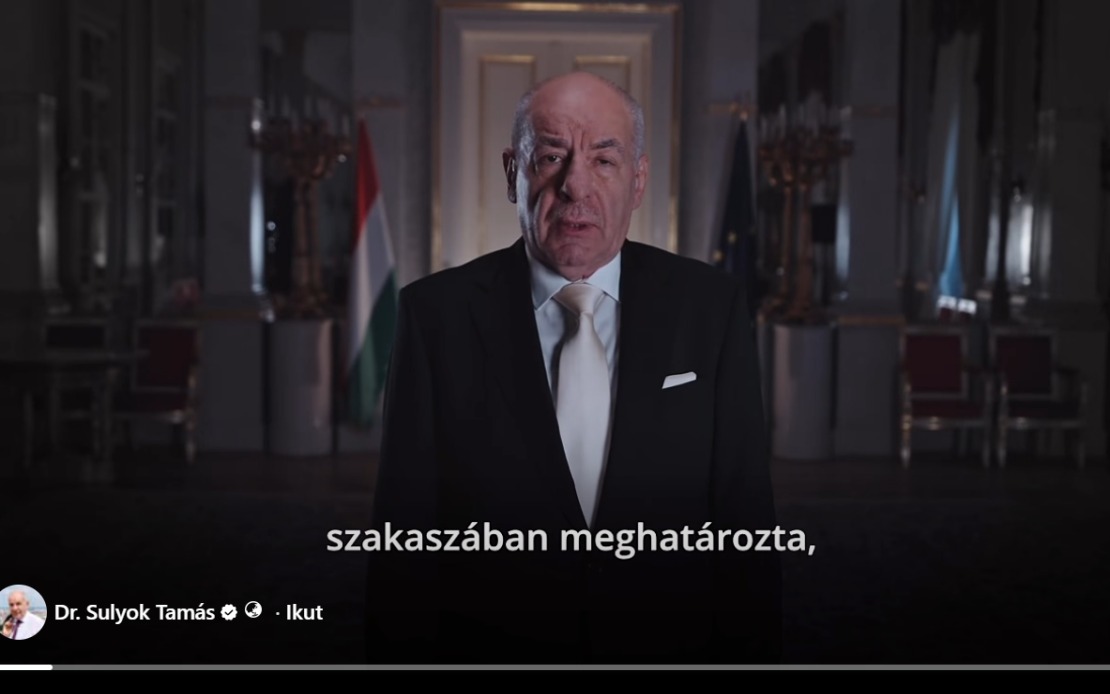
Yet Sulyok's final video address to the nation highlighted a troubling dimension of the constitutional changes that warrants serious consideration. The departing president lamented that Hungary's presidency has become structurally weakened to the point where the head of state now exists "at the mercy of the executive and politics" with "no control function" remaining. This critique suggests that in addressing what it perceives as the previous regime's democratic deficiencies, the new government may have overcorrected by eliminating meaningful checks on executive authority. The weakening of the presidential office raises questions about the adequacy of constitutional safeguards in Hungary's revised institutional framework.
For Malaysian observers, Hungary's constitutional turbulence offers instructive parallels regarding the fragility of democratic institutions when concentrated political power creates opportunities for rapid institutional reformation. Like Malaysia, Hungary is a parliamentary democracy where legislative majorities possess considerable authority to reshape fundamental institutions. The speed and relative ease with which a newly empowered parliamentary majority can engineer constitutional changes—including the removal of an incumbent president who enjoyed legitimate election—illustrates the vulnerability of constitutionally protected positions to legislative majorities pursuing transformative agendas.
The Hungarian case also demonstrates the limited utility of constitutional court intervention in politically charged scenarios. While legal expertise might identify technical irregularities, courts confronting determined parliamentary majorities backed by electoral mandates often find themselves constrained in their ability to enforce substantive constitutional principles. This dynamic has relevance for Malaysia's own constitutional framework and the role of its courts in mediating power struggles between competing branches of government.
The broader implications extend to Southeast Asia's democratic experiments more generally. The transition from Orbán's government and the subsequent constitutional upheaval suggest that electoral defeats of long-entrenched ruling coalitions can trigger cascading institutional changes as victorious successors seek to reshape governance structures. For nations in the region with similarly dominant political coalitions or strong presidential or parliamentary executives, Hungary's experience underscores both the possibility of electoral-driven transitions and the constitutional vulnerabilities that such transitions can expose.
The constitutional amendments now taking effect in Hungary go beyond the presidential removal, enabling broader political reforms that the new government frames as modernizing and democratizing measures. However, the simultaneous weakening of the presidential office that Sulyok lamented suggests these reforms may represent a recalibration of power rather than a comprehensive restoration of democratic checks and balances. Whether the new institutional configuration provides adequate constraints on executive authority or whether it simply redirects concentration toward the prime minister's office remains to be seen as Hungary's political transition continues unfolding.

