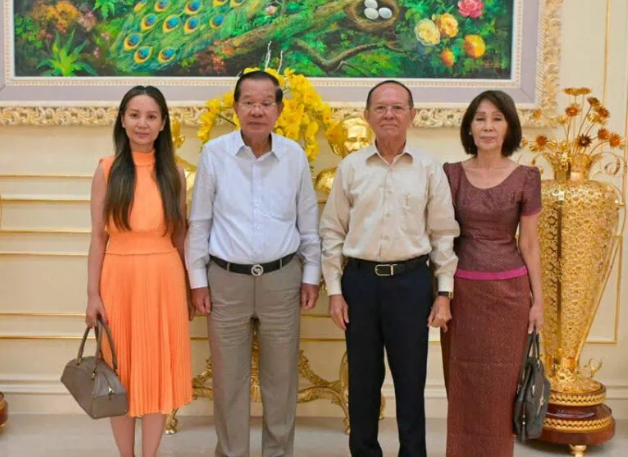
Cambodia's political landscape appears to be undergoing a subtle but significant realignment following the recent private meetings between Senate president Hun Sen and Kem Sokha, once his most formidable political adversary. The two leaders met at Hun Sen's residence on Sunday morning for three hours, during which the ruling party chief praised Sokha's daughter, Kem Monovithya, in unexpectedly glowing terms that have sparked speculation about shifting dynamics within the Southeast Asian nation's leadership circles.
Hun Sen disclosed the encounter through a social media announcement, revealing that Sokha arrived accompanied by his wife and daughter for the morning gathering that commenced at 9am and concluded at noon. The Senate president noted that this represented Sokha's second recent visit to his home, following an earlier gathering several weeks prior during which the former opposition leader had discussed plans to visit troops and civilians displaced by the ongoing Cambodia-Thailand border tensions. The precise topics discussed during the three-hour session remain undisclosed, and Hun Sen provided no commentary regarding whether political matters featured prominently in their conversation.
Particular significance attaches to Hun Sen's direct commendation of Monovithya, whom he described in familial terms as his "niece" while emphasising that he had devoted considerable time during the meeting to conversing with her. His characterisation of the younger woman as an "excellent human resource for the nation" carries particular weight given her substantial history within Cambodia's opposition movement, having served in significant roles within the Cambodia National Rescue Party that her father previously led. The remark, whether intentional or otherwise, suggests that doors which appeared permanently closed in Cambodia's fractious political environment may now be gradually reopening.
The evolving relationship between these two figures represents a dramatic reversal from a decade of intense political confrontation. Kem Sokha stood as co-founder and president of the CNRP, which emerged as Cambodia's primary opposition force during the 2013 national elections and the 2017 commune elections before the Supreme Court dissolved the party in November 2017. That dissolution came mere weeks after Sokha's arrest on charges that would ultimately result in a 27-year prison sentence imposed in 2023 for alleged conspiracy with foreign powers—accusations his supporters have consistently dismissed as politically motivated.
Sokha's legal situation has undergone substantial modifications over recent months, developments that coincide with his gradual reintegration into public life. The Phnom Penh Appeal Court upheld his conviction and sentence on April 30, 2026, but circumstances shifted dramatically when a royal pardon on May 25 terminated his remaining imprisonment and house arrest obligations. Although political activity restrictions remained in force, a subsequent royal decree issued on July 24 lifted a five-year overseas travel prohibition that had constrained his movements. These incremental steps, while maintaining formal restrictions on his political participation, have created space for him to appear in public as what he describes as a private citizen.
The timing of Sokha's return to public visibility merits careful analysis within the broader context of Southeast Asian politics and Cambodia's internal reconciliation efforts. On July 28, merely days after his travel restrictions were lifted, Sokha travelled to Banteay Meanchey province to engage with families displaced by Cambodia-Thailand border conflicts. During that visit, he scrupulously maintained the fiction of acting in a personal rather than institutional capacity, emphasising that he represented no political party or state entity. Nevertheless, his willingness to articulate concerns about displaced Cambodians to international community members suggests he remains engaged with substantive national issues despite formal prohibitions on political activity.
For Malaysian and broader Southeast Asian observers, these developments carry implications extending beyond Cambodia's borders. The region has witnessed recurring cycles of political conflict followed by tentative reconciliations that frequently prove fragile or incomplete. Cambodia's experiment in cautiously reintegrating a disgraced opposition figure while maintaining restrictions on his political agency offers lessons regarding the possibilities and limitations of managed political rehabilitation. The gradual nature of Sokha's return to public life, through carefully staged royal decrees rather than dramatic announcements, reflects a desire to avoid triggering backlash while simultaneously signal that certain exclusions may not be permanent.
The question of Monovithya's future role remains deliberately ambiguous. Hun Sen's praise, while flattering, contains no explicit indication regarding whether he envisages her assuming any formal political or public position. Her background within the CNRP, combined with her family name and demonstrated engagement with national issues, would position her to play various roles should restrictions be progressively eased. The very fact that Hun Sen chose to highlight her in his social media statement, rather than simply acknowledging Sokha's visit, suggests she occupies his calculations regarding Cambodia's political evolution.
Observers should note that neither Hun Sen nor Sokha's representatives have framed these meetings as components of a formal reconciliation process or political agreement. The carefully maintained discretion regarding discussion topics, combined with the absence of joint statements or announcements, indicates both parties wish to preserve flexibility and avoid triggering concerns among their respective supporters. For Hun Sen, acknowledging too openly that he is rehabilitating his former rival might appear to signal weakness or concession. For Sokha, accepting overtures without explicit guarantees regarding future political participation or his family's standing could appear naive or defeatist.
The Cambodia-Thailand border situation provides convenient cover for Sokha's public reappearance, allowing both him and the government to characterise his activities as humanitarian rather than political in nature. This framing permits incremental steps toward normalisation without requiring either party to make formal concessions or negotiate transparency. Whether these meetings ultimately presage substantive political changes, formal party rehabilitation, or simply reflect a gradual softening of personal animosities remains unclear, and both leaders appear content to allow ambiguity to prevail for now.
For Cambodia's broader political landscape, these developments suggest that the regime's confidence may be sufficiently secure to tolerate increased visibility and engagement by opposition figures and their families. Conversely, Sokha's acceptance of Hun Sen's hospitality and his careful maintenance of the private citizen distinction indicate that he recognises the limits of what remains politically possible for him under current arrangements. The three-hour conversation at Hun Sen's home may ultimately represent less a prelude to dramatic political transformation and more an acknowledgment that permanent exclusion serves neither party's interests, even if full rehabilitation remains officially off the table.

