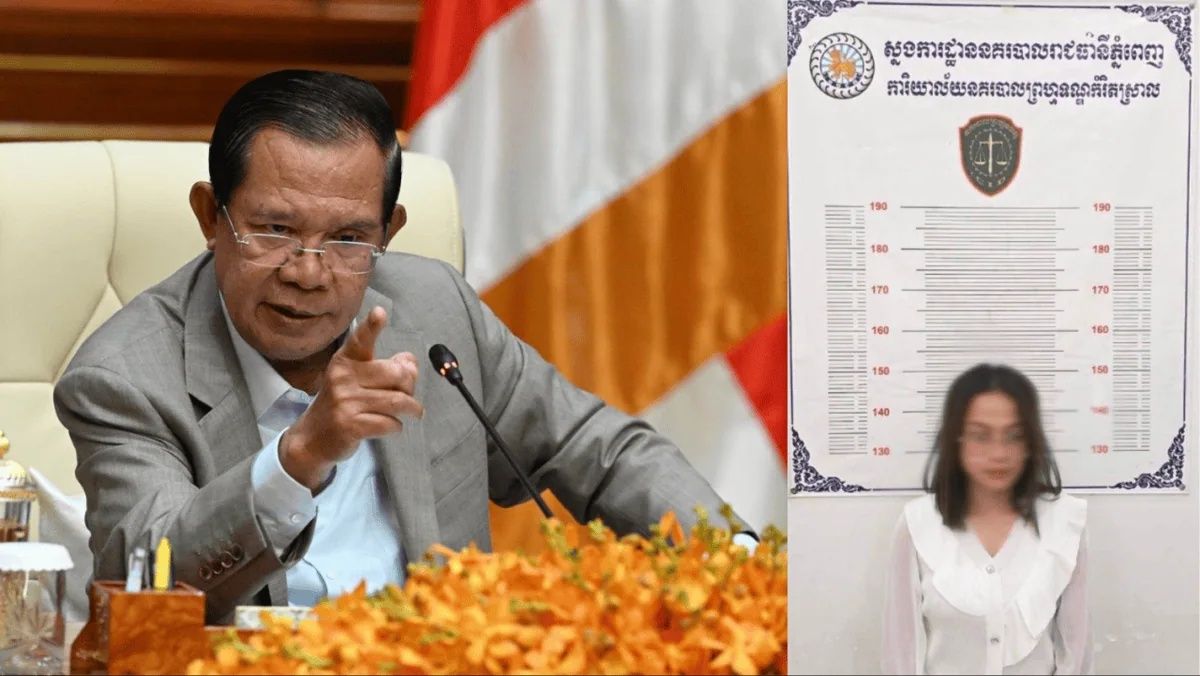
Cambodia's Senate president Hun Sen has ordered the Ministry of Women's Affairs and the National Council for Women to serve as plaintiffs in legal proceedings against citizens accused of using demeaning language toward women and violating broader Khmer social ethics. The directive emerged during a Friday meeting with council representatives, signalling a coordinated government approach to what officials characterise as linguistic degradation of national values and institutions.
Hun Sen cited two recent incidents to justify the initiative. An unnamed woman allegedly employed vulgar language to insult government agencies and public servants, prompting authorities to summon both her and her husband for a formal written apology. A second case involved a woman identified as Chenda Sovannary, who reportedly engaged in heated exchanges with a soldier during a dispute concerning a mobile phone transaction. These examples formed the basis for Hun Sen's broader commentary on what he views as unacceptable social conduct.
During his remarks, Hun Sen questioned why any citizen would resort to insults over trivial matters, framing the soldier incident as particularly egregious. His comments extended beyond the specific cases to encompass working-class individuals generally, suggesting that construction workers and other ordinary professionals equally deserve protection from verbal abuse. This framing attempts to position the policy as universally protective rather than targeting specific groups, though critics may observe that the emphasis on women's councils directing litigation raises distinct questions about application and intent.
The Senate president attempted to preempt accusations that such measures represent authoritarian overreach by drawing parallels to private sector practices. He noted that major social media companies maintain community standards and enforce ethical guidelines without facing accusations of rights suppression, implying that government action should be treated similarly. This comparison proved controversial, as it conflates voluntary platform governance with state-mandated legal prosecution, fundamentally different mechanisms operating under different accountability frameworks.
Hun Sen explicitly instructed the National Council for Women to establish monitoring capacity focused on social media platforms, particularly Facebook, where much public discourse now occurs. He called for dedicated teams to track instances of cursing and insulting language, effectively proposing systematic digital surveillance of online speech. The emphasis on Facebook specifically reflects Cambodia's heavy reliance on the platform for civic participation and information exchange, making it a natural focal point for government attention.
The initiative requires coordination among multiple government entities to construct what Hun Sen termed a protective mechanism for Khmer women's dignity and values. The Ministry of Interior, Ministry of Information, Ministry of Culture and Fine Arts, and Ministry of Post and Telecommunications must collaborate to establish enforcement frameworks. This multi-agency approach suggests the government intends comprehensive implementation rather than ad-hoc prosecution, raising logistical and policy questions about coordination, resource allocation, and decision-making authority.
Hun Sen defended the policy by asserting it aims to protect national dignity rather than restrict fundamental freedoms, a distinction that observers in Southeast Asia and internationally have scrutinised. Cambodia has faced repeated criticism from human rights organisations regarding its record on free expression, press freedom, and online speech protections. Previous governments have employed broadly defined legal concepts to constrain dissent and restrict opposition activities, creating context that informs how this new directive may be perceived and potentially applied.
The legal mechanism proposed through women's affairs bodies introduces procedural questions about standing, evidentiary standards, and appellate review. Whether women's councils possess adequate legal expertise to serve as plaintiffs and whether courts will apply consistent standards across cases remain unresolved. The involvement of women's affairs authorities in criminal or civil prosecutions creates institutional tensions, as these bodies traditionally address policy development, advocacy, and community engagement rather than litigation.
For Malaysia and other Southeast Asian nations, Cambodia's approach illustrates evolving government strategies regarding online speech and social media regulation. As digital platforms become primary venues for public discourse throughout the region, governments increasingly develop frameworks nominally targeting specific harms—whether framed as protecting women, preventing immoral content, or safeguarding national dignity—that potentially affect broader speech rights. Malaysian readers should observe how such policies develop and how courts interpret enabling legislation, as regional governments sometimes adopt similar approaches.
The policy's implications extend beyond Cambodia. It reflects broader regional tensions between aspirational governance frameworks emphasising digital safety and cultural values alongside international commitments to human rights and free expression. The framing of speech restrictions as protective rather than restrictive, and the invocation of private sector analogy to justify government action, represent argumentative patterns that merit careful examination. These rhetorical strategies appear in policy debates throughout Southeast Asia, shaping how citizens and policymakers understand proportionate responses to legitimate social concerns.
Implementation challenges will test the policy's actual scope. Defining what constitutes impermissible insult versus protected criticism, determining whether political speech receives different treatment, and ensuring consistent application across cases will likely prove contentious. Cambodia's judiciary's independence record raises concerns about whether prosecution will remain focused on the stated objective of protecting women's dignity or expand to encompass broader political speech.
The directive also raises questions about enforcement priorities and resource utilisation. Whether law enforcement agencies will prioritise investigating disputed mobile phone transactions and alleged insults over other crimes, and whether prosecutorial resources should focus on such cases, reflects broader policy choices about justice system priorities. These tensions between symbolic governance addressing social values and practical crime prevention represent ongoing challenges for Southeast Asian governments balancing multiple, sometimes competing objectives.

