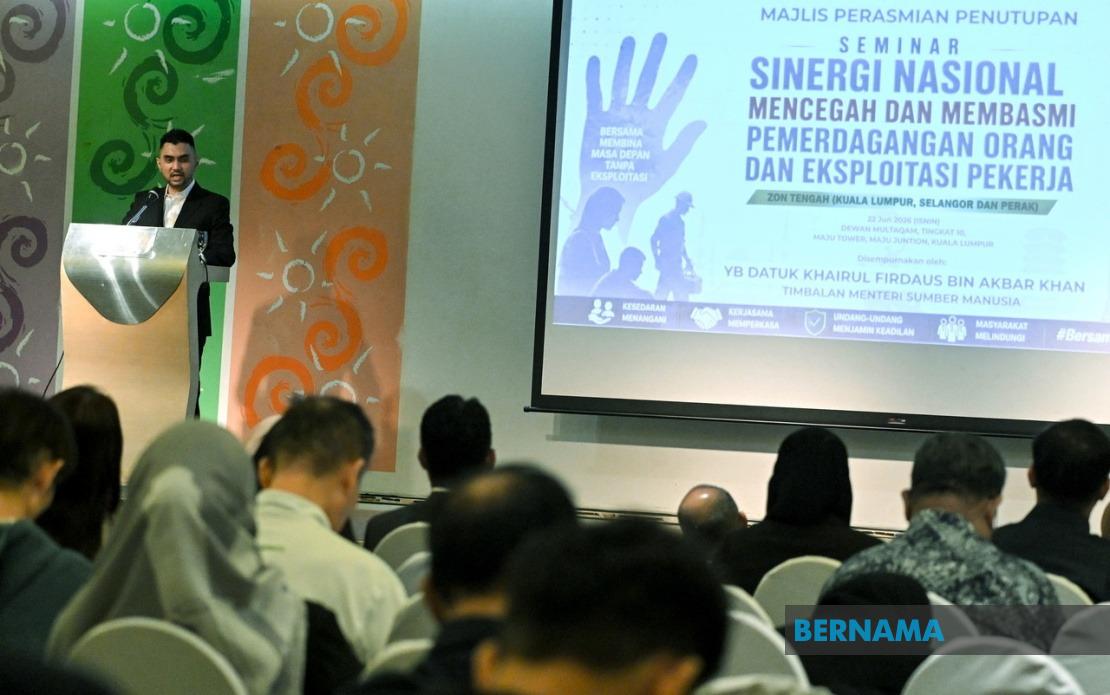
The steady downward trajectory in human trafficking and labour exploitation cases rescued across Malaysia since 2023 reflects growing success in government enforcement operations, according to Deputy Human Resources Minister Datuk Khairul Firdaus Akbar Khan. Speaking after the closure of the National Synergy Seminar on Preventing and Eradicating Human Trafficking and Labour Exploitation in the Central Zone, he highlighted figures showing 70 victims rescued in 2023, a sharp drop to 10 in 2024, a modest uptick to 17 in 2025, and just four recorded cases through May of this year according to data compiled by the Peninsular Malaysia Manpower Department (JTKSM).
While the declining numbers offer encouragement to policymakers and enforcement agencies, the minister cautioned against complacency, recognising that official statistics may not capture the full extent of this hidden crime. The gap between reported and actual victims remains a persistent challenge in combating trafficking networks that deliberately operate in shadows to avoid detection. Khairul Firdaus emphasised that although enforcement appears to be working, the criminality of human trafficking and labour exploitation inherently tends to escape official notice, creating blind spots in the data that could mask an ongoing problem beneath the surface.
The government's commitment to tackling forced labour has materialised in intensive operational activity during the first five months of 2026. A total of 386 enforcement operations focused on labour violations were conducted nationwide, resulting in the opening of 311 investigation papers. These figures demonstrate a substantial institutional effort to identify, investigate, and prosecute those involved in labour trafficking schemes, ranging from agricultural enterprises to manufacturing facilities and domestic service arrangements. The breadth of these operations suggests authorities are casting a wide net across multiple economic sectors where vulnerability to exploitation tends to concentrate.
Malaysia's efforts align with international standards established through its ratification of International Labour Organisation protocols designed to eliminate forced labour globally. The ILO framework provides both benchmarks for measuring progress and technical guidance for strengthening domestic mechanisms. By anchoring its anti-trafficking agenda to these international commitments, Malaysia demonstrates accountability to the global community and gains access to best practices developed by other nations grappling with similar challenges. This alignment also facilitates regional cooperation and information-sharing across Southeast Asia, where trafficking networks often operate across borders.
The National Synergy Seminar initiative represents a preventive approach that complements traditional enforcement activities. Operating as a series of national awareness tours, the JTKSM-organised events travel to different zones, providing education and exposure regarding the mechanisms of human trafficking and the vulnerability factors that make certain populations susceptible to exploitation. Nearly 1,000 participants attended seminars across three zones—the North Zone in Sungai Petani, Kedah on May 18, the Central Zone programme, and the South Zone in Kluang, Johor on June 8—creating forums for frontline workers, community leaders, employers, and civil society representatives to exchange insights and coordinate responses.
The seminar structure reflects recognition that combating trafficking requires multi-stakeholder engagement rather than enforcement action alone. When diverse participants share perspectives and recommendations, they build a collective understanding of emerging vulnerabilities and develop coordinated prevention strategies. Employer participation proves particularly valuable, as awareness among business leaders about their supply chains and labour practices can prevent situations where trafficking occurs inadvertently through contractor networks or subcontracted workers. Similarly, engagement with community organisations strengthens early warning systems that detect suspicious recruitment patterns or coercive labour arrangements before victims become trapped.
Malaysia's position as a destination country for trafficked persons from neighbouring states places particular responsibility on its institutions. Economic disparities across Southeast Asia create push factors that drive vulnerable migrants toward Malaysia's relatively higher wages, while labour demand in sectors such as agriculture, construction, and domestic service creates pull factors. Criminal networks exploit this imbalance, promising legitimate employment while delivering debt bondage, document confiscation, and restrictive working conditions. The declining rescue numbers may reflect better border screening, improved labour inspections, or successful prosecution campaigns that deter trafficking operations, yet the persistent flow of undocumented migrants into Malaysia suggests continued vulnerability.
The investigation paper statistics offer insight into enforcement priorities and capacity. Opening 311 cases from 386 operations indicates selective prosecution focusing on the most serious or prosecutable violations. Investigators must build evidence chains sufficient to secure convictions in courts, requiring victim testimony—sometimes challenging when survivors remain traumatised or fear deportation—alongside documentation of wage theft, movement restrictions, and other coercive practices. The ratio suggests authorities exercise judgment about case viability while managing limited prosecutorial resources, though critics argue this approach may allow marginal offenders to escape accountability.
Regional cooperation mechanisms remain underdeveloped despite the transnational nature of trafficking networks. Information-sharing between Malaysia and source countries in Southeast Asia could strengthen prevention at origin points, while coordinated investigations across borders could dismantle trafficking syndicates operating regionally. Bilateral agreements with Thailand, Myanmar, Laos, and Cambodia regarding labour standards and trafficking prevention could address root causes in source communities. Enhanced cooperation with Indonesia, which sends substantial numbers of domestic workers to Malaysia, would benefit both nations' workers and reduce vulnerability to exploitation in transit and at destination.
The challenge ahead involves sustaining momentum in enforcement while deepening preventive interventions. Malaysia might expand the awareness seminar model into workplaces and educational institutions, embedding anti-trafficking principles in occupational safety training and student curricula. Strengthening victim support services—including shelter, legal assistance, and psychological care—encourages survivors to report crimes and testify against traffickers. Addressing root causes through regional development initiatives that reduce economic desperation in source communities offers long-term solutions, though requiring sustained commitment across multiple countries with varying political priorities and resource constraints.