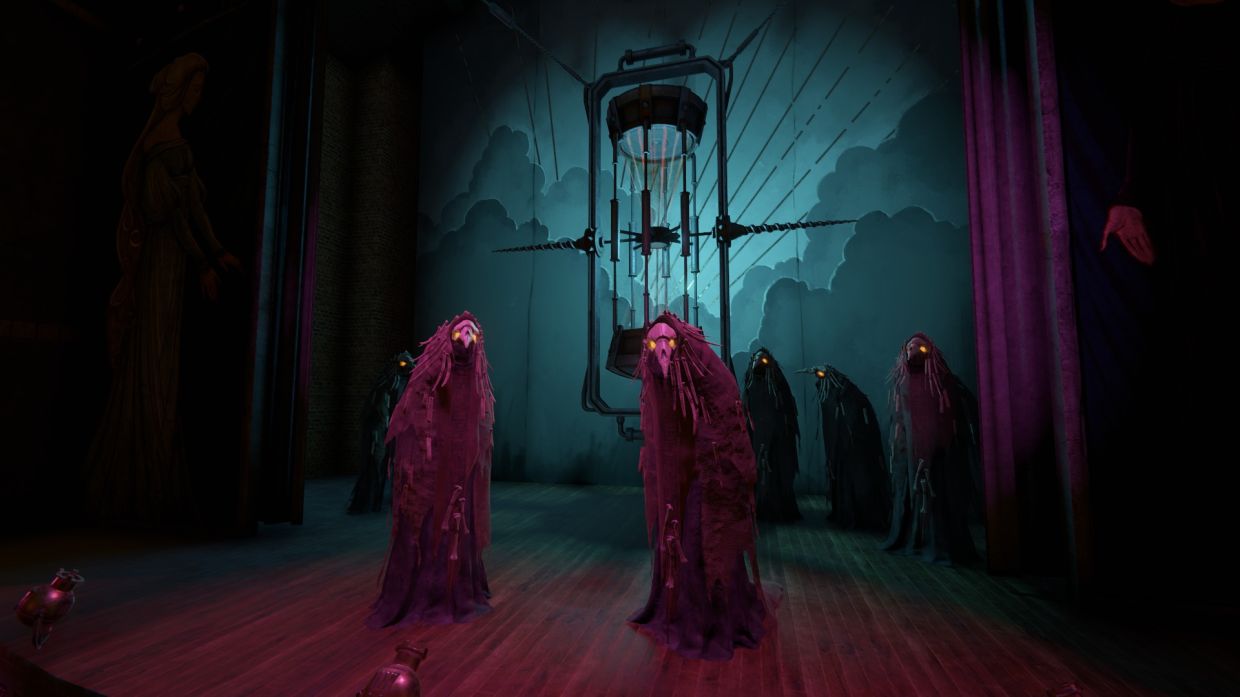
Video games have largely followed the trajectory of other entertainment media—designed to provide comfort, escape, and the dopamine rush of achievement. Yet a small Russian studio is swimming against this current, crafting experiences that deliberately embrace discomfort and failure as their central artistic purpose. Ice-Pick Lodge, a Petersburg-based developer, has created narrative-driven games that reject the conventional formula of progression and reward, instead forcing players to grapple with moral ambiguity, resource scarcity, and the inevitability of setback.
The studio's approach centres on characters whose dialogue contains profound philosophical weight. A severe judge with white hair intones that ambitious dreams inevitably crumble when their moment passes. A theatre director warns that a production's worth is measured by how thoroughly it destabilises the audience—demanding a doctor, a spa, morphine, a priest, or a coffin. These aren't throwaway lines but thematic anchors that signal the games' refusal to provide easy answers or comfortable narratives. By embedding such stark observations into character speech, the developers ground their artistic philosophy directly into the player's experience.
Alexandra Golubeva, game director at Ice-Pick Lodge, sees this approach as a corrective to the broader entertainment ecosystem. While most games and digital platforms operate on short feedback loops—the 30-second TikTok cycle, the bite-sized achievement systems designed to trigger repeated dopamine responses—her games do precisely the opposite. They create deliberately jarring, prolonged experiences of discomfort that players must endure. Golubeva frames this as offering something genuinely counterculturative: the opportunity to subject oneself to sustained difficulty, emerging into one's normal life with a renewed appreciation for comfort and stability. The logic is almost paradoxical—make yourself miserable in the game world so that your actual life feels better by comparison.
This philosophy extends to the technical structure of gameplay. Players begin with overwhelming responsibility—save as many lives as possible, or choose not to. Simultaneously, they encounter layered mysteries: where does plague come from, does it serve a purpose, and what do the townspeople hiding about their true intentions? The game design systematically undermines moral certainty. Players will make wrong choices. Characters will deceive them. Assumptions will prove false. The experience is calibrated to generate cognitive and emotional discomfort, not to celebrate player mastery.
The difficulty settings themselves become philosophical statements. Players who attempt to reduce the challenge encounter a stern warning: the experience is designed to be "almost unbearable." This isn't marketing hyperbole but a genuine design principle. One player progressed to Day 5 before the game's systems overwhelmed him—his character spiralled into poverty and hunger, creating a death loop he couldn't escape. Only by adjusting settings did he regain footing, but even this adjustment came as a confession of weakness rather than a victory.
Gabriel Winslow-Yost, a contributing editor at a major gaming publication, notes that video games possess a unique capacity to access negative emotional states that other media cannot reach as directly. Film, literature, and theatre can present failure and tragedy, but games place the player inside failure, making it their own lived experience rather than a spectacle observed from distance. This distinction matters profoundly for how audiences process these themes psychologically.
The narrative mechanics reinforce this philosophy through time-travel mechanics that paradoxically increase tension rather than reducing it. Players can theoretically reverse decisions by travelling backward and altering their choices. However, this ability is gated by a limited in-game resource. Exhaust it and the option vanishes entirely. Some quests are designed to permanently erase save files, eliminating even the possibility of reversion. The game thus mimics reality's fundamental constraint: you cannot undo everything, and some consequences are irreversible.
Alexander Souslov, executive producer and lead designer, emphasises that failure in video games operates differently from failure in actual life. In reality, people naturally reframe negative events constructively, finding silver linings and lessons. But within a game's bounded system, failure becomes unmistakably personal. That bad ending belongs entirely to the player. Their avatar's suffering reflects their own decisions. This ownership of failure—the inability to rationalize it away—creates psychological conditions unavailable in other media. Players cannot claim the character failed; only they could have chosen differently.
This design inverts conventional power fantasy narratives. Most games celebrate the player's triumph over adversity, the hero's journey from weakness to dominance. Ice-Pick Lodge games begin from a position of absolute catastrophe and invite the player to salvage what they can. Recovering from total failure becomes its own form of empowerment—not the fantasy of transcendent victory, but the grittier satisfaction of incremental recovery after disaster. This represents a mature gaming aesthetic, one that acknowledges how adult life rarely involves unambiguous victories and more often concerns managing accumulated failures.
For Southeast Asian audiences, where many countries maintain strong narrative traditions emphasizing moral instruction and philosophical reflection, this Russian approach offers an intriguing alternative to Western gaming conventions. Rather than importing games built exclusively around reward loops and escapism, this model demonstrates how interactive media can function as philosophical inquiry. The games ask what happens when players genuinely face the consequences of their choices, when comfort is withheld, and when failure becomes inescapable. In an entertainment landscape increasingly dominated by attention-extracting algorithms and quick-hit satisfaction mechanics, Ice-Pick Lodge proposes that some of gaming's greatest potential lies in making players deeply, uncomfortably aware of their own capacity for failure.

