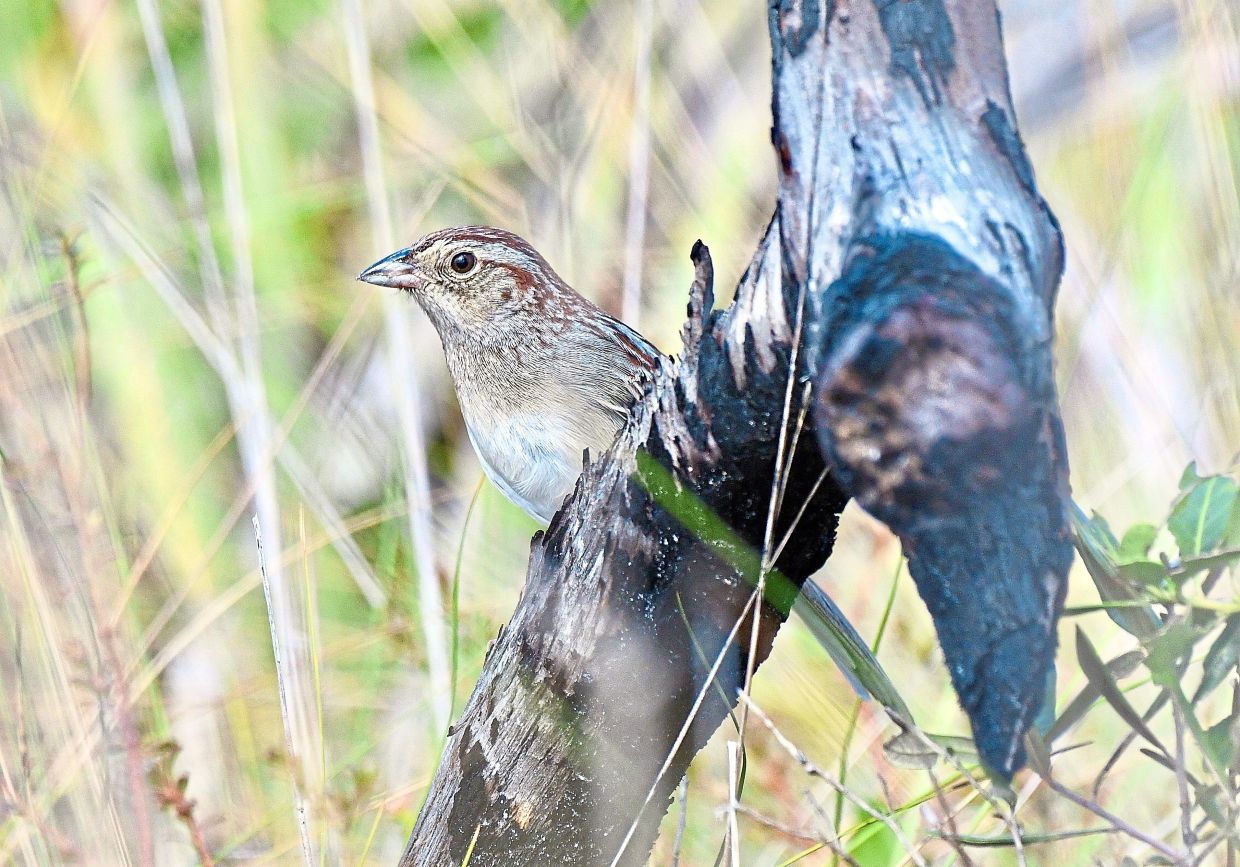
In the pine flatwoods of South Florida, small brown sparrows emerge from dense undergrowth to vocalize from tree branches, producing a remarkable diversity of sounds that belies their understated appearance. The Bachman's sparrow, a species familiar to ornithologists and birdwatchers across the region, demonstrates an astonishing vocal repertoire that challenges our understanding of how animals learn and transmit cultural knowledge across generations. Within a single population, these birds collectively maintain approximately 120 distinct song types, yet any individual sparrow will learn only a fraction of this total—typically around 48 different variants—during its formative years.
The question of how young birds select which songs to adopt has fascinated researchers for decades, particularly as the answer illuminates broader principles of animal behavior and evolution. Traditional explanations have emphasized social and cultural mechanisms, with scientists attributing song choice to the tendency of juvenile birds to imitate successful males who demonstrate superior courtship abilities or display elaborate physical ornaments. This framework, while valuable, has presented an incomplete picture of the forces shaping vocal traditions within bird communities. The assumption that cultural transmission operates independently of environmental factors has begun to crack under closer scrutiny.
Recent research conducted at Florida Atlantic University and published in March introduces a previously underexplored dimension to this puzzle: the acoustic properties of the physical landscape itself. The researchers, led by behavioral ecologist Rindy Anderson, hypothesized that the natural environment acts as a filter, degrading certain sound frequencies as they travel through trees, shrubs, and wind-affected spaces. If young sparrows demonstrate an innate preference for undistorted songs during their critical learning window, this would create a mechanism by which environmental factors directly influence which vocal traditions persist and which gradually fade from the population's collective repertoire.
To test this hypothesis, the research team conducted a sophisticated series of recordings and playback experiments. They captured examples of both rare and commonly sung Bachman's sparrow songs, then replayed these recordings in various natural environments representative of the sparrows' habitat—dense forests, open windswept plains, and intermediate settings. The consistent finding proved striking: rare song variants experienced significantly greater acoustic degradation during transmission through these environments compared to their common counterparts. The implications were clear: environmental conditions were actively selecting against certain vocal types by rendering them less recognizable to young learners.
The acoustic architecture of sparrow songs follows a consistent basic structure, beginning with a buzzing or whistling note that transitions into a trill section. Variation emerges in the speed of these trills and their frequency composition, with some elaborations containing multiple trill frequencies layered together. This standardized framework, combined with the documented variation, creates an ideal system for studying how transmission dynamics influence cultural evolution. The researchers discovered that songs which degraded more severely during environmental transmission tended to be those already present at lower frequencies within the population—a finding suggesting a feedback loop where acoustic interference gradually erodes less common variants.
This research aligns with the established acoustic adaptation hypothesis, a theoretical framework suggesting that environmental conditions and climate fundamentally shape the vocal characteristics of animal species. The principle has been observed across diverse taxa: low-frequency bellows produced by rainforest monkeys propagate effectively through dense vegetation where higher frequencies would be absorbed, while the shrill croaks of frogs have evolved specifically to cut through the acoustic clutter of rushing water. These examples demonstrate that natural selection and environmental constraints operate on vocal communication just as powerfully as they shape morphology or behavior.
However, the broader scientific picture remains complex and contested. A comprehensive analysis of 5,085 songbird species conducted recently suggested that sexual selection—the competitive and mate-choice dynamics within populations—may represent the dominant force driving variation in bird vocalizations, potentially overshadowing environmental factors. This finding introduces a note of caution against overestimating environmental influence. Within the Bachman's sparrow itself, Anderson acknowledges that acoustic clarity represents merely one component of a multifaceted system determining which songs achieve cultural transmission. Social factors and the prestige of particularly successful singers likely maintain equivalent or superior importance in shaping vocal traditions.
The research nonetheless expands our understanding of how animal communication systems evolve and diversify. For a song to become established in a population's repertoire, it must first be perceived by developing birds with sufficient clarity to permit accurate learning and reproduction. This seemingly obvious principle gains explanatory power when paired with field evidence demonstrating that environmentally degraded songs are indeed learned less frequently. David Wheatcroft, an ornithologist at Stockholm University who examined the study, notes the logical foundation of this mechanism while acknowledging the surprise of confirming it in natural field conditions where countless additional variables potentially influence which songs become rare or common.
The implications of this research extend beyond academic understanding of sparrow communication. In an era of rapid environmental change, from habitat fragmentation to climate-driven alterations in vegetation structure, the recognition that physical environment actively shapes cultural transmission in animals raises important conservation questions. If habitat degradation affects which vocalizations persist, then landscape-level changes could fundamentally alter the acoustic traditions of bird populations within timescales measurable in decades. Malaysian and Southeast Asian readers, in regions experiencing intensive deforestation and habitat conversion, should recognize that such environmental transformation carries consequences beyond simple biodiversity loss—it actively reshapes the communication systems by which surviving species coordinate behavior and reproduce.
For Southeast Asia particularly, where tropical rainforests harbor extraordinary avian diversity and where acoustic adaptation likely plays significant roles in species with complex vocalizations, understanding these mechanisms becomes increasingly crucial. Future conservation efforts might need to account for the acoustic properties of protected habitats, ensuring that preserved forests maintain the structural complexity necessary for species-typical sound transmission. The Bachman's sparrow research, conducted in a subtropical system superficially distant from tropical Southeast Asia, ultimately reminds us that fundamental principles of environmental influence on animal behavior operate universally. As generations of songbirds make choices about which vocalizations to perpetuate, they respond not only to social pressures and mating opportunities but also to the physical constraints imposed by their surroundings—a reality that connects avian biology to the broader challenge of maintaining viable populations in a rapidly changing world.

