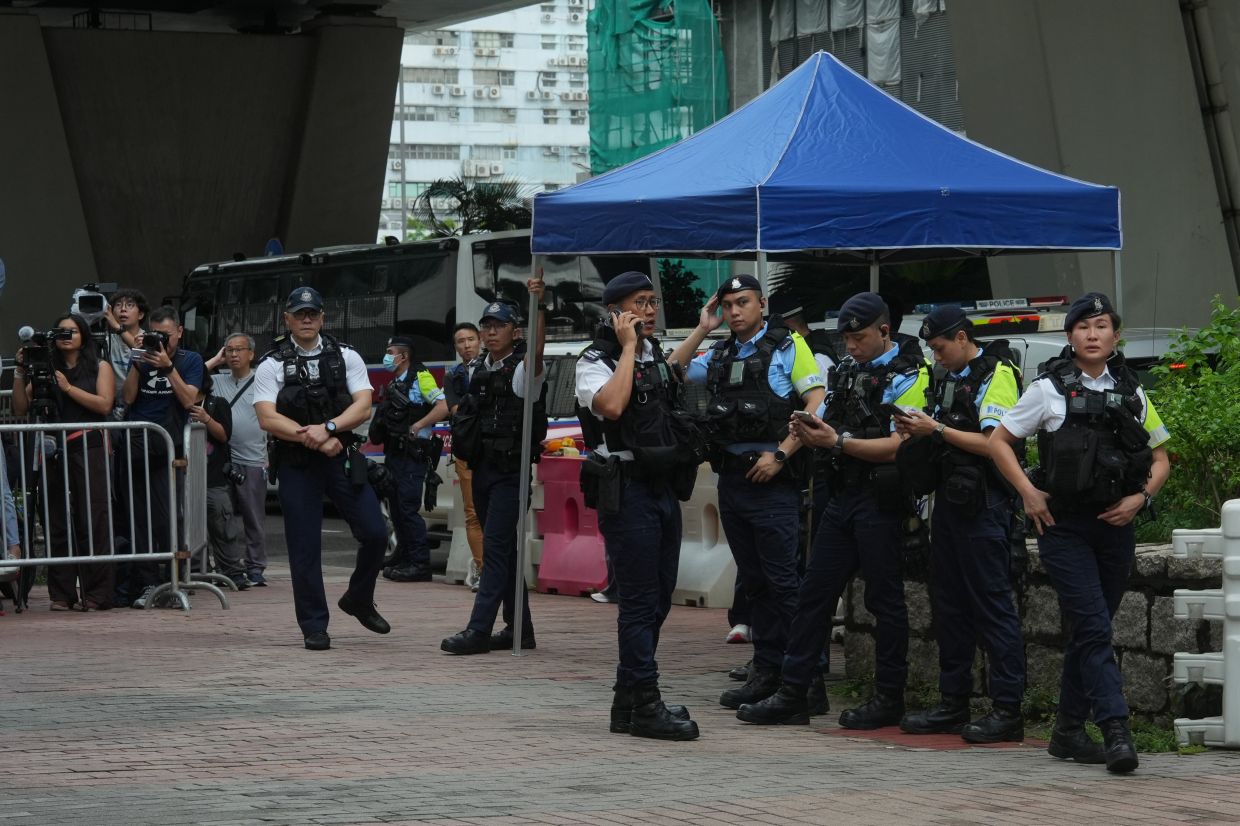
A woman has been detained by Hong Kong police for allegedly wearing a T-shirt bearing a seditious message while standing outside West Kowloon Court, in an incident that unfolded just hours before the territory's courts delivered guilty verdicts against two prominent pro-democracy activists. The arrest, announced by authorities on Monday night, characterised the detention as part of a security operation aimed at maintaining public order, though police declined to disclose specifics of the enforcement action. The woman faced multiple charges including disorderly conduct in a public place, obstruction of police, and acting with seditious intention—offences that have become increasingly common under Hong Kong's National Security Law.
The timing of the arrest proved particularly significant, occurring in the early hours of Friday morning when more than fifty people had gathered outside the courthouse to witness or observe proceedings in a closely watched case. According to media accounts, a plainclothes officer identified the woman as wearing a black T-shirt featuring Japanese characters and removed her from the queue, escorting her into a police vehicle while journalists documented the encounter. The removal occurred against a backdrop of heightened security and police direction to media personnel to vacate the area, illustrating the tense atmosphere surrounding proceedings that would ultimately result in convictions against the Hong Kong Alliance in Support of Patriotic Democratic Movements of China and two of its former leaders.
The woman's arrest preceded by hours the court's pronouncement that Lee Cheuk-yan, the alliance's former chairman, and Chow Hang-tung, its former vice-chairwoman, had committed the offence of inciting subversion. Both individuals have spent nearly five years in custody pending trial, facing allegations that their advocacy for an end to "one-party dictatorship" in mainland China constituted illegal attempts to undermine Communist Party governance. The case represents one of the most significant prosecutions since the National Security Law's implementation, with the High Court's 216-page judgment establishing novel legal interpretations concerning what behaviours qualify as subversive under Hong Kong law.
The three-judge panel's ruling introduced a sweeping definition of subversion, holding that any effort to challenge or erode the Communist Party of China's authority over the country could constitute the offence, given that China's constitution does not accommodate Western-style democratic systems. This interpretation substantially broadens the scope of conduct potentially criminalised under the security legislation, extending beyond traditional understandings of subversion focused on violent overthrow or armed rebellion. By effectively treating democratic advocacy and constitutional reform calls as inherently subversive to the Chinese state system, the court has provided legal framework for prosecuting political speech and assembly that questions single-party governance.
Lee, a former member of Hong Kong's Legislative Council, had become a symbolic figure for democracy activists during his decades advocating for political change. Chow, a qualified barrister with a background in civil liberties work, similarly represented a layer of Hong Kong's professional class willing to challenge government policies through legal and political channels. Their prosecution and conviction signal a significant hardening of enforcement against middle-class, legally-trained opposition figures who might previously have operated within broader interpretations of protected expression. The case thus marks a watershed moment in transforming Hong Kong's political and legal landscape, where even measured calls for democratic governance now face prosecution as state crimes.
A fourth defendant, former vice-chairman Albert Ho Chun-yan, remains in detention and awaits sentencing after pleading guilty to inciting subversion in January. His decision to enter a guilty plea, despite reportedly having legal expertise available to contest charges, may indicate either assessment that defence appeared futile under the court's broad interpretation or broader strategic considerations. Ho's case, pending sentencing determination, will likely provide further indication of penalty severity the courts consider appropriate for national security convictions.
For Malaysian observers and regional analysts monitoring Hong Kong's political trajectory, this cascade of arrests and convictions illuminates the accelerating integration of Hong Kong's governance framework with mainland Chinese priorities. The arrest of a woman wearing a T-shirt, captured on camera during what appeared to be routine courthouse attendance, exemplifies how security operations have expanded beyond traditional crime prevention into surveillance and control of political expression in public spaces. The incident's documentation and police efforts to exclude journalists underscore coordination between law enforcement and information management strategies.
The Hong Kong Alliance itself, which had organised the annual Tiananmen Square memorial vigil for over three decades, has since been dismantled, removing one of Asia's most significant annual commemorations of the 1989 pro-democracy movement. The organisation's dissolution and the criminal prosecution of its leadership represent the effective elimination of institutional space for commemoration of sensitive historical events or advocacy for political change within Hong Kong. This structural transformation carries implications beyond Hong Kong's borders, particularly for expatriate Chinese communities and international civil society networks that had previously regarded Hong Kong as a relatively open venue for political activism.
The prosecution unfolds against a backdrop of sustained implementation of the National Security Law since 2020, which has proceeded through waves of enforcement targeting political parties, media organisations, teachers' associations, and individual activists. The courts' willingness to convict based on expansive definitions of subversion, as demonstrated in the Lee and Chow case, suggests that prosecutorial discretion and judicial interpretation will continue broadening the practical scope of offences. Meanwhile, security operations targeting individuals based on T-shirt messages or other forms of symbolic political expression indicate enforcement extends well beyond formal political organisations into everyday public conduct.
For Southeast Asian governments and civil society observers, Hong Kong's trajectory raises questions about convergence between security priorities and political control mechanisms. Malaysia's own experience with sedition and national security legislation provides contextual framework for understanding how such tools, once enacted for security purposes, become instruments for suppressing political opposition and managing public discourse. The arrests accompanying the Lee-Chow conviction proceedings demonstrate how high-profile cases become occasions for expanded security operations and enforcement intensity affecting casual bystanders.
The broader implication centres on the transformation of Hong Kong's legal and political space from a jurisdiction where protest, advocacy, and civil disobedience, though occasionally prosecuted, remained common features of public life into an environment where even passive symbols of political dissent trigger detention. This evolution reflects not merely law enforcement adaptation but rather fundamental recalibration of the boundary between permissible political expression and prosecutable criminal conduct. As Hong Kong's courts continue interpreting national security legislation, the precedents established in cases like Lee Cheuk-yan and Chow Hang-tung's conviction will shape enforcement patterns and discourage political participation across the territory, with potential demonstration effects throughout the region.

