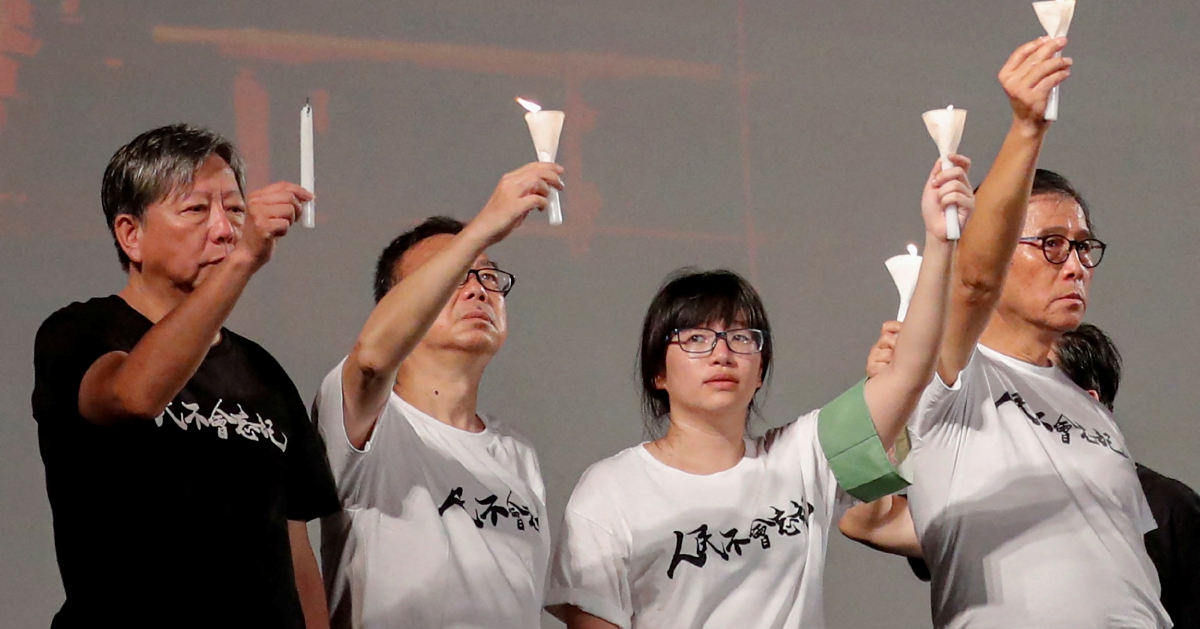
A Hong Kong court delivered guilty verdicts on Friday against two prominent activists for orchestrating annual memorial gatherings dedicated to commemorating the 1989 Tiananmen incident, bringing a conclusion to a case that underscores the city's increasingly restrictive environment for civil liberties and historical remembrance. The charges of "incitement to subversion" represent the first prosecutions specifically targeting those who organised the long-running Victoria Park vigils, once considered Hong Kong's most visible expression of dissent and transnational solidarity with democracy causes across the region.
The Tiananmen incident of 1989 remains a deeply sensitive topic in mainland China, where state media has heavily restricted discussion and the government maintains strict control over public commemoration. For decades, Hong Kong's distinct legal and political status allowed residents to hold an annual June 4th vigil in Victoria Park, drawing tens of thousands in recent years. These gatherings represented one of Asia's most enduring symbols of free expression and civil disobedience, with participants carrying candles, banners, and wreaths to honor the estimated hundreds killed during the military crackdown on student-led pro-democracy protests in Beijing.
The conviction of these two organisers carries profound implications not only for Hong Kong but for how Beijing's expanding influence shapes political freedoms across Asia. When Hong Kong was returned to Chinese rule in 1997, the "One Country, Two Systems" framework was intended to preserve Hong Kong's autonomy and distinct legal protections for at least fifty years. However, the implementation of the National Security Law in 2020 and subsequent political developments have fundamentally altered this arrangement, with authorities interpreting security-related offences increasingly broadly to encompass activities once considered protected speech.
The charges against the vigil organisers centre on their statements and calls to action, which prosecutors allegedly characterised as attempting to undermine state authority and incite others to do the same. This interpretation of "subversion" extends well beyond traditional notions of violent uprising or direct plotting, instead treating educational activities, public commemoration, and advocacy for historical remembrance as threatening to national security. The precedent set by this judgment may embolden further prosecutions of individuals involved in other forms of political expression or activism that authorities deem insufficiently aligned with state narratives.
For Malaysian observers, the Hong Kong situation offers an instructive case study in how political freedoms can contract rapidly when institutional safeguards are undermined. Malaysia's own experience with restricted political expression, changes to sedition laws, and debates over what constitutes acceptable speech make the Hong Kong developments particularly relevant. The city's transformation demonstrates how ostensibly technical legal amendments can be weaponised to suppress activities that previously operated within established norms of civil society participation.
The Victoria Park vigils had become increasingly contentious with authorities in recent years, with police presence intensifying and organisers facing mounting pressure. Participation figures had already begun declining as the political atmosphere grew more restrictive, but the vigils persisted as a symbol of resistance to Beijing's attempts to erase historical memory and control public discourse. The conviction of the vigil organisers effectively removes institutional continuity from these commemorative efforts and signals that even organising non-violent public assembly around politically sensitive topics carries substantial legal risk.
The broader context of intellectual and cultural control extends beyond Hong Kong to regional implications. Taiwan watches these developments closely as they reflect broader patterns of how Beijing tolerates dissent and political expression in territories within its sphere of influence. Southeast Asian governments and civil society leaders also observe Hong Kong's trajectory as a cautionary example of how security frameworks can metastasize into tools for suppressing legitimate discourse. The conviction sends a message that historical narratives, particularly those contradicting official accounts, face mounting legal jeopardy.
International press freedom advocates and human rights organisations have expressed alarm at the conviction, viewing it as another indicator of Hong Kong's deteriorating civic space. The United Nations Office of the High Commissioner for Human Rights has previously warned that Hong Kong's national security legislation contains provisions that are vague and overly broad, making them susceptible to misuse. The conviction of vigil organisers validates these concerns, demonstrating that authorities are willing to deploy the law against activities that most democracies would protect as fundamental rights to assembly, speech, and historical remembrance.
The practical consequence of this judgment is the near-certain cessation of the Victoria Park vigils in their traditional form. While individuals may still attempt private commemoration, the removal of legal protection for public gathering and the demonstration that organisers face criminal liability fundamentally alters the landscape for civil society action. This represents not merely a legal outcome but a watershed moment in Hong Kong's transformation from a city characterised by substantial freedoms to one where political expression is carefully circumscribed and monitored.
Moving forward, the conviction may inspire regional governments to examine their own legislation around public assembly, historical narratives, and political expression. In Malaysia's context, ongoing debates about the Sedition Act and other restrictive statutes take on new urgency when observing how Hong Kong has employed security legislation. The case demonstrates that the consequences of loose legal frameworks extend far beyond their initial stated purpose and can be deployed against populations in ways that were theoretically prohibited or politically unthinkable at the moment of enactment.
The Hong Kong court's decision ultimately reflects a fundamental recalibration of the boundaries between state prerogative and citizen expression, tilting decisively toward state authority. For activists across Asia concerned with preserving democratic space, the conviction serves as both a stark warning and a catalyst for reevaluating strategies for advocacy and historical remembrance in an environment where legal protections have significantly eroded. The Victoria Park vigil era appears to have concluded, marking the end of one chapter in Hong Kong's ever-shrinking civil liberties landscape.

