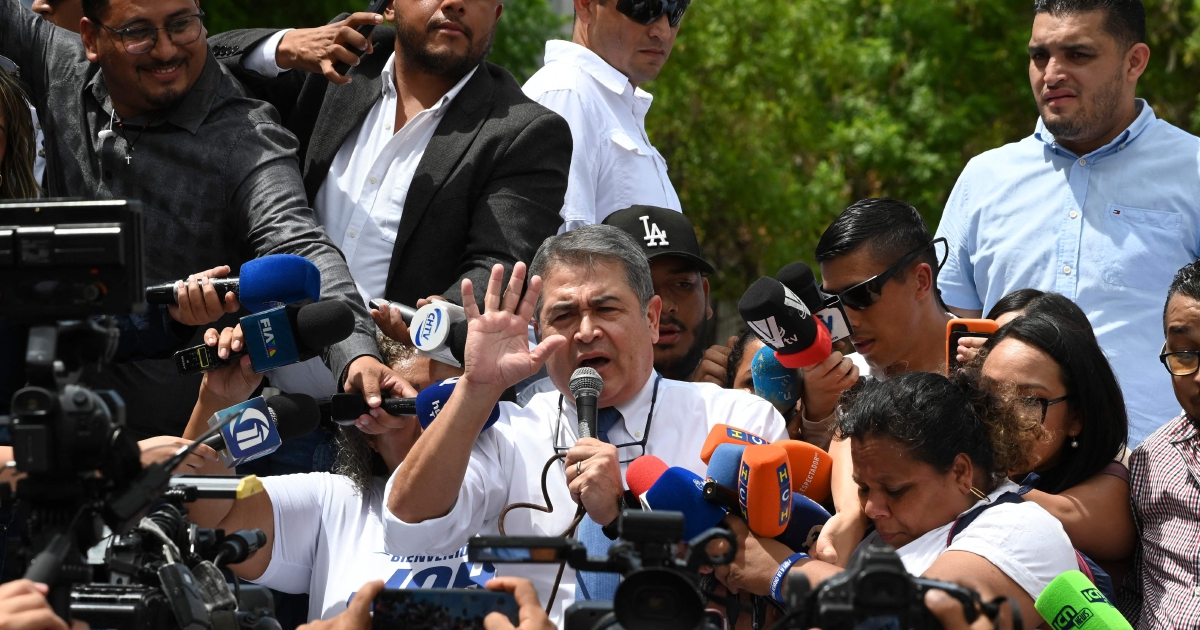
A Honduran court has permitted former president Juan Orlando Hernandez to remain at liberty as he confronts mounting corruption allegations domestically, according to a judicial determination issued on Monday. The decision represents a significant development in the legal trajectory of the Central American leader, whose fortunes shifted dramatically following his unexpected pardon from Washington, where he had faced serious narcotics-related accusations.
Hernandez's ability to avoid pretrial detention comes despite facing substantial charges relating to alleged financial crimes and abuse of power during his tenure in office. The judicial ruling grants him the freedom to move about Honduras while his legal proceedings advance, a resolution that contrasts sharply with the restrictive conditions he might have anticipated when his corruption investigation intensified in recent years. This outcome underscores the complex interplay between international and domestic accountability mechanisms, particularly as they apply to figures of significant political stature in Latin America.
The former leader's original predicament stemmed from an extradition to the United States, where prosecutors constructed a case accusing him of facilitating large-scale drug trafficking operations and money laundering across multiple jurisdictions. His conviction in a Manhattan federal court in March 2023 carried a sentence of 45 years imprisonment, effectively ending any prospect of resumed political involvement in Honduras. However, Trump's executive clemency last year fundamentally altered this trajectory, reinstating a freedom that many observers believed had been permanently forfeited.
For Malaysia and Southeast Asia, the Hernandez case illuminates persistent governance challenges that transcend geographical boundaries. Central America and Southeast Asia share structural vulnerabilities—porous borders, weak institutional oversight, and transnational criminal networks that exploit state capacity deficits. The manner in which Honduras addresses corruption within its own system carries implications for regional responses to similar problems across Southeast Asia, where politicians accused of financial crimes routinely navigate complex legal landscapes shaped by both domestic and international pressures.
The Trump pardon itself represents an extraordinarily consequential intervention in another nation's judicial affairs, raising questions about sovereignty, the limits of executive clemency, and the precedents established when powerful international actors effectively nullify convictions obtained through processes of another country. This development occurred amid broader concerns about institutional integrity in Honduras, where public confidence in governmental transparency remains significantly compromised. The nation has experienced sustained international scrutiny regarding corruption across multiple administrations, and reversals of accountability measures contribute to perceptions of systemic dysfunction.
Hernandez's corruption trial focuses on allegations that he misappropriated state resources and engaged in illicit financial transactions that benefited his personal and political interests. These charges represent the institutional attempt to address what many Hondurans regard as systemic plundering of national resources. The court's decision to permit his freedom during proceedings suggests either confidence in his appearance at trial obligations or judicial recognition that pretrial incarceration standards in Honduras operate under different constraints than those applied in the United States.
For Malaysian observers monitoring international legal developments, the situation reflects broader questions about how states pursue accountability when accused officials possess substantial resources and international connections. Malaysia's own experiences with corruption prosecutions involving high-profile figures demonstrate the complexities of maintaining institutional credibility whilst ensuring fair legal process. The contrast between Hernandez's experiences in American courts—where conviction resulted in decades-long incarceration—and Honduras's apparent inclination toward permitting his freedom whilst charges advance illustrates divergent approaches to criminal justice that complicate international efforts to combat corruption systematically.
The ruling also underscores how executive clemency from foreign powers can fundamentally reshape domestic legal landscapes. Hernandez's pardon eliminated accountability for transnational drug trafficking whilst leaving him exposed to domestic corruption charges—a bifurcation that raises questions about the comprehensiveness of either justice system's approach. His freedom in Honduras despite the Trump pardon's origin emphasizes that local judicial mechanisms continue functioning independently, though their effectiveness remains constrained by institutional limitations and political pressures endemic to Central American governance structures.
Moving forward, the corruption trial will occupy significant political and social space in Honduras as citizens assess whether their judicial system can enforce accountability against powerful former leaders. The permitting of Hernandez's freedom during proceedings suggests the court believes presentation of evidence can proceed without requiring pretrial detention, though skeptics might interpret the ruling as symptomatic of broader systemic vulnerabilities. For Southeast Asian jurisdictions grappling with similar corruption challenges, Honduras's experience offers cautionary lessons about the importance of maintaining institutional independence and resisting pressure that undermines accountability mechanisms, whether that pressure originates domestically or internationally through controversial executive interventions.

